
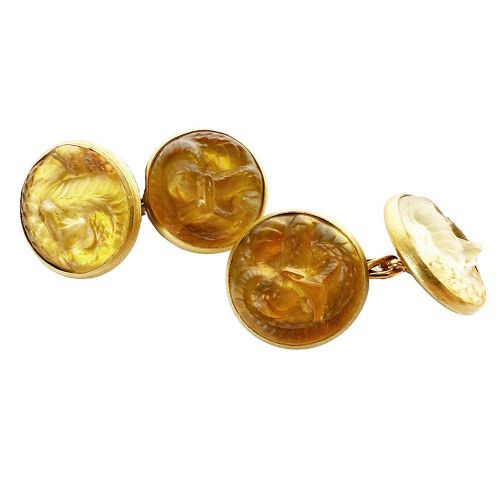


Vintage Sleeve Links
These vintage sleeve links bring working metal and coloured enamel to a cuff, offering a sharp finish drawn from a century of changing design.
Vintage Sleeve Links
When you search for vintage sleeve links, you are looking at men's cuff fastenings spanning the Victorian era through to the mid-twentieth century. The selection leans heavily towards the 1930s, offering geometric enamel work alongside earlier gold and gemstone pairs.
You will encounter pieces in diverse forms, from Art Nouveau plant motifs to sporting themes and simple double-sided designs. The materials range from base silver plate up to high-carat gold set with diamonds, sapphires and mother of pearl.
Most examples function through hinged bars, rigid posts, or double-sided faces connected by short chains. They serve as miniature canvases of their respective decades, reflecting the shift from ornate Victorian engraving to clean modernist lines.
Materials and construction
Makers shaped these links using precious metals including nine-carat, fifteen-carat, and eighteen-carat gold, alongside platinum and silver. Enamel work, particularly vitreous enamel in green, black, and blue, provides the vibrant colour found across many Art Deco examples.
Goldsmiths integrated natural stones such as banded agate, sapphires, and multi-gem settings into the metal frames. Techniques combined hand engraving, as seen in the belt motif Victorian pairs, with cast forms like French mistletoe leaves and glass serpents.
Vintage Sleeve Links Retail Price Guide 2026
Typical asking prices for vintage sleeve links among the pieces listed under this phrase on Sellingantiques today, from the lower quarter to the upper quarter. They describe what is for sale here now, not the wider market.
Materials represented include silver, platinum, yellow, white, and rose gold alongside vitreous enamel and banded agate.
Assessing quality
Quality rests in the weight of the metal and the precision of the mechanics, distinguishing solid gold or platinum mountings from lighter silver-plated alternatives. The crispness of the casting and the depth of hand-engraved detailing reveal the hand of a skilled workshop.
Enamel condition dictates distinction at the higher end, where intact, unblemished glass-like surfaces show superior kiln-firing. Maker attribution also elevates certain pieces, particularly those bearing recognised marks from firms such as R Lalique or Payton Pepper and Co.
R Lalique·Payton Pepper and Co·Taye Kenning and Spencer Ltd
The Vintage Sleeve Links Glossary
- Double-sided
- A pair featuring decorative faces on both ends of the connecting link rather than a simple T-bar backing.
- Vitreous enamel
- Glass powder fused to metal under high heat, creating a hard, glossy coloured surface.
- Cabochon
- A gemstone shaped and polished with a smooth, rounded dome instead of faceted edges.
- Regimental
- Bearing the crest, colours, or insignia of a military unit, often commissioned in gold.
- Modernist
- A design style prioritising clean geometric lines and minimal ornamentation, prevalent in the nineteen-thirties.
Vintage Sleeve Links: Frequently Asked Questions
How do double-sided links work?
Double-sided links feature a decorative face at both ends of a short chain or rigid connector. You tilt one face sideways to push it through the shirt buttonholes before settling it flat against the cuff.
This style ensures that the fastening looks orderly from every angle on the wrist. It represents a traditional construction method common in heavier gold and platinum pairs.
What distinguishes Art Deco sleeve links?
Art Deco pieces rely on strict geometric shapes, symmetry, and contrasting blocks of coloured enamel. They reflect the architectural and industrial design influences of the nineteen-thirties.
These links often utilise modernist patterns that break away from earlier organic floral styles. The metals are frequently white gold, yellow gold, or platinum paired with vivid green or black enamel.
Are these suitable for daily wear?
Solid gold and platinum pairs handle regular use well due to the durability of the precious metals. Enamel links require slightly more care to avoid chipping against hard desk surfaces.
Checking the strength of hinges and connecting chains ensures the fastenings remain secure throughout the day. Antique mechanisms generally prove robust if handled with reasonable care.
How are periods identified?
Periods are told apart through a combination of materials, motifs, and manufacturing techniques. Victorian pieces often display heavy gold engraving or mourning elements, while Edwardian examples favour platinum and delicate gemstones.
Later mid-century designs introduce sporting themes and cleaner abstract forms. Hallmarks stamped onto the metal provide definitive dates for British-made items.