
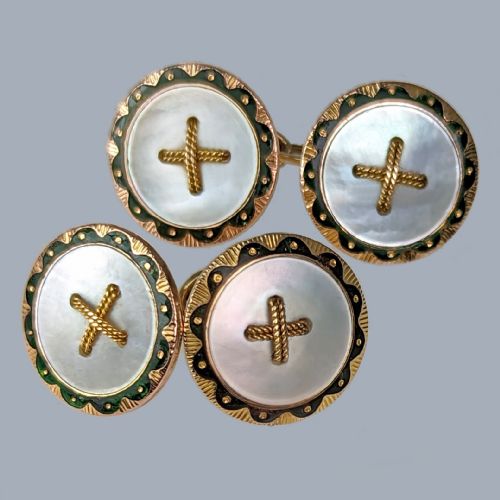


Vintage Enamel Cufflinks
These vintage enamel cufflinks bring clean Art Deco geometry and rich colour to a double cuff, offering a sharp touch of period style.
What vintage enamel cufflinks are
Vintage enamel cufflinks are men's shirt fastenings decorated with fused glass powder, appearing predominantly in the Art Deco style from around nineteen thirty. These matching pairs combine geometric modernist designs with durable vitreous coatings to secure shirt cuffs with distinctive colour.
The pieces seen here span from the nineteen thirties into the forties, encompassing both abstract modernist motifs and playful novelty subjects like the Austin Mini. Buyers encounter matching pairs intended for daily wear, produced in silver, brass, and yellow gold.
How they were made
Craftsmen applied powdered glass paste into recessed metal channels or onto textured bases before firing the pieces at high temperatures to vitrify the surface. This technique bonded the colourful enamel permanently to substrates of silver, silver plate, brass, or eighteen carat yellow gold.
Metalwork involved stamping or casting the base frames into geometric Art Deco shapes, often featuring clean modernist lines that framing the glossy enamel insets.
Retail Price Guide 2026
Typical UK retail prices for vintage enamel cufflinks, calculated from the Sellingantiques database of over a million retail prices indexed since 2003. This retail price guide relies exclusively on Sellingantiques data; no external sources or auction records are used, so the figures do not describe the wider market.
The documented periods span from nineteen thirty through to the mid-nineteen forties.
What varies in quality
The choice of base metal fundamentally divides the range, moving from plated brass and standard silver up to substantial eighteen carat yellow gold housings. Heavier precious metal mounts provide greater structural integrity and weight to the finished fastening.
The precision of the enamel work dictates the finer tier of these accessories, where smooth, flush surfaces without pitting distinguish superior studio output from simpler production. Maker attribution, such as work originating from Cartier, elevates specific examples through documented provenance and refined finishing.
Cartier
The Vintage Enamel Cufflinks Glossary
- Art Deco
- A design style dominant in the nineteen thirties characterised by sleek geometric shapes, streamlined forms, and modern industrial motifs.
- Vitreous enamel
- A material made by fusing powdered glass to a metallic substrate through firing, creating a durable and glossy coloured surface.
- Gents cufflinks
- Traditional men's shirt fastenings designed to pass through buttonholes on double cuffs and secure them with a toggle or rigid bar.
- Modernist
- An aesthetic movement focusing on minimalism, abstract patterns, and rejection of traditional ornamentation, clearly visible in these nineteen thirties pieces.
Frequently Asked Questions
How do I fasten vintage enamel cufflinks?
These pieces generally utilise a rigid bar, swivel toggle, or chain connection designed to slip horizontally through double shirt buttonholes before turning to lock securely.
Ensure the mechanism moves freely without straining the enamel sections set into the front face.
What period do most of these cufflinks date from?
The vast majority originate from the nineteen thirties, capturing the height of Art Deco design through modernist geometric motifs and vibrant colour palettes.
A few examples extend slightly later into the nineteen forties with novelty subjects and precious metal constructions.
Are these cufflinks made of solid gold?
Materials vary across the selection, with some examples utilising eighteen carat yellow gold while others employ silver, silver plate, or brass.
Check the individual listing details to confirm whether a piece has a solid precious metal construction or a plated finish.
How do I care for vintage enamel cufflinks?
Protect the glass coatings by storing each pair separately in a soft pouch to prevent scratching against other metallic accessories.
Clean the surfaces gently with a damp cloth and avoid harsh chemical dips that might damage the vintage metalwork.