


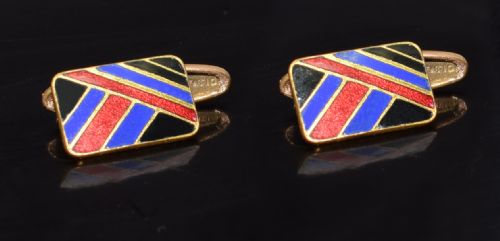


1930s Gents Cufflinks
These 1930s gents cufflinks bring sharp geometric lines and vibrant colour to a shirt cuff, offering a polished piece of period attire.
1930s Gents Cufflinks
When buyers search for 1930s gents cufflinks, they encounter pairs defined by the bold geometric vocabulary of the Art Deco style. These accessories secure French cuffs with an unmistakable period character that reflects the design priorities of the interwar decades.
The version most commonly met on this page is the matching pair featuring colourful enamel panels set into metal bases. These pieces frequently display modernist motifs, skyscraper silhouettes, and clean linear patterns typical of English production from around 1930.
How they were made
Metalwork forms the structural foundation of these items, utilising silver, silver plate, brass, chrome plated metal, and silver-tone metal to shape the fastenings and frames. Artisans formed these metals into crisp modernist geometries that define the silhouette of each pair.
Vitreous enamel and standard enamel provide the rich green, black, and multi-coloured surfaces characteristic of the period. This glassy material was fused into recessed metal channels to create smooth, durable fields of colour.
1930s Gents Cufflinks Retail Price Guide 2026
Typical asking prices for 1930s gents cufflinks among the pieces listed under this phrase on Sellingantiques today, from the lower quarter to the upper quarter. They describe what is for sale here now, not the wider market.
What varies in quality
The calibre of these accessories depends largely on the precision of the metalwork and the crispness of the enamel application. Superior examples demonstrate clean geometric lines, secure matching panels, and robust mechanical connections that maintain their alignment during daily wear.
Material choice also separates the tiers of production, moving from simpler base metals like brass and chrome plated variants up to solid silver constructions. The depth of the vitreous enamel and the complexity of modernist designs further distinguish finer workshop output from standard commercial items.
The 1930s Gents Cufflinks Glossary
- Art Deco
- A design style dominant in the 1930s characterised by sleek geometric shapes, streamlined forms, and modern industrial motifs. It heavily influences the visual appeal of these accessories.
- Vitreous Enamel
- A material created by fusing powdered glass to a metallic substrate through high-temperature firing. This technique produces a hard, glossy, and durable coloured surface.
- Silver Plate
- A base metal foundation coated with a thin layer of silver through electroplating. This method offered the appearance of solid silver at a more accessible cost during the period.
- Modernist
- An aesthetic movement embracing functionalism, abstraction, and clean lines. In these pieces, it manifests as stark geometric arrangements devoid of Victorian ornamentation.
1930s Gents Cufflinks: Frequently Asked Questions
How do I fasten these cufflinks?
These items utilise hinged bars or rigid fixed backs that pass through the buttonholes of a double-turnback cuff. The mechanism rotates or holds steady to secure the two halves across the fabric.
Matching pairs ensure that the decorative faces display uniformly when fastened on both wrists, maintaining a balanced appearance.
Are these cufflinks suitable for daily wear?
Sturdy metal bases and fired enamel surfaces make these pieces durable enough for regular use on formal or dress shirts. Proper care prevents impact damage to the glass surfaces.
Storing them in a dedicated box protects the enamel panels from scratching against other metallic items when not on the wrist.
What defines the Art Deco style here?
Symmetric geometric arrangements, skyscraper motifs, and flat planes of colour identify the aesthetic of this era. Ornamentation moves away from floral curves toward industrial simplicity.
English makers applied these principles directly to small accessories, creating miniature canvases of modernist design for the cuff.
How do I identify silver from plate?
Solid silver pieces typically carry hallmarks or stamps indicating the metal purity, whereas plated items rely on a superficial coating over base metals like brass. Weight and the presence of wear through to the underlying metal reveal the construction method.
Examining the edges under magnification helps clarify whether the surface is a precious metal or an applied layer.