
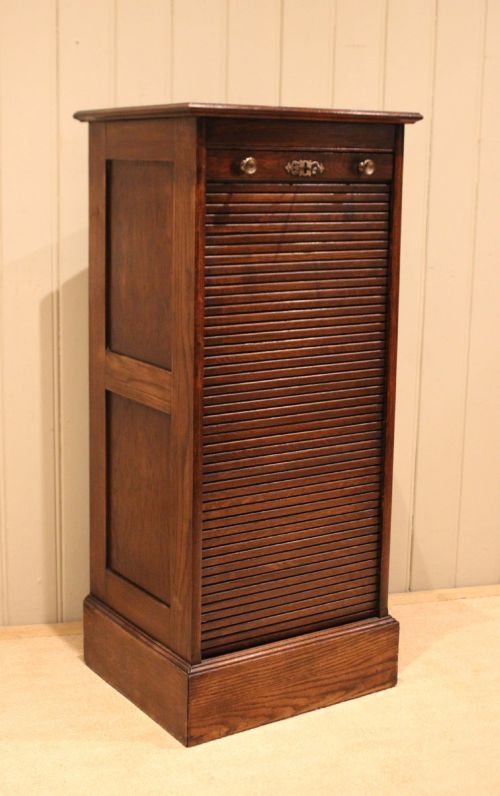
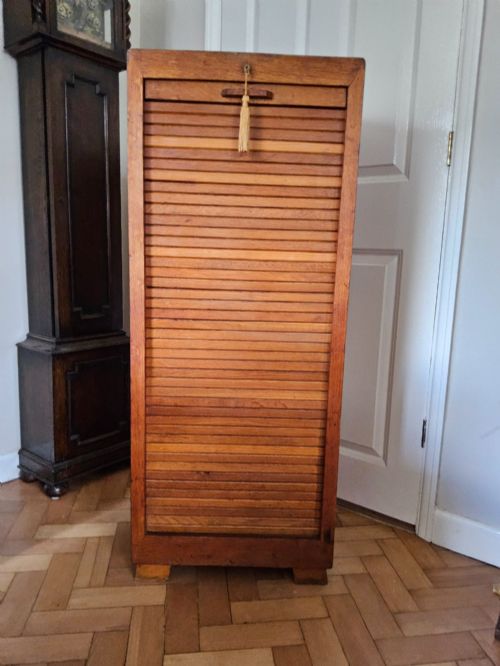
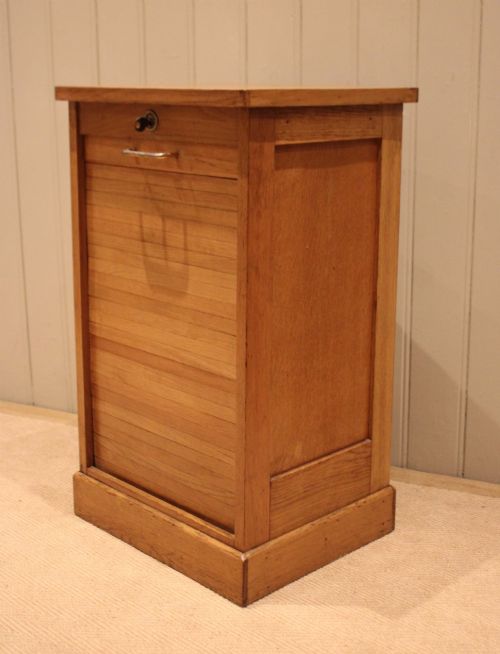
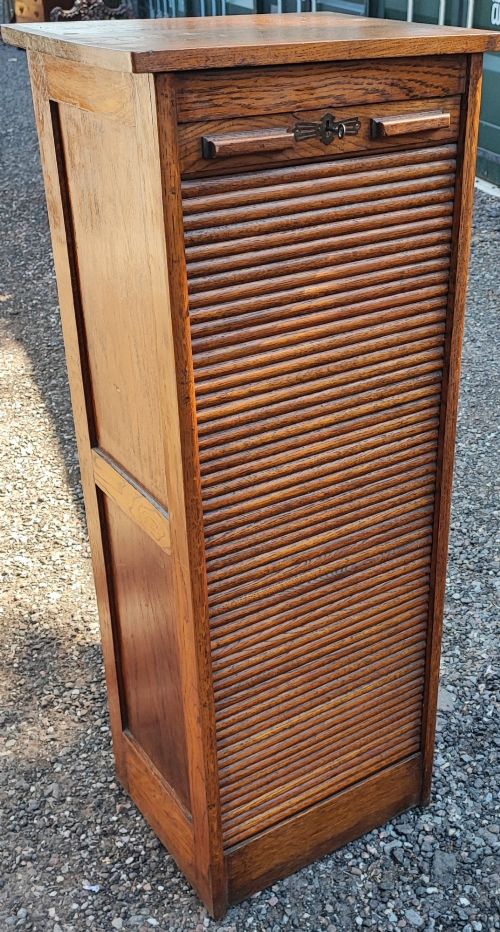
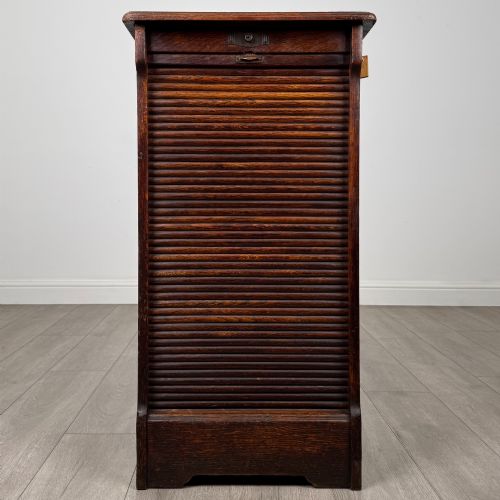
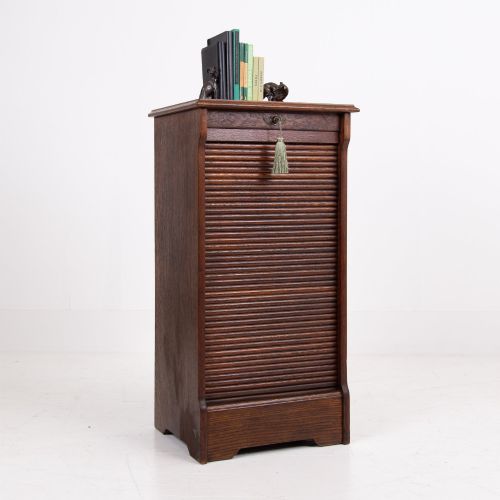
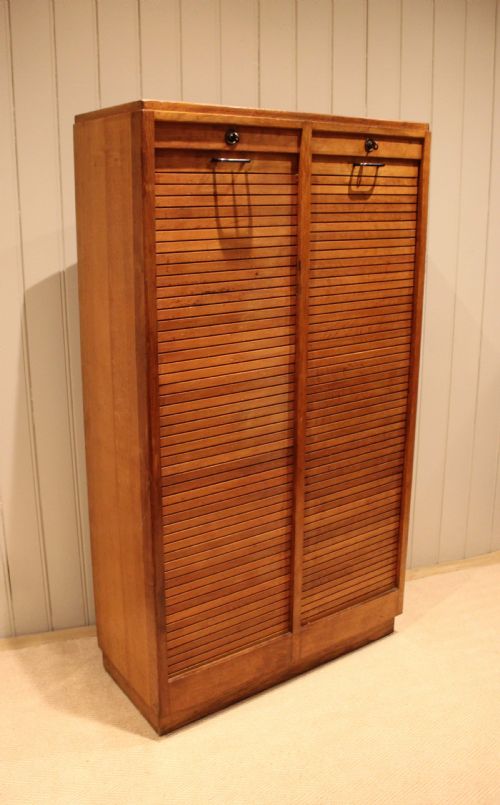
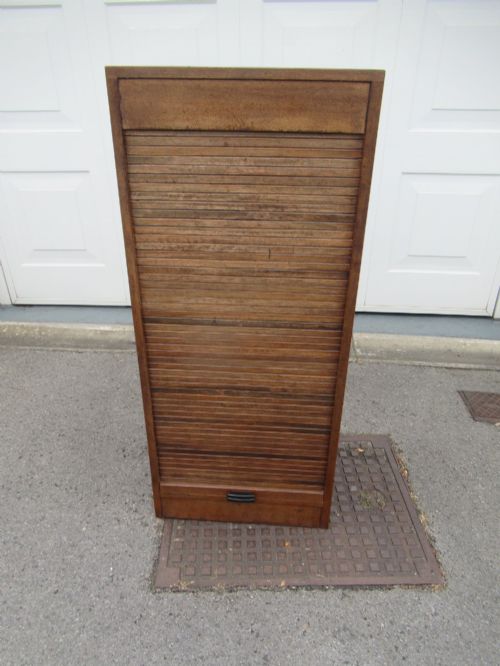


Vintage Shutter Filing Cabinet
These vintage shutter filing cabinets offer clever slatted roll-front storage for the desk or office, combining practical paper organisation with classic period timberwork.
Vintage Shutter Filing Cabinet
A vintage shutter filing cabinet provides enclosed storage for papers using a flexible slatted door that slides smoothly around a track. You will most frequently meet pieces from the Edwardian period and the early twentieth century, constructed with sturdy oak bodies.
The selection ranges from small proportioned single column units to double tambour front office cabinets. Most examples originate from English workshops or French utility traditions, spanning decades from nineteen hundred to nineteen forty.
How they were made
The primary construction relies on solid oak, mahogany, or pine, shaped into robust filing cabinets designed for heavy office use. Individual wooden slats are typically fixed to a canvas backing to form the flexible tambour shutter mechanism.
Metal and brass components appear in the operational hardware, key escutcheons, and internal fittings that support the sliding shutter action. These materials ensure both the structural rigidity of the cabinet body and the smooth operation of the roll front.
Every single cabinet hides its contents behind a clever curtain of wooden slats that rolls away like magic.
What varies in quality
Superior quality shows in the precision of the timber selection, particularly in finely figured oak or rich mahogany cabinets. The smoothness of the tambour action and the integrity of the canvas backing determine how well the sliding shutter functions.
Finer examples display careful proportions and restrained decorative styling, such as Art Deco influences or well-executed Edwardian detailing. Lesser pieces may exhibit stiffer slat movement or simpler secondary timbers like pine without the same degree of cabinet-making finesse.
The Vintage Shutter Filing Cabinet Glossary
- Tambour
- A flexible door or shutter made of narrow wooden slats glued to a canvas backing, allowing it to slide around a curved track. This clever mechanism conceals office files while saving space in compact rooms.
- Edwardian
- The period spanning the reign of King Edward VII, characterised by lighter proportions and refined adaptations of earlier furniture styles. Cabinets from this era often feature excellent oak joinery.
- Art Deco
- A design style emerging in the early twentieth century that emphasises geometric shapes, streamlined forms, and modern industrial aesthetics. Pieces bearing this influence show clean lines on traditional cabinet bodies.
- Utility
- A functional design approach developed during periods of material restriction, focusing on honest construction and straightforward forms without redundant ornamentation. French utility pieces prioritize unadorned practicality.
Vintage Shutter Filing Cabinet: Frequently Asked Questions
What is a tambour front?
A tambour front consists of narrow wooden slats attached to a flexible canvas backing that slides along a recessed track. This mechanism rolls neatly around the side or back of the cabinet to open the storage space.
It allows the door to vanish completely into the body of the cabinet without swinging outward into the room. This makes it particularly useful for tight office spaces and desks.
How do I date these cabinets?
Dating relies on stylistic clues, timber choices, and construction methods associated with specific decades from nineteen hundred to nineteen forty. Edwardian and early twentieth-century examples often feature traditional oak joinery and brass hardware.
Later pieces from the nineteen thirties and forties introduce Art Deco influences or French utility designs. Examining the interior fittings and secondary woods helps place the cabinet within its specific period.
Where were these cabinets used?
These cabinets were originally designed for commercial offices, legal practices, and studies to keep administrative papers organised and secure. Their compact footprint made them ideal for working environments where floor space was at a premium.
Today, they transition easily into domestic settings as home office storage or hallway accent furniture. They provide practical filing capacity while retaining a distinct period aesthetic.
Are these cabinets made of solid wood?
The listings show construction primarily in solid timbers such as oak, mahogany, and pine, chosen for their durability in daily office environments. The shutter slats and cabinet carcasses utilise these traditional hardwoods and softwoods.
Canvas backing is also employed internally to hold the wooden shutter slats together. Metal and brass hardware complete the structural assembly.