





Vintage Scenery Wall Art
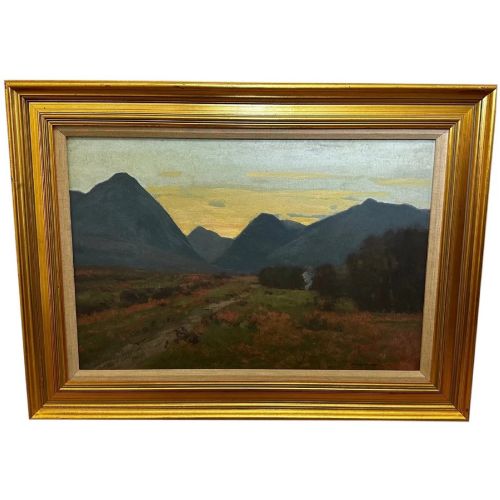
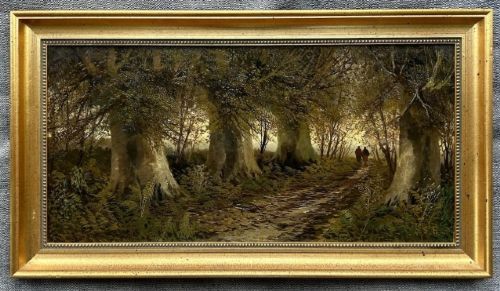
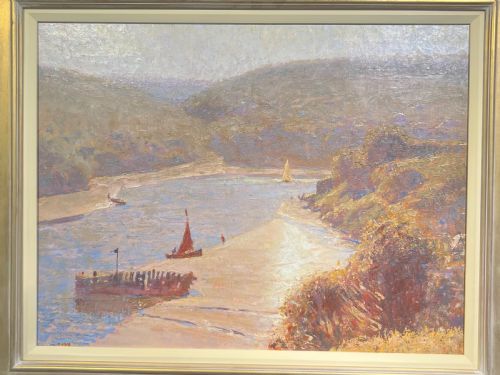
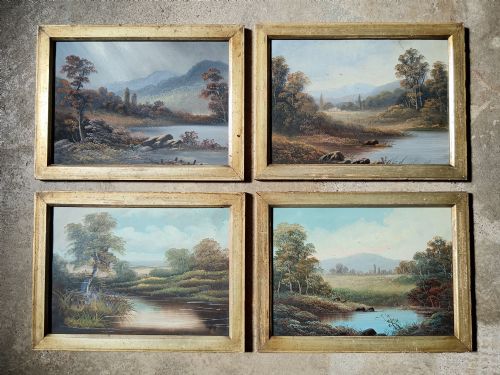
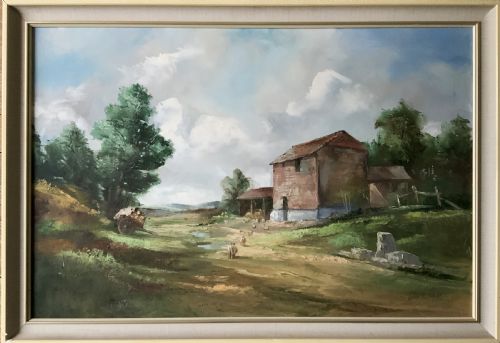
Vintage scenery wall art brings together original paintings and watercolours depicting pastoral views, rivers and coastal harbours.
Vintage Scenery Wall Art
Vintage scenery wall art comprises original paintings and watercolours capturing landscapes, coastal views and rural scenes. When exploring vintage scenery wall art, buyers encounter works created across the nineteenth and twentieth centuries, spanning Victorian, Edwardian and mid-century periods.
Most pieces arrive within period frames, including gilt wood and ebonised moulding. These works offer a direct window into historical topography and traditional artistic interpretations of the countryside.
Materials and construction
Artists painted these works primarily with oil paint on canvas or applied watercolour to paper. Heavy opaque gouache also appears across specific landscape compositions from the early twentieth century.
Supports commonly consist of stretched canvas secured to wooden stretcher frames or heavy paper housed beneath glass. Frames are predominantly constructed from timber, finished with gilt or ebonised treatments.
Elements of quality
Quality rests upon the artist's handling of light, atmosphere and perspective within the landscape. Finer pieces demonstrate confident brushwork, tonal depth and a convincing sense of place, whether depicting a Highland loch or a Cornish farmyard.
The integrity of the physical materials also dictates standard, with well-preserved canvas tension, stable pigment adhesion and original period framing elevating the overall execution of the artwork.
George Houston·Thomas W Lascelles·William Mellor·Stanley Orchart·Noel Harry Leaver·Samuel Towers·Jack R Mould·Arthur Walker Redgate·Robert John Hammond·Percy Lancaster·Daniel Sherrin
The Vintage Scenery Wall Art Glossary
- Oil paint
- A slow-drying medium consisting of pigments suspended in a drying oil, typically linseed. It allows for rich colour blending and textured impasto application.
- Watercolour
- A paint consisting of colour pigments suspended in a water-soluble vehicle, usually applied to paper. It produces translucent washes and delicate tonal gradations.
- Gilt wood
- Timber framing coated with a thin layer of gold leaf or gold-coloured metallic finish. It enhances the visual presence of the artwork.
- Ebonised frame
- Wood treated with a chemical stain or finish to imitate ebony. This dark, uniform border provides a strong contrast to lighter landscape paintings.
Vintage Scenery Wall Art: Frequently Asked Questions
How do I care for vintage oil paintings?
Keep paintings away from direct sunlight and steady humidity fluctuations to protect the canvas and paint layers.
Dust the surface gently with a soft, dry brush and avoid using liquid cleaners on the paint or frame.
Are these paintings supplied with frames?
Many pieces retain their original wooden or gilt frames, which are noted in the individual descriptions.
Some buyers choose to retain these historic surrounds while others opt for alternative framing methods.
How can I identify the period of a painting?
Dating relies on stylistic clues, framing materials, artist signatures and recorded exhibition dates. Victorian and Edwardian works often feature heavier gilt mouldings, while mid-century pieces lean towards simpler timber profiles.
Examining the canvas backing and stretcher construction also helps confirm the age of the physical object.
Where were these landscape scenes usually painted?
Artists travelled across Britain and Europe to capture rural and coastal environments. Common locations include Scottish lochs, Welsh mountains, English rivers and continental coastlines.
Many works record specific topographic sites noted by the artist on the front or reverse of the canvas.