
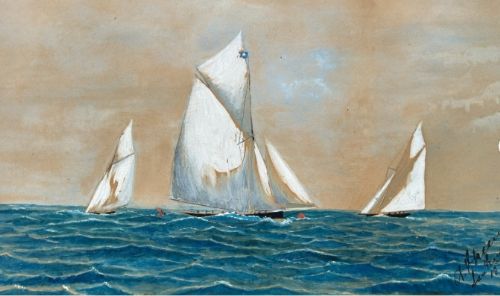


Vintage Sailboat Watercolour Art
Vintage sailboat watercolour art captures maritime life through delicate pigment on paper, offering collectors a direct window into coastal history.
Vintage Sailboat Watercolour Art
Vintage sailboat watercolour art encompasses maritime scenes rendered in watercolour pigment on paper, depicting racing yachts, fishing boats, and coastal harbours. These paintings capture the movement of vessels on the water through the fluid application of medium.
The pieces on this page emerge from periods spanning the nineteenth century through the mid-twentieth century, with styles including British Impressionism and nineteenth-century maritime art. Buyers encounter framed artworks depicting scenes from British coastal towns and American waters.
Framed paintings dominate the selection, often preserved behind glass within wood or gilt wood frames that complement the nautical subject matter. Works range from detailed depictions of trawling luggers to atmospheric harbour views by recognised regional artists.
Materials and techniques
Watercolour pigment applied to paper forms the core medium of these maritime works, sometimes supplemented by ink for definition. Artists utilise the translucency of the pigment to render the shifting light of the sea and sky.
Historic framing materials such as wood and gilt wood enclose the paintings, frequently paired with protective glass. These protective enclosures help preserve the delicate paper supports from environmental moisture and atmospheric damage over decades.
Listings feature works from the 1880s through the 1950s, executed in watercolour and ink on paper within period wood and gilt frames.
Distinctions in quality
Skill in handling the translucent properties of watercolour pigment separates master marine artists from competent amateurs. Superior works capture the weight of water, the tension in rigging, and the atmospheric haze of coastal air with economy and precision.
The strength of provenance and documentation influences the standing of a piece. Signed works and attributions to recorded painters carry distinct weight compared to anonymous works from provincial schools.
Richard Harry Carter·William Tuck·Charles Harmony Harrison·Ernest F. Hill·Stanley Orchart·John McDougal·Harry Wanless·Thomas Bush Hardy·Henry Scott Tuke·Henry Bright
The Vintage Sailboat Watercolour Art Glossary
- Watercolour pigment
- A colourant ground with a water-soluble binder, applied to paper in thin, translucent washes. This medium allows artists to build luminous effects of light on water.
- Gilt wood
- Wood carved and coated with a thin layer of gold leaf or metallic paint. This framing material adds warmth and historical character to marine paintings.
- Trawling lugger
- A traditional fishing boat rigged with lugsails, common in nineteenth and early twentieth-century British coastal waters. These vessels frequently appear in regional maritime art.
- British Impressionism
- An art movement focusing on natural light and everyday subjects, visible in coastal scenes from the late nineteenth and early twentieth centuries. Painters worked outdoors to capture transient atmospheric conditions.
Vintage Sailboat Watercolour Art: Frequently Asked Questions
How do I date an old maritime painting?
Examination of costume, vessel rigging, and framing materials provides clues to a painting's origin. Signatures and dates inscribed by the artist offer the most direct evidence.
Paper quality and backing materials also indicate age, as nineteenth-century paper differs noticeably from mid-twentieth-century stocks.
Are these paintings original works?
The listings consist of original hand-painted watercolours on paper rather than reproductions or prints. Each piece represents a singular creation by the artist.
Brushwork and pigment pooling visible under magnification confirm the hand-painted nature of the artwork.
How should I display watercolour art?
Watercolours require protection from direct sunlight to prevent the pigment from fading over time. Hang them on interior walls away from strong natural light sources.
Maintaining stable room temperature and humidity prevents the paper support and wooden frame from warping.
What subjects appear in these scenes?
Coastal views feature prominently, including racing yachts, moored ships, lighthouses, and bustling harbour entrances. Fishing boats at work near the shore also recur frequently.
Locales range from West Country fishing ports to Scottish lochs and American coastal waters.