


Vintage Round Cabinet
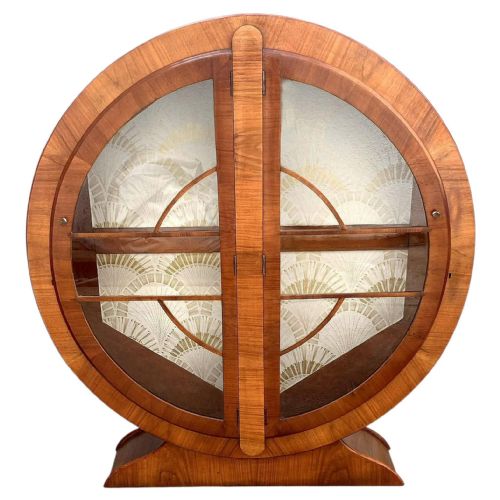
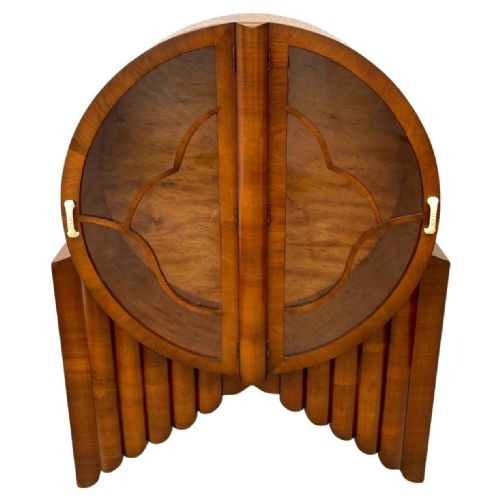
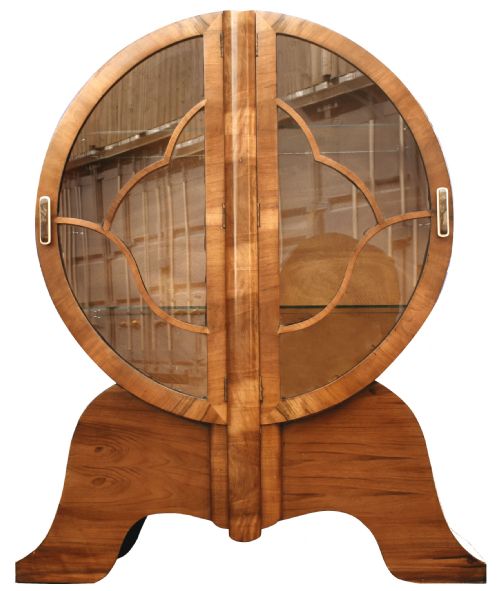
These vintage round cabinet designs bring curves into a rectilinear room, offering compact display space in walnut and mahogany.
Vintage Round Cabinet
A vintage round cabinet spans several decades of domestic storage, drawing heavily on the streamlined geometries of the Art Deco era alongside earlier Victorian forms. Most examples encountered here take the shape of display cabinets, vitrines, and bedside tables constructed with cylindrical or drum profiles.
Makers utilised the curved footprint to maximise floor space in smaller rooms while providing visible storage for glassware, books, and ornaments. Walnut and burr walnut dominate the selection, often finished with glass panels and brass fittings.
Materials and construction
Construction relies upon bending timber veneers around sturdy internal frames to achieve consistent curves, particularly in Art Deco and Victorian pieces. Walnut, burr walnut veneer, and mahogany form the primary carcasses, paired with leaded glass panels and brass hardware.
Marble tops appear on certain Victorian cylindrical bedside versions, providing a durable and cool surface that contrasts with the warm timber below.
The inventory spans from the Victorian era through the 1960s, featuring walnut, mahogany, marble, and leaded glass.
Assessing quality and execution
Quality rests in the matching of timber veneers across curved doors and panels, where grain patterns should flow continuously around the cylindrical body. Superior examples maintain tight joints on curved mouldings and feature clear, unblemished leaded glass.
The integration of functional elements, such as smooth-sliding drawers in bedside drum tables and well-fitted glass shelving in display cabinets, separates standard production from finer workshop output.
The Vintage Round Cabinet Glossary
- Vitrine
- A glass-fronted cabinet designed specifically for displaying fine objects or china. These pieces often feature internal illumination or mirrored backs.
- Burr walnut veneer
- A thin slice of wood taken from a growth on a walnut tree, prized for its swirling, highly figured grain pattern. Cabinet makers apply it to primary surfaces for decorative effect.
- Demilune
- A half-moon or semicircular shape utilised in the design of console tables and side cabinets. This form sits flush against a wall while projecting outward.
- Leaded glass
- Glass panes held together within narrow strips of lead, forming geometric or decorative patterns across cabinet doors. This technique appears frequently on Art Deco display pieces.
Vintage Round Cabinet: Frequently Asked Questions
What is a round display cabinet used for?
These cabinets serve to showcase glassware, ceramics, and small collectables while protecting them from dust within a compact footprint.
The curved glass and timber framing allow items to be viewed from multiple angles in a living room or dining space.
How do I date a round wooden cabinet?
Dating relies upon identifying stylistic markers, such as the symmetrical geometric veneers typical of the 1930s Art Deco period versus the heavier carved details of Victorian pieces.
Materials also provide clues, as walnut and burr walnut veneers became particularly popular during the interwar decades for curved furniture.
Are round bedside tables practical?
Drum-shaped bedside tables offer enclosed storage for nighttime essentials without sharp corners protruding into tight bedroom spaces.
Many incorporate internal shelving or small cupboards behind curved doors to keep surfaces tidy.
How do I clean walnut veneer?
Maintenance requires dusting with a soft, dry cloth and avoiding silicone-based polishes that can build up on the vintage finish.
Keeping the timber away from direct sunlight prevents the walnut grain and veneer from fading over time.