
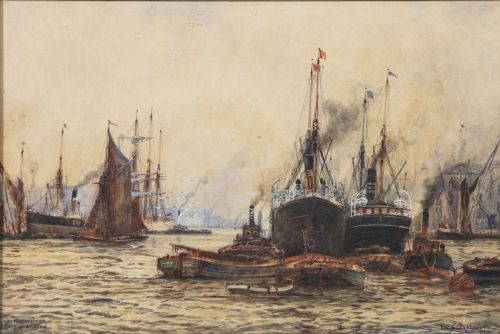
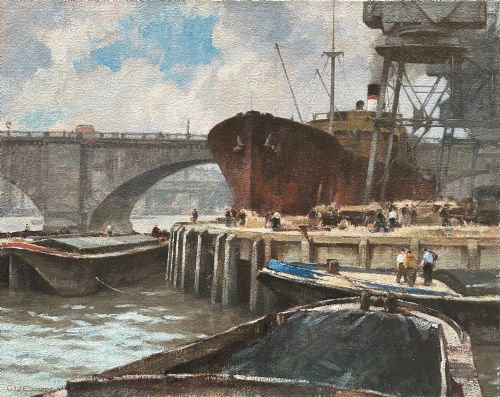


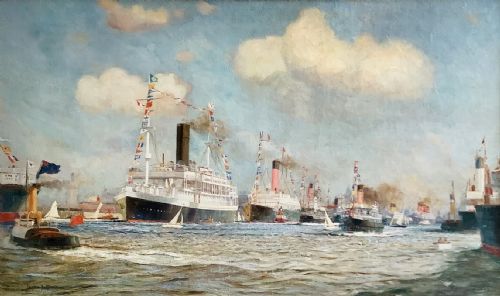
Vintage River Shipping Painting
These vintage river shipping painting examples capture bustling maritime activity from the nineteenth and early twentieth centuries, offering a wonderful focal point for any room.
Vintage River Shipping Painting
When you search for a vintage river shipping painting, you are looking at works depicting maritime scenes along waterways like the Thames, the Medway, the Humber, and international waters such as the Pearl River. These works record commercial vessels, clippers, junks, and steamers at bustling ports.
The pieces you are most likely to meet on this page span the nineteenth century, the Edwardian period, and the early twentieth century up to nineteen thirty. They appear primarily as watercolours on paper and oil on canvas.
Subjects range from London Bridge and the Pool of London to foreign ports like Holland and Hong Kong. They document working rivers and maritime trade with notable topographical detail.
How they were made
Artists worked primarily in watercolour on paper or oil on canvas, often mounted behind glass with gilt frames. These materials dictated the crispness of maritime rigging and the atmospheric quality of water and sky.
Techniques relied on careful brushwork to capture distant bridges, such as Tower Bridge, alongside the intricate details of sailing ships, clippers, and steam vessels. Pigments were applied to canvas or paper to reflect the changing light of moonlight or morning port scenes.
Listings feature works spanning the nineteenth century, the Edwardian period, and nineteen thirty, created in oil and watercolour.
What varies in quality
Quality rests on the precision of the vessel rigging, the handling of water and atmospheric perspective, and the strength of the composition. Stronger examples place the viewer directly into the active port or busy estuary.
The presence of a recognised hand, alongside original framing and good preservation of the paper or canvas under glass, separates the finer works from more standard topographical records.
Frank William Scarbrough·Cyril Walduck Edwards·William Frederick Settle·Thomas Bush Hardy·William Wyld·Hubert Thornley·Edward Fletcher·James Scrimgeour Mann
The Vintage River Shipping Painting Glossary
- Watercolour
- A paint consisting of a pigment suspended in a water-based solution, frequently utilised on paper for maritime scenes.
- Oil on canvas
- Pigment mixed with an oil medium and applied to stretched canvas, seen across several nineteenth and twentieth-century works.
- Gilt
- A gold-coloured application used to finish the wooden frames surrounding these maritime artworks.
- Seascape
- A painting depicting the sea, coastal waters, or river shipping activities.
- Topographical
- Relating to the accurate representation of particular places, such as the Pool of London or the River Medway.
Vintage River Shipping Painting: Frequently Asked Questions
How old are these paintings?
The works listed here date from the nineteenth century, the Edwardian era, and into the nineteen thirties.
They reflect maritime commerce and river traffic from distinct historical periods spanning more than half a century.
Where were these scenes painted?
Locations include British waterways such as the Thames, Humber, and Medway, alongside international ports like Hong Kong and Holland.
Artists recorded real commercial shipping lanes, docks, and bridges of the era.
What mediums were used?
Artists utilised watercolour on paper and oil on canvas to create these river scenes.
Works on paper are typically protected under glass within gilt wooden frames.
How do I hang them?
These framed pieces suit wall art placement in studies, living rooms, or hallways.
Keep them away from direct sunlight to protect watercolours and canvas from fading.