


Vintage Repeating Clock
A vintage repeating clock is a portable timepiece designed to sound the time on demand, bringing mechanical complexity and brass-and-glass polish into a room.
Vintage Repeating Clock
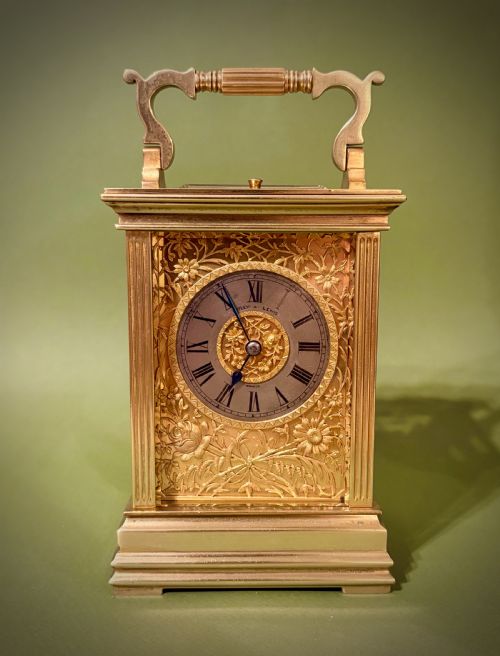
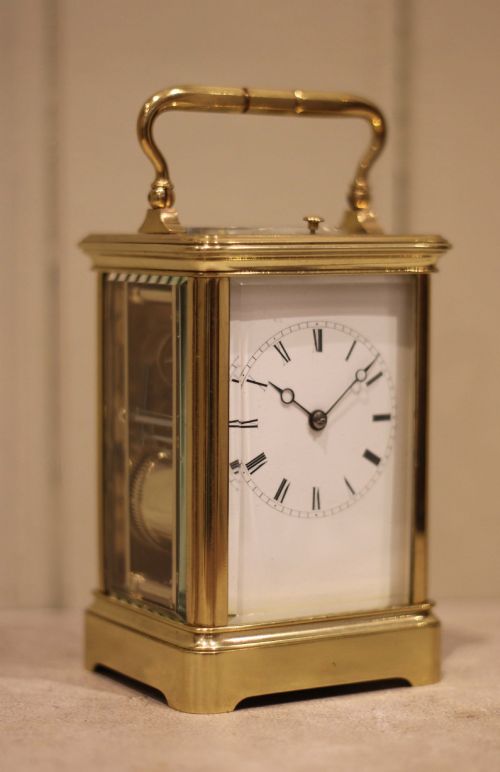
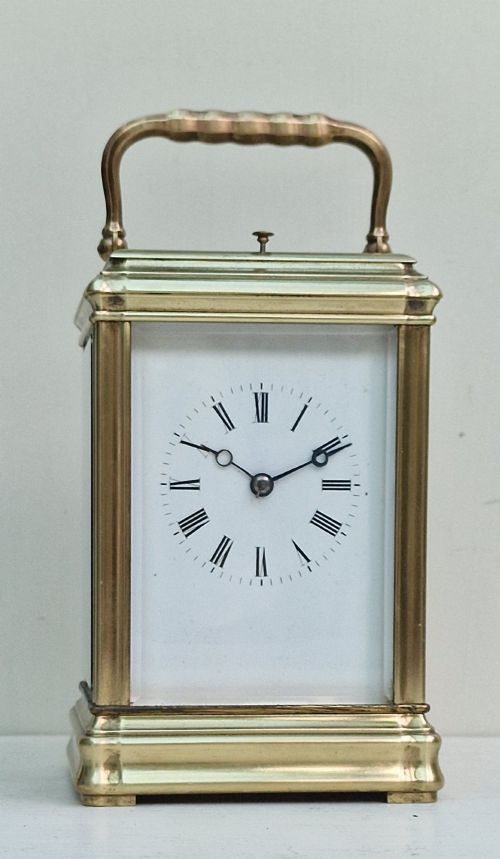
A vintage repeating clock on this page is most frequently encountered as a French carriage clock from the nineteenth century, built with bevelled glass panels held in brass framing. These pieces span periods from the Victorian era into the early twentieth century, taking forms such as gorge cases, doucine cases, and mantel clocks.
Beyond the standard carriage clock format, the selection includes bracket clocks and table clocks dating back to the Regency period. These heavier wooden structures house similar mechanical repeat mechanisms designed to sound hours and quarters when triggered.
Materials and construction
Brass, gilt brass, and silver gilt form the primary structural housing for the majority of these clocks, often polished or fully gilded to create a bright metallic finish. Bevelled glass panels enclose the movement, allowing a clear view of the internal cogs and escapements.
Enamel provides the surface for white dial faces, sometimes decorated with additional enamel paintings or bandings, while steel components operate the intricate striking and repeating gear trains within.
One exceptional carriage clock listing specifically notes direct race horse interest linked to its nineteenth-century maker and provenance.
Markers of quality and execution
Quality in a vintage repeating clock rests in the complexity and execution of its internal movement, shifting from simple hour strike-repeat functions up to grand sonnerie, petite sonnerie, and alarm capabilities. The precision of the gear cutting and the crispness of the bell or gong strike dictate the mechanical tier of the piece.
External casing detail separates standard examples from finer works, visible in heavy gorge cases, engraved mask dials, or original gilding that remains intact across the brass frame.
DROCOURT·Henry Jacot·L Epee·J.W.BENSON·DWERRIHOUSE & BELL·Hunt & Roskell
The Vintage Repeating Clock Glossary
- Repeating mechanism
- A complication that sounds the last elapsed hour or quarter-hour when a button or pendant is pressed, allowing time checks in the dark. This mechanical feature defines the core function of these pieces.
- Carriage clock
- A small, spring-driven portable timepiece originally made for travelling officers in the nineteenth century. They typically feature a carrying handle on top and glass panels on all sides.
- Gorge case
- A distinct rectangular carriage clock case style characterised by stepped mouldings to the top and base. This architectural frame houses the movement securely.
- Grande Sonnerie
- A striking system that automatically chimes both the hours and the quarters every fifteen minutes. It represents a high level of horological craftsmanship.
- Platform escapement
- The small, self-contained regulating assembly mounted visibly near the top of the movement. It replaced the pendulum to allow portable clocks to keep time while moving.
Vintage Repeating Clock: Frequently Asked Questions
How do I operate the repeat mechanism?
Most carriage clocks feature a small button or plunger on the top plate above the handle. Pressing this down firmly engages the gear train to strike the last hour and quarters on the internal bell or gongs.
Avoid forcing the lever if the mechanism feels stuck or has run down. Ensure the clock is fully wound before testing the striking functions.
What is the difference between carriage and bracket clocks?
Carriage clocks are small, portable, glass-sided pieces designed for travel or mantle placement, typically housed in brass frames with carrying handles. Bracket clocks are larger wooden table clocks originating from earlier domestic interiors.
Both incorporate repeating gear trains, but their weight, scale, and primary housing materials differ significantly.
How do I wind a vintage repeating clock?
Winding requires a matching key inserted into the winding squares on the back plate. Turn the key gently clockwise until resistance indicates the mainspring is fully tensioned.
Take care not to overwind the springs, as older steel can snap under excessive force. Separate squares usually control timekeeping, striking, and alarm functions.
How do I date a French carriage clock?
Dating relies on maker marks stamped on the movement back plate, serial numbers, and style evolutions in the brass case design. Victorian and late nineteenth-century examples often display maker signatures or retailer stamps on the enamel dial.
Case shapes also shift across decades, moving from simple corniche frames to heavier gorge and doucine architectural forms.