



Vintage Repeating Carriage Clock
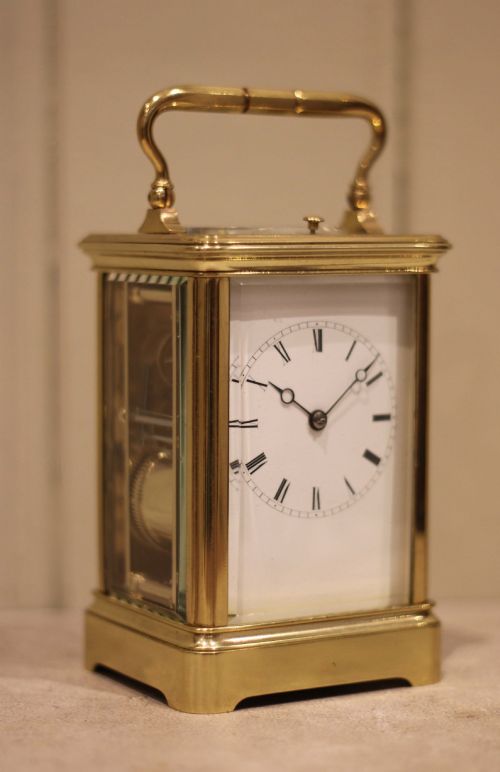
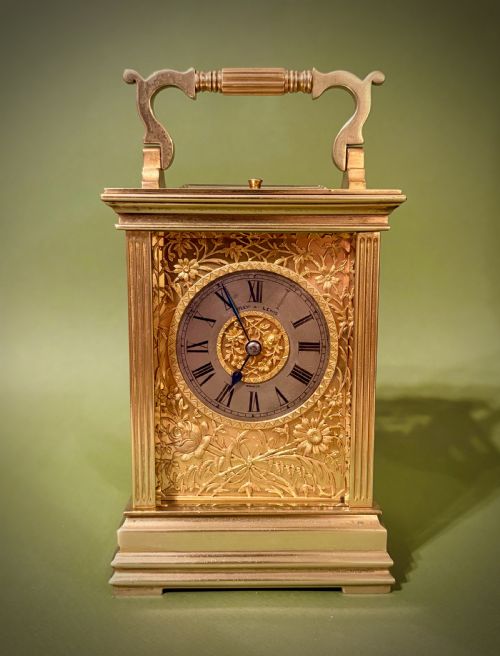
These vintage repeating carriage clock examples are portable timepieces that sound the hours and quarters upon demand, offering brass and glass housing.
Vintage Repeating Carriage Clock
A vintage repeating carriage clock represents a portable timepiece designed for travel during the nineteenth and early twentieth centuries. These mechanisms include striking trains that sound the last hour or quarters when a button on the case is pressed.
The pieces met on this page originate predominantly from French workshops operating across the Victorian, Edwardian and Belle Epoque periods. Common housing forms include the classic brass frame with bevelled glass panels and the stepped gorge case.
Makers housed these movements in brass, gilt brass, gilded metal, and occasionally silver gilt. Many examples integrate enamel dials or painted enamel bandings alongside steel components.
Materials and Construction
Workshops constructed these clocks using heavy brass frameworks fitted with thick bevelled glass panes to protect the mechanical movement within. Gilt brass and fully gilded metal finishes provided decorative brilliance to the exterior metalwork.
Clockmakers utilised steel for internal springs and arbors, while white enamel dials featured black Roman or Arabic numerals. Some examples incorporated enamel paintings and engraved brass masks surrounding the dial aperture.
Vintage Repeating Carriage Clock Retail Price Guide 2026
Typical asking prices for vintage repeating carriage clock among the pieces listed under this phrase on Sellingantiques today, from the lower quarter to the upper quarter. They describe what is for sale here now, not the wider market.
Object types include standard carriage clocks, alarm clocks, and specialised clock accessories.
Distinctions in Quality
Quality rests upon the complexity of the internal train, separating standard hour-repeating clocks from those featuring petite sonnerie, grande sonnerie, or alarm complications. The presence of original gilding and undamaged enamel dial work further separates standard production from finer horology.
Case architecture also dictates distinction, moving from plain rectangular brass frames to complex gorge cases, doucine profiles, and giant proportions. Signed movements by notable makers elevate the horological standing of an individual piece.
DROCOURT·Henry Jacot·L Epee·J.W.BENSON·Hunt & Roskell·DWERRIHOUSE & BELL
The Vintage Repeating Carriage Clock Glossary
- Repeating movement
- A mechanism that sounds the hours and quarters upon depressing a plunger or button on the case. This function allowed travellers to check the time in darkness.
- Gorge case
- A stepped brass carriage clock case style featuring a concave moulding beneath the top plate. This profile appears frequently on better French examples.
- Petite sonnerie
- A striking train configuration that sounds the hours on the hour and passes quarters without repeating the hours on the quarter. It represents a more complex mechanism than standard time-and-strike.
- Grande sonnerie
- A striking system that sounds both the hours and every quarter hour automatically as each quarter passes. These movements often combine with repeaters.
- Gilt brass
- Brass coated with a thin layer of gold through fire gilding or electroplating. This finish provided a rich yellow lustre to the exterior frame.
Vintage Repeating Carriage Clock: Frequently Asked Questions
How do I operate the repeater button?
Depressing the plunger on top of the case winds the striking train briefly to sound the last elapsed hour and quarters. This lets you check the time without viewing the dial in low light.
Ensure you press the button firmly until it stops, allowing the mechanism to complete its sequence without interruption.
What is the difference between striking and repeating?
A striking clock rings the hours automatically as they pass, governed by internal count wheels or rack systems. A repeating clock does this on demand when the owner presses the button.
Many vintage carriage clocks combine both functions, striking the hours automatically while offering the repeating button for manual checks.
How should I wind a carriage clock?
Use the appropriate key on the winding squares located at the backplate of the movement. Turn steadily clockwise until you feel resistance, taking care not to over-wind.
Separate arbors control the timekeeping train, the striking train, and any alarm function present on the movement.
How do I date a French carriage clock?
Examine the style of the case, the escapement type, and any serial numbers stamped on the backplate. Victorian and late nineteenth-century examples often display maker stamps or retailer signatures on the dial or movement.
Platform escapements evolved from cylinder types to lever escapements by the late nineteenth century, offering another clue to the period of manufacture.