
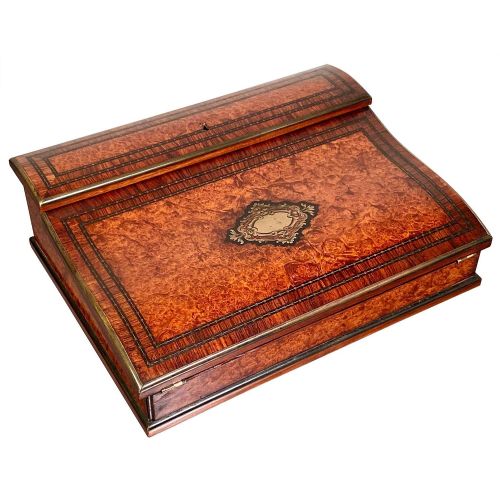


Vintage Portable Writing Desk
A vintage portable writing desk is a clever folding box built for correspondence on the move, combining sturdy travel construction with refined desk space.
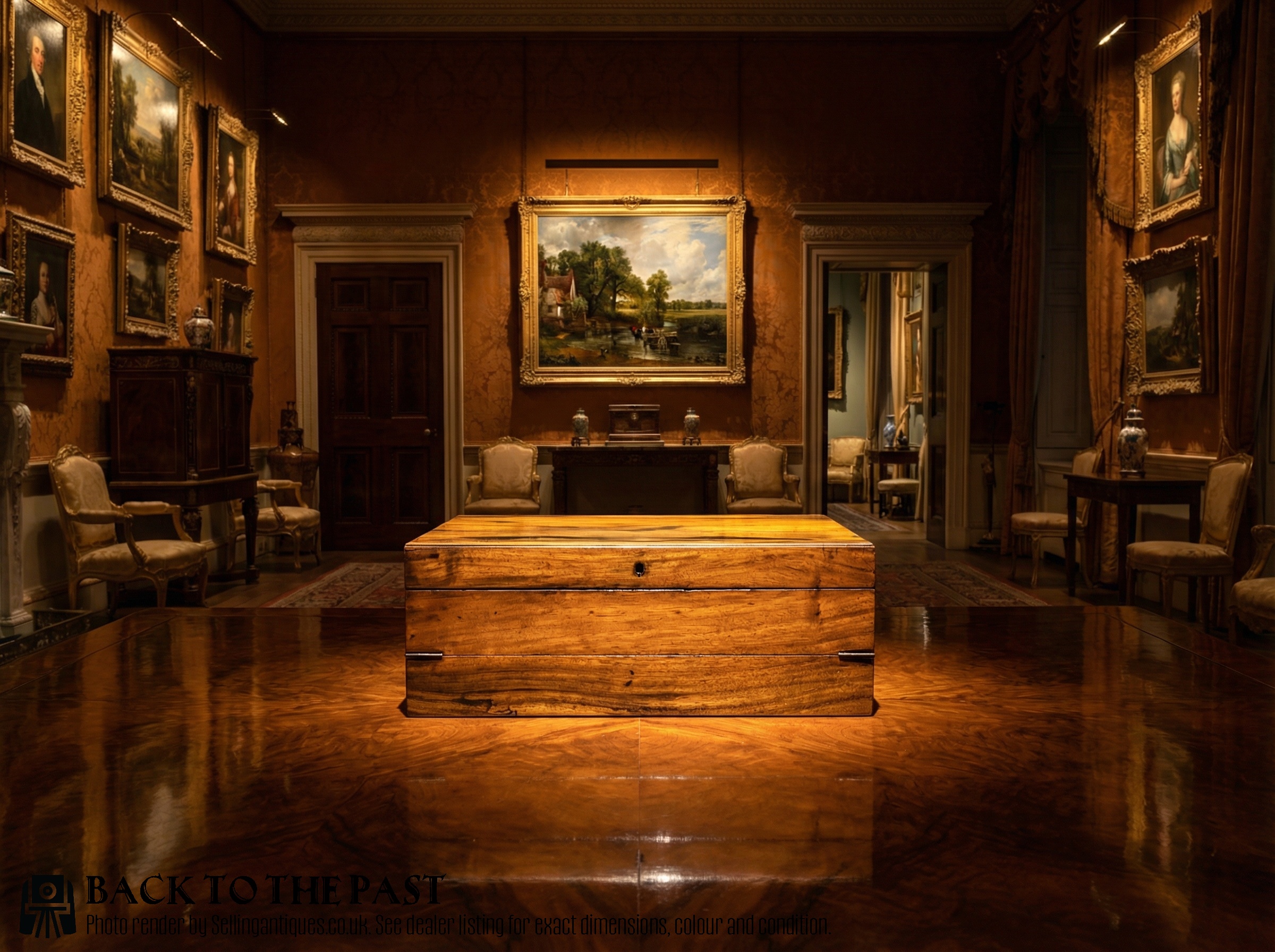
Vintage Portable Writing Desk
A vintage portable writing desk encompasses compact slope boxes, lap desks, and campaign chests designed to fold flat and travel securely across the nineteenth and early twentieth centuries. These pieces span Georgian, Victorian, and Edwardian eras, offering compartments for inkwells, paper, and letters.
The most common examples on this page are nineteenth-century mahogany, rosewood, and walnut writing slopes featuring brass banding and fitted leather writing surfaces. Many open to reveal secret drawers, letter racks, or compartments tailored for portable correspondence.
How they were made
Cabinet makers utilised dense hardwoods such as mahogany, rosewood, burr walnut, pollard oak, and teak to withstand frequent travel, reinforcing corners and edges with heavy brass binding and flush lifting handles. Sloped lids were hinged to fold open, revealing fitted interiors lined with tooled leather surfaces.
Fitted compartments incorporated hidden drawers, glass ink bottles, and occasionally specialised decorative techniques like Tunbridge ware mosaic, coromandel veneer, or intricate Anglo-Indian antler and Vizagapatam work.
What varies in quality
Quality rests in the density of timber figure, such as burr walnut or figured mahogany, and the precision of brass inlay and corner mounts set flush into the wood. The complexity of internal mechanics, including secret drawer releases, spring-loaded letter racks, and integrated metamorphic components, elevates the standard of a piece.
The integrity of the original leather writing surface, the presence of matching glass inkwells, and the retention of maker signatures or stamps separate standard travel boxes from finer commissioned examples.
J.C Vickery·Fisher
The Vintage Portable Writing Desk Glossary
- Writing slope
- A box with an angled lid that folds down to create a writing surface while storing stationery inside.
- Campaign desk
- Portable furniture built in sections or folding formats for military officers on active service.
- Tunbridge ware
- Woodwork decorated with intricate mosaics made from tiny coloured wood prisms forming geometric or floral patterns.
- Secret drawers
- Concealed compartments hidden behind false panels or accessed through hidden spring mechanisms within the desk interior.
- Brass bound
- Edges and corners reinforced with brass strips and corner brackets to withstand the knocks of travel.
Vintage Portable Writing Desk: Frequently Asked Questions
How do I open a secret drawer?
Many Victorian writing slopes conceal secret compartments behind internal partitions or letter slot dividers that slide away when you lift a specific panel or remove a dummy drawer.
Examine the inner walls and base of the pen tray for sliding stops or hidden wooden pins that release the locking mechanisms.
Can I use a portable desk for modern writing?
These boxes provide a compact writing surface and storage for modern stationery, though the angled slope suits fountain pens and notebook entries better than laptop computers.
Ensure the leather writing surface is stable and clean before resting paper upon it to protect old timber and leather from ink stains.
How do I date a campaign writing slope?
Dating relies on timber choices, brass hardware style, and construction methods, with Georgian pieces often featuring simpler box joints and rosewood veneers, while Victorian examples frequently employ burr walnut and elaborate brass corner binding.
Maker stamps and patent brass hinges also help narrow the decade of production.
Were these desks only used by the military?
While campaign styles were built for military officers on active service, similar portable boxes were widely used by civilians, travellers, and diplomats for correspondence at home and abroad.
The sturdy brass mounts and secure locks made them practical for general domestic use as well as rigorous travel.