


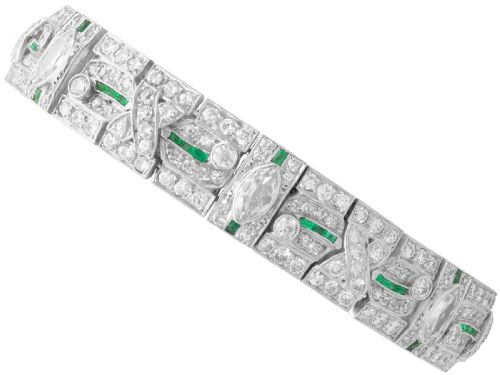


Vintage Platinum Bangle
A vintage platinum bangle brings the crisp geometry and enduring strength of early twentieth-century design directly to the wrist.
Vintage Platinum Bangle
A vintage platinum bangle encompasses sophisticated wristwear originating primarily from the Edwardian, Art Deco, and mid-century eras. When exploring a vintage platinum bangle, buyers frequently encounter intricate bracelet forms set with diamonds, emeralds, sapphires, and pearls.
The selections span distinct historical periods including the 1900s, 1910, 1920, 1930, and 1950. Art Deco geometric motifs and Edwardian delicacy dominate the aesthetic landscape of these pieces.
Alongside pure platinum iterations, variations incorporate complementary metals such as 18ct gold, yellow gold, and white gold. These materials frequently combine to support significant gemstone carat weights.
Materials and construction techniques
Master jewellers utilised platinum for its remarkable tensile strength, allowing artisans to create exceptionally delicate yet secure settings for diamonds and coloured stones. This metal choice defined the construction of twentieth-century fine jewellery.
Gems such as diamonds, Ceylon sapphires, emeralds, and pearls were meticulously integrated into platinum mountings, often alongside elements of 18ct yellow or white gold. The combination of these materials required advanced metallurgical skill.
Artisans employed precise techniques to mount multi-carat gemstone arrangements, resulting in substantial weights like the heavy Art Nouveau platinum bracelet recorded at twenty-one grams.
Listings feature periods from 1900 through 1950, utilising platinum, diamond, emerald, sapphire, pearl, and gold.
Factors distinguishing quality variations
Stylistic execution and period provenance also define the upper tier of pieces, particularly French import items and documented Art Deco designs. The finesse of the metalwork and the integration of diverse materials reflect the proficiency of the workshop.
The Vintage Platinum Bangle Glossary
- Platinum
- A dense, ductile precious metal prized for its silvery-white lustre and exceptional strength. It became the favoured setting material for fine jewellery throughout the Edwardian and Art Deco periods.
- Art Deco
- A design style flourishing during the 1920s and 1930s characterised by symmetrical geometric patterns, stylised motifs, and linear elegance. It remains a dominant aesthetic among vintage bracelets.
- Edwardian
- A decorative period spanning the early 1900s known for lace-like platinum work, delicate pearl integration, and refined diamond settings. Pieces from this era display notable lightness.
- Ceylon Sapphire
- A natural sapphire originating from Sri Lanka, celebrated for its vibrant blue hue. These stones frequently appear alongside significant diamond totals in mid-century pieces.
- Line Bracelet
- A continuous string of gemstones, typically diamonds, linked symmetrically around the wrist. This form showcases uniform stone sizing and secure metal articulation.
Vintage Platinum Bangle: Frequently Asked Questions
What periods do these pieces span?
The available selection spans the early twentieth century through the mid-century era. Key periods represented include Edwardian, Art Nouveau, Art Deco, and the 1950s.
Each period imparts distinct stylistic characteristics, from Edwardian lace-like delicacy to bold Art Deco geometry and heavy mid-century gemstone configurations.
Which gemstones commonly accompany platinum?
Diamonds form the primary gemstone element across the collection, often appearing in substantial carat weights. Emeralds, sapphires, and pearls also feature prominently.
Coloured stones such as Ceylon sapphires are frequently paired with intricate diamond pavé settings mounted in platinum or gold.
How do platinum and gold combine?
Certain pieces integrate platinum alongside 18ct yellow gold or white gold. This dual-metal approach allowed makers to blend contrasting colour tones and structural properties.
Such combinations appear in both Edwardian bangles and specific Art Deco bracelets to highlight different design tiers.
Are French import pieces common?
French import items occasionally appear within the selection, representing distinct continental craftsmanship from the mid-century period. These pieces often feature significant gemstone arrangements.
Such items highlight international manufacturing standards and distinct stylistic import markings from their era of origin.