


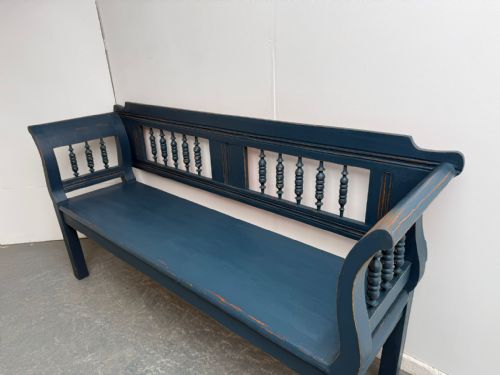

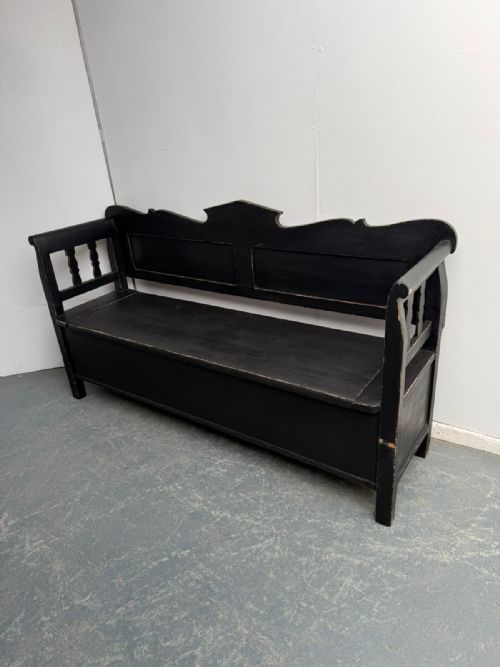

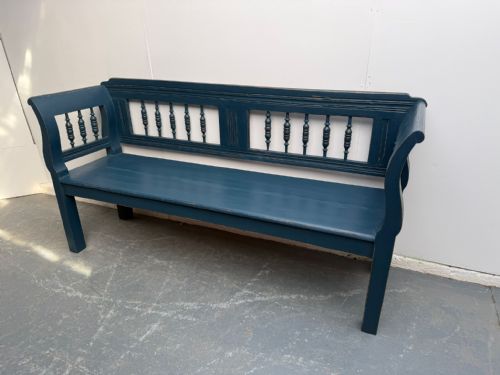


Vintage Painted Settle
These vintage painted settle pieces bring folk character and practical storage to a hallway, combining sturdy pine construction with centuries of regional decorative tradition.
Vintage Painted Settle
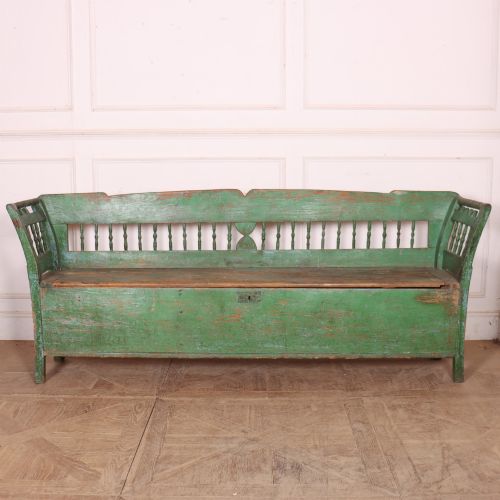
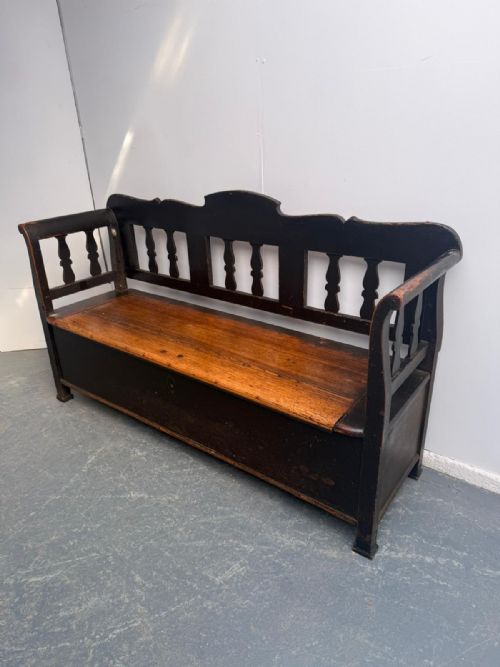
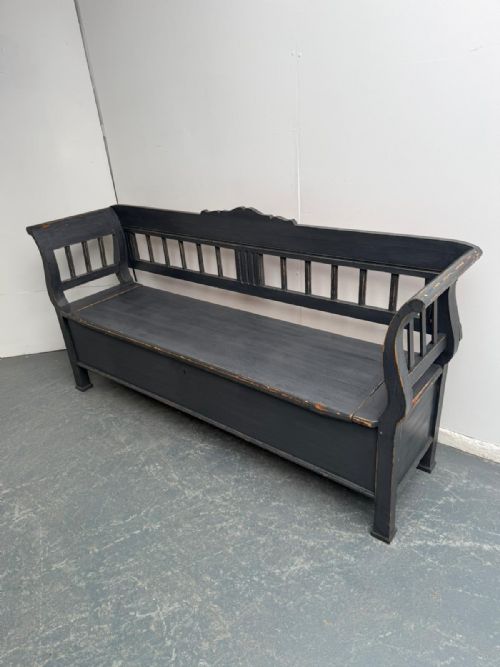
A vintage painted settle provides a high-backed wooden seat designed to keep out drafts, frequently incorporating a storage box beneath the hinged bench. The examples seen on this page span from the Georgian period through the Victorian era and into the early twentieth century, originating from English workshops, French chateaux, and various European folk traditions including Swedish, Austrian, and Hungarian styles.
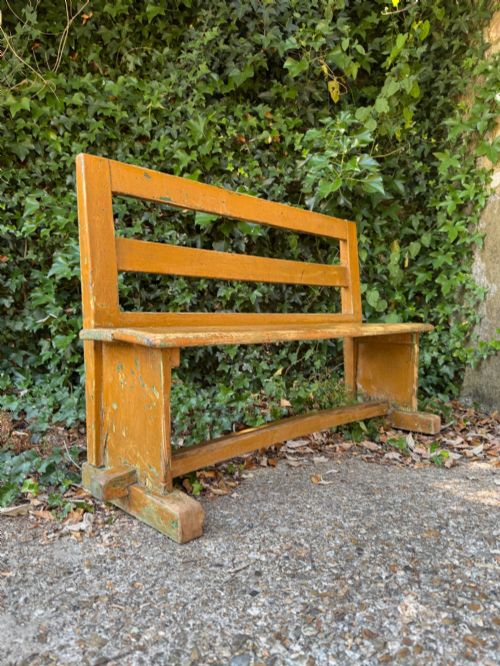
Most pieces encountered here are constructed from pine and finished with historic or later painted layers in shades of blue, green, grey, black, or cream. While traditional settles share space with related forms such as farmhouse benches, corner sofas, and tavern benches, the defining characteristic remains the combination of timber framing and applied paint.
How they were made
These items rely on solid timber construction, primarily utilising pine for the structural panels, armrests, and high backs. Joinery is typically straightforward and robust, designed to withstand daily use in domestic kitchens, farmhouses, and public hostelries.
Surfaces are prepared with paint, often applied in distinct regional palettes associated with Austrian, Hungarian, or Scandinavian folk art. Iron hardware, including hinges and fixings for storage compartments, completes the functional assembly.
Design styles represented span English country, French chateau, and Hungarian, Austrian, and Scandinavian folk art.
What varies in quality
Quality in these pieces rests upon the integrity of the original timber and the survival of early or untouched paint surfaces. Examples retaining their authentic regional pigment display greater character than those stripped or heavily refinished.
Proportion and scale also separate standard utility items from finer decorative pieces, particularly where high backs or integrated storage boxes remain structurally sound and unaltered by later restorations.
William Frederick Settle
The Vintage Painted Settle Glossary
- Settle
- A wooden bench with a high back, solid arms, and frequently a box compartment beneath the seat for storage. This form evolved to provide shelter from draughts in domestic interiors.
- Box settle
- A specific variant of the bench featuring a hinged seat that opens to reveal an enclosed storage space. These items served a dual purpose for seating and household storage.
- Folk art
- Decorative design and craftsmanship associated with specific regional traditions, often seen in the distinctive painted finishes of Austrian, Hungarian, and Scandinavian furniture.
- Pine
- A softwood commonly utilised in the construction of country furniture across Britain and Europe. It provides a stable base for painted decoration.
- High back
- An elevated rear panel designed to deflect cold air away from the seated person. This feature distinguishes settles from standard dining and farmhouse benches.
Vintage Painted Settle: Frequently Asked Questions
How do I use a settle?
Place the bench in a hallway or kitchen where the high back can block draughts and the lift-up seat can store everyday items.
Ensure there is sufficient wall space to accommodate the height of the back panel without dominating the room.
Are these pieces strictly English?
The selection includes items from various European regions alongside English examples.
Austrian, Hungarian, and Swedish pieces often feature distinct painted folk art styles that differ from traditional British country furniture.
What is a box settle?
A box settle incorporates an integrated storage compartment beneath the hinged seat.
This design allowed households to keep blankets or boots neatly tucked away beneath the seating area.
How do I identify the period?
Dating relies on construction methods, timber characteristics, and the style of any applied paint.
Georgian and Victorian examples often show distinct joinery techniques compared to pieces from the early twentieth century.