
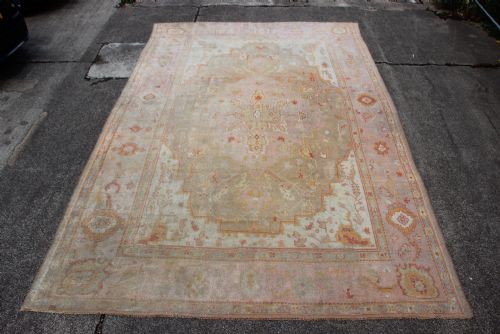
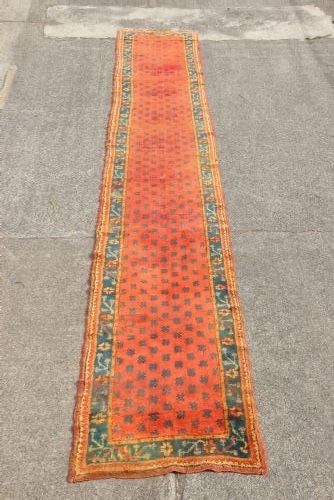
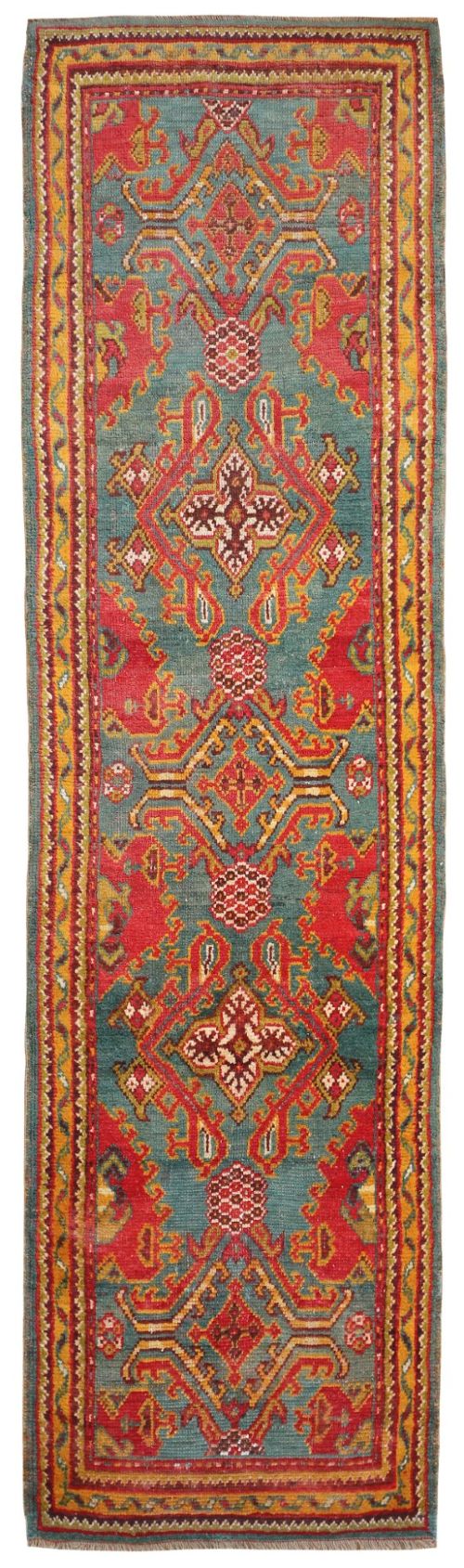
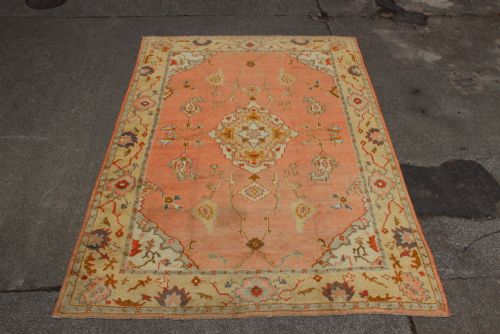

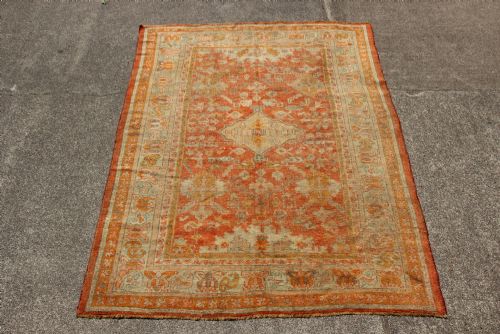
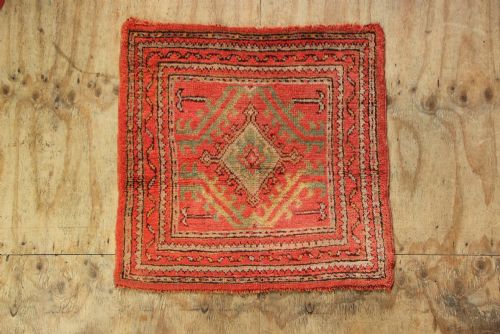
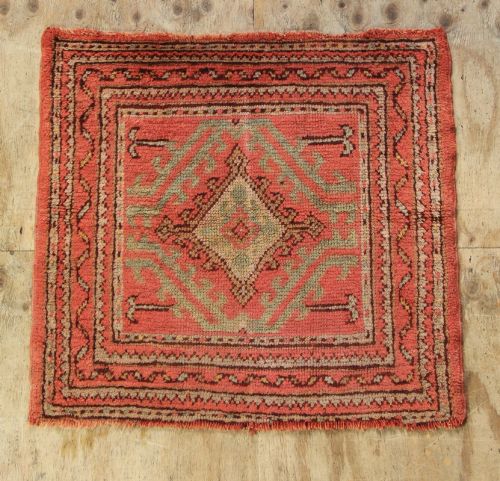


Vintage Oushak Wool Rug
A vintage oushak wool rug brings monumental West Anatolian colour and grand floral geometry to a room.
Vintage Oushak Wool Rug
When you search for a vintage oushak wool rug, you encounter hand-knotted floor coverings originating from Western Turkey during the late nineteenth and early twentieth centuries. These pieces encompass grand room-size carpets, square formats, long narrow runners, and smaller mats.
The versions most likely to appear on this page date from the Victorian era up to the nineteen-twenties, displaying Ottoman and Anatolian design traditions. They span immense palace dimensions down to compact accent pieces, uniting historic Western Turkish weaving centres with domestic interiors.
Materials and Construction
Makers constructed these textiles utilising natural wool and cotton foundations, occasionally incorporating angora wool to impart a distinct softness to the pile. Artisans hand-knotted the fibres onto sturdy cotton warps and wefts, securing the structure for generations of daily use.
The regional looms of Western Turkey relied on vegetable and early aniline dyes to achieve characteristic pale, faded, beige, and green fields. This traditional hand-knotting method yields flexible, substantial floor coverings with an organic drape.
Listings span production dates from the Victorian era through 1920, predominantly featuring wool and cotton materials across Turkish styles.
Assessing Quality and Character
The upper tier of these textiles reveals itself through finely balanced proportions, sophisticated dye saturation, and the harmonious fading of pale blue or neutral fields. Superior examples maintain structural integrity across expansive room-size dimensions without compromising the supple handle of the wool.
Design clarity and the distinction of scarce colour palettes, such as green fields or unusual runner formats, separate exceptional specimens from standard production. The finesse of the hand-knotting density and the preserved integrity of the original borders ultimately determine the standing of each piece.
The Vintage Oushak Wool Rug Glossary
- Oushak
- A town in Western Turkey renowned historically for large-scale carpet production. These rugs employ distinctive floral motifs and relaxed geometric medallion layouts.
- Ghiordes
- A historic weaving centre in Anatolia associated with specific Turkish knotting techniques and classical design vocabularies. Pieces attributed to this tradition share stylistic traits with broader regional production.
- Kilim
- A flat-woven textile produced without a pile by tightly interweaving warp and weft strands. These items offer a lighter, reversible alternative to knotted carpets.
- Runner
- A long, narrow carpet format designed specifically for hallways, corridors, or alongside beds. These pieces require careful scaling to fit linear domestic spaces.
- Angora wool
- A fine fibre sourced from specialised goats, utilised in select regional rugs to impart a luxurious texture. It creates a softer pile compared to standard sheep wool.
Vintage Oushak Wool Rug: Frequently Asked Questions
Where were these rugs made?
These textiles originated in Western Turkey, specifically around the historical weaving centre of Oushak and surrounding Anatolian towns.
Weavers in these regions produced carpets for both local Ottoman markets and international export, establishing a distinct aesthetic based on large floral patterns and muted palettes.
How do I clean a wool rug?
Maintain wool pile carpets through gentle vacuuming without rotating brush bars, avoiding the fringe edges to prevent fraying.
Professional specialist cleaning is essential for addressing deep soil or spills to protect natural dyes and fragile cotton foundations.
Can I place these in high traffic areas?
Hand-knotted wool construction provides natural resilience, allowing these rugs to withstand regular movement in hallways and living rooms.
Placing a quality underlay beneath the textile prevents slippage and reduces friction against the floorboards, extending the lifespan of the fibres.
How do I date an antique rug?
Dating relies on examining structural materials, dye characteristics, and design motifs typical of Victorian production periods up to the nineteen-twenties.
Variations in knot density, palette fading, and the presence of early synthetic or traditional natural dyes help establish the approximate decade of creation.