


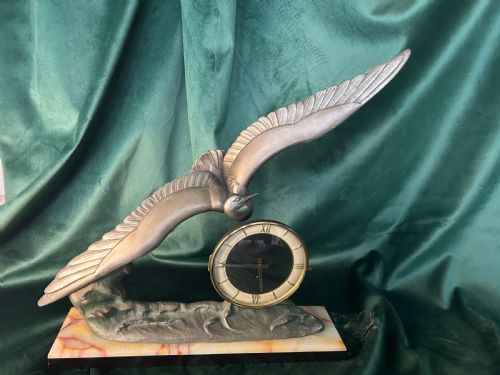


Vintage Onyx Table Clock
These vintage onyx table clock pieces are solid stone timepieces from the Victorian, Art Deco, and Belle Epoque eras that bring genuine period weight to a room.
Vintage Onyx Table Clock
A vintage onyx table clock sits squarely in the realm of nineteenth and early twentieth-century timekeeping, spanning the Victorian era through the 1930s. The versions most commonly met on this page combine polished green onyx or marble bodies with brass and glass components.
Makers shaped these stones into architectural mantel clocks, desk clocks, and complete clock garniture sets with matching side ornaments. Art Deco and Victorian examples dominate the forms, reflecting both geometric modernism and ornate nineteenth-century taste.
How they were made
Cutteries shaped solid blocks of green onyx and marble into heavy architectural cases, often mounting them on brass feet. Enamel dials and protective glass bezels complete the clock faces.
Foundries cast accompanying figures in spelter or bronze, gilding the metal surfaces to contrast with the dark stone. French and English workshops balanced the immense weight of the natural stone against delicate brass movements.
Some desk sets combine time, atmospheric pressure, and temperature into a single heavy block of polished stone.
What varies in quality
The density and uniformity of the green onyx or marble set the baseline, with richly figured stone demanding superior masonry work. Finely cast brass bezels and heavy enamel dials indicate workshops that invested in durable materials.
Completeness defines the upper tier, particularly when a clock retains its original garniture sidepieces or integrated barometers. Art Deco sculptures cast by named artists elevate the object beyond a simple timepiece into sculptural metalwork.
Elliott·Ferdinand Priess·Garrards
The Vintage Onyx Table Clock Glossary
- Garniture
- A matching set of ornamental pieces consisting of a central clock flanked by two matching side urns or figures. These sets were designed to sit symmetrically on a mantelpiece.
- Spelter
- A zinc alloy commonly used as a less costly alternative to bronze for casting decorative figures. It was frequently painted or gilded to resemble higher-value metals.
- Crystal Regulator
- A clock housed in a glass-panelled brass case that allows the movement and pendulum to be viewed from multiple angles. These were popular in late nineteenth-century France.
Vintage Onyx Table Clock: Frequently Asked Questions
How do I wind an onyx clock?
Use the key provided to turn the winding arbors in the dial clockwise or counter-clockwise depending on the movement design. Take care not to overwind the mainspring.
Keep the clock on a level surface so the pendulum or balance wheel maintains an even beat. Adjust the slow-fast regulator lever carefully if the timekeeping drifts.
What is a clock garniture?
A clock garniture is a matched set containing a central timepiece and two matching decorative sidepieces, such as urns or candelabras. They were made to create a balanced display on a fireplace mantel.
These sets utilise the same marble or onyx and metal mounts across all pieces. Finding a complete set together remains a notable advantage for collectors.
How do I date a marble clock?
Examine the style of the numerals, the shape of the case, and the materials used in the construction. Victorian pieces often display ornate brass casting and heavy pediments.
Art Deco examples from the 1920s and 1930s favor streamlined geometric lines and contrasting coloured marbles. The presence of maker marks on the movement backplate also aids dating.
Where should I place a heavy stone clock?
Support the weight of an onyx or marble clock on a sturdy piece of furniture like a mantelpiece or a heavy sideboard. Natural stone clocks carry significant mass and require a stable foundation.
Avoid placing them in direct sunlight or damp areas that could degrade the stone polish or affect the brass movement. Ensure the surface is level to prevent the clock from stopping.