
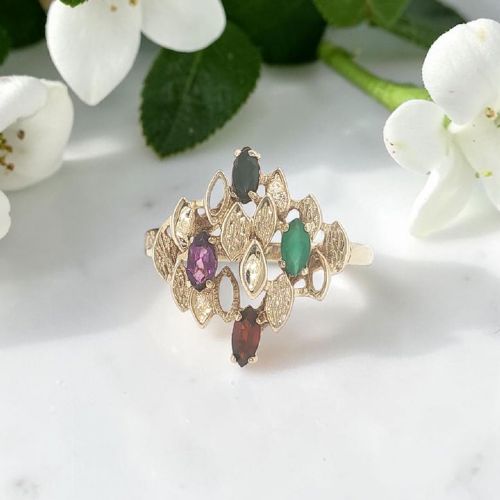
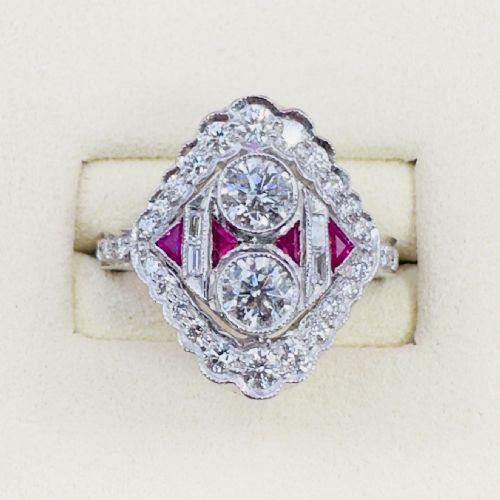
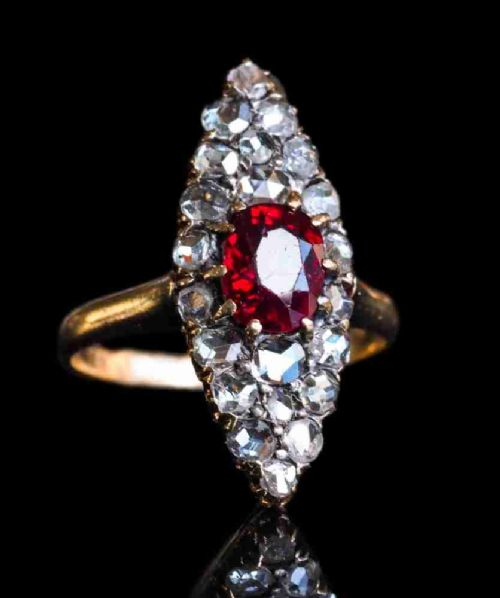


Vintage Marquise Cluster Ring
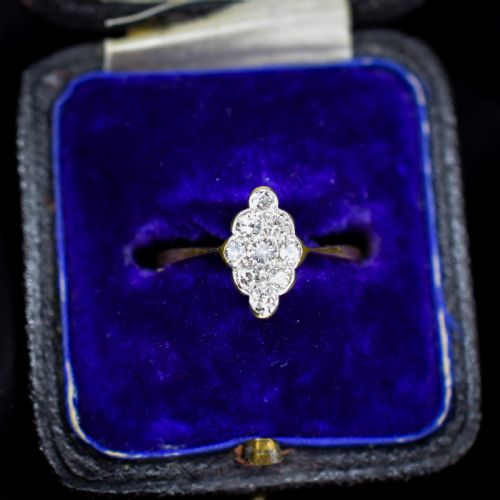
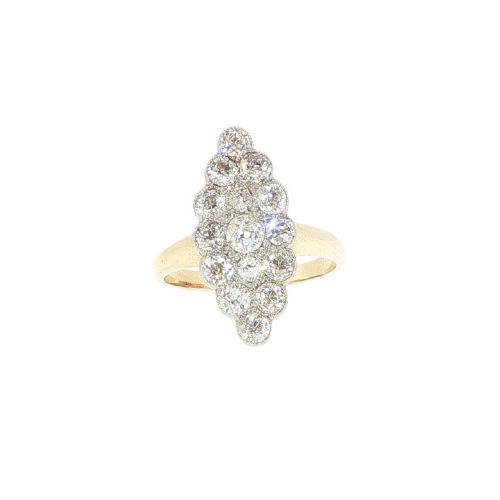
A vintage marquise cluster ring draws the eye with its elongated, boat-shaped silhouette designed to sit gracefully along the finger.
Vintage Marquise Cluster Ring
A vintage marquise cluster ring brings together an elongated central profile and a dense arrangement of gemstones, creating a distinctively theatrical outline on the hand. When exploring this selection, buyers frequently encounter Edwardian and Art Deco specimens alongside mid-century interpretations.
The term encompasses both the traditional boat-shaped navette and parallel elongated geometric forms shaped by jewelers to maximise finger coverage. These pieces combine central diamonds or coloured stones framed by smaller accent gems.
Origins span British workshops, French ateliers, and Italian makers, reflecting stylistic shifts from delicate Edwardian filigree to streamlined mid-century modernism. The enduring appeal lies in this interplay between pointed geometry and sparkling pavé or claw settings.
Materials and construction methods
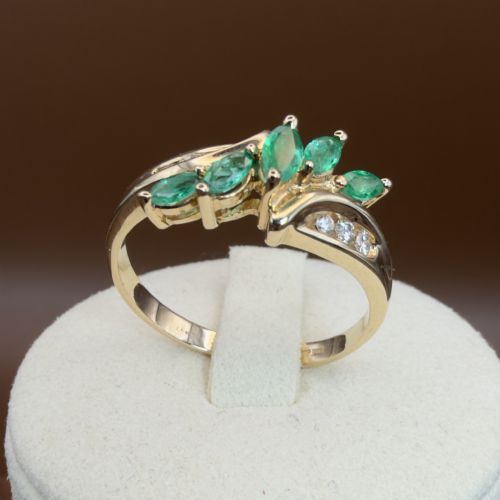
Goldsmiths utilised combinations of 18ct yellow gold, 18ct white gold, and platinum, often pairing platinum tops with yellow gold shanks during the Edwardian and Art Deco eras to enhance the brilliance of white diamonds. Gemstones such as diamonds, sapphires, rubies, and emeralds were selected for their depth of colour and durability.
Settings relied on delicate claw, rubover, and grain techniques, requiring meticulous hand-piercing of the metal framework to allow light to pass through the stones. Master craftsmen balanced structural integrity with visual lightness, ensuring complex multi-stone arrangements remained secure on the hand.
Materials span platinum, 18ct yellow and white gold, alongside diamonds, sapphires, rubies, and emeralds.
Distinguishing quality across the range
Quality rests upon the precision of the stone symmetry and the integrity of the original metalwork, particularly the crispness of millegrain edges and pierced galleries. Superior examples maintain balanced proportions where the central marquise or navette flows seamlessly into the shoulder design without appearing disjointed.
The selection of the primary gem dictates the upper echelon of the market, where unheated sapphires, Colombian emeralds, or high-colour old-cut diamonds are matched with uniform accent stones. Lesser examples exhibit uneven stone calibration or heavier, less refined metal casting from later production periods.
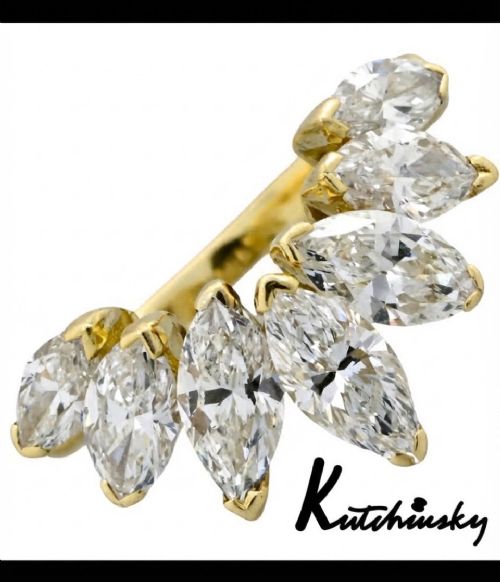
Kutchinsky
The Vintage Marquise Cluster Ring Glossary
- Marquise
- A boat-shaped gemstone cut featuring curved sides and two pointed ends, designed to maximise carat weight perception.
- Navette
- French for little ship, this term describes an elongated, pointed cluster ring shape resembling a small hull.
- Old cut
- A diamond facet style hand-polished before modern brilliant-cut standards, characterised by a smaller table and high crown.
- Millegrain
- A decorative technique featuring tiny, raised metal beads along the edge of a setting, common in Edwardian and Art Deco pieces.
- Cluster
- An arrangement of multiple gemstones set closely together to create the visual impact of a single larger stone.
Vintage Marquise Cluster Ring: Frequently Asked Questions
How do I care for my ring?
Clean your piece gently using warm water, mild soap, and a soft-bristled brush to remove daily oils from beneath the cluster setting.
Avoid harsh chemical dips or ultrasonic cleaners, especially if the piece contains softer coloured stones or pearls.
Are these rings suitable for daily wear?
Most sturdy Edwardian and Art Deco examples withstand regular wear if checked periodically by a professional jeweler for loose claws.
Items featuring delicate emeralds or antique pearls require greater care to prevent impact damage to the softer stones.
How can I tell the era of a ring?
Examine the metal combinations and setting styles, noting that platinum-topped yellow gold points toward the Edwardian and early Art Deco periods.
Geometric symmetry and stepped motifs typically indicate 1920s and 1930s design, while heavier castings often signal mid-century production.
What is the difference between marquise and navette?
The terms are frequently used interchangeably to describe elongated, pointed jewellery, though marquise strictly refers to the shape of the centre stone.
Navette specifically describes the boat-shaped silhouette of the entire cluster framework.