
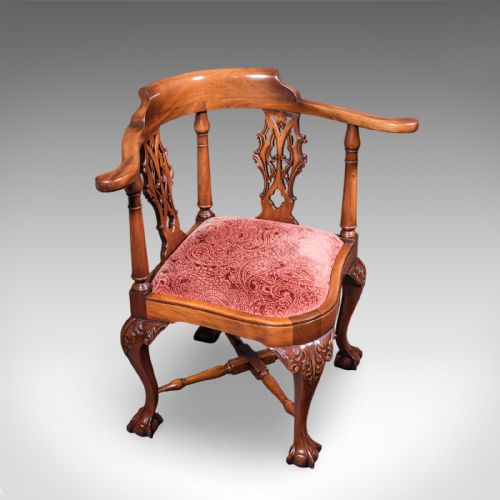


Vintage Mahogany Corner Chair
These vintage mahogany corner chair designs fit neatly into domestic spaces, offering curved rails and sturdy uprights built for sociable sitting.
Vintage Mahogany Corner Chair
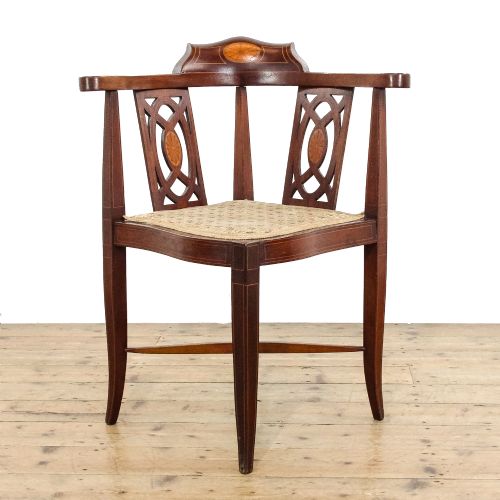
A vintage mahogany corner chair brings compact seating to angles and junctions in a room, fitting snugly where standard chairs obstruct the flow. These pieces often feature curved backs and multiple spindle supports leading down to a central seat.
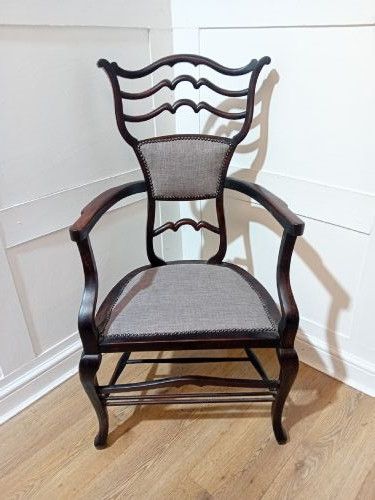
The selections available here span from robust Georgian and 18th century examples through to Victorian iterations and lighter Edwardian revival pieces. Makers adapted the form across these periods to serve as dressing seats, occasional salon chairs, and intimate armchairs.
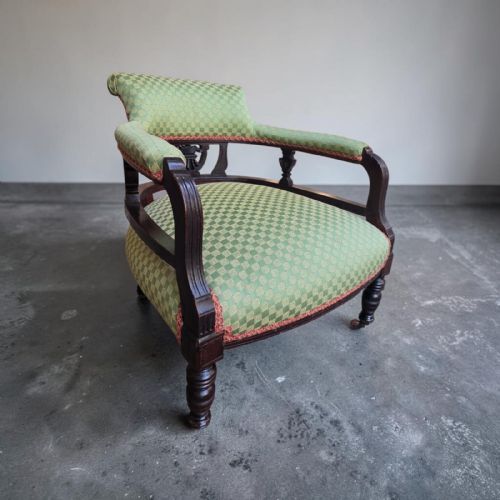
Most examples encountered on this page belong to the Edwardian era, often displaying delicate wood inlay and satinwood details alongside the dark grain of the primary timber. Buyers also encounter earlier Georgian forms alongside Victorian tub chairs and occasional corner stools.
How they were made
Cabinetmakers constructed these frames primarily from mahogany, selecting the dense wood for its strength in curved components and intricate turnings. Workshops frequently enhanced the surfaces with satinwood, boxwood, and intricate wood inlay.
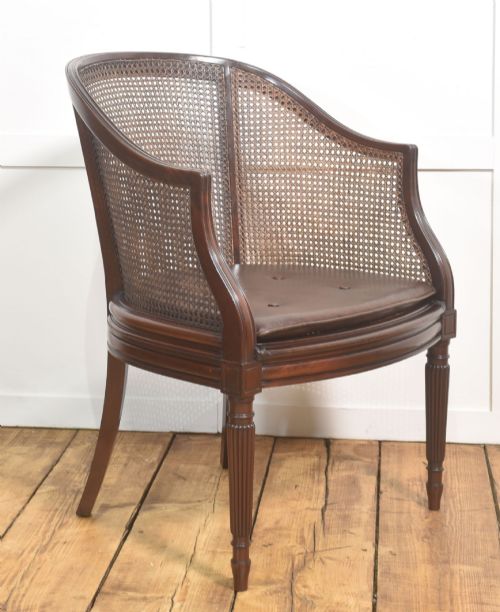
Upholstered versions incorporate padded seats covered in fabric or leather, secured with upholstery studs. Some examples combine the timber frames with woven cane panels for lighter backrests and supportive seating.
Listings span from the mid-eighteenth century through the Victorian era to the Edwardian period, uniting mahogany, oak, leather, and cane.
What varies in quality
The distinction between standard production and finer pieces lies in the precision of the joinery and the depth of the carved ornament. Master workshops ensured that complex curves and intersecting rails remained rigid and flush over centuries of use.
Quality also shows in the choice of secondary timbers and the crispness of any inlaid motifs or boxwood stringing. Finer examples retain balanced proportions that support the sitter comfortably without looking clumsy in a corner space.
The Vintage Mahogany Corner Chair Glossary
- Corner chair
- A seating form designed to fit into the angle of a room, featuring a diagonal seat and a continuous curved backrest supported by posts. These items provide compact placement while maintaining a sturdy frame.
- Inlay
- A decorative technique where contrasting materials such as satinwood or boxwood are set into recesses flush with the mahogany surface. This method creates geometric patterns and floral motifs across the wood.
- Tub chair
- An armchair characterised by a low, rounded back that curves continuously into the arms. These seats offer enclosed comfort and frequently appear in Edwardian and Victorian forms.
- Cane
- Material woven from the peeled bark of rattan palms, utilised for light and resilient chair panels. It offers breathable support in backrests and seating surfaces.
- Georgian revival
- A stylistic movement where makers replicated or reinterpreted the furniture forms of the 18th century. These pieces combine earlier architectural proportions with the manufacturing methods of later decades.
Vintage Mahogany Corner Chair: Frequently Asked Questions
Where should I place a corner chair?
These seats suit awkward angles, empty room junctions, and bedroom dressing areas where standard furniture blocks pathways. Their angled design makes effective use of dead space while offering an accessible seat.
In living rooms, they provide an intimate spot for conversation without jutting out into the main floor area. They also function well as standalone accent pieces against plain walls.
How do I identify an Edwardian example?
Edwardian pieces often feature lighter frames decorated with contrasting wood inlay, satinwood stringing, or boxwood details. They frequently date from around nineteen hundred to nineteen ten and lean towards delicate aesthetics.
These chairs commonly serve as occasional salon seating or low armchairs rather than heavy structural furniture. Their construction reflects the revival styles popular during the early twentieth century.
Are these chairs suitable for daily use?
Most solid mahogany frames remain structurally robust for regular sitting, provided the joints have been properly maintained over the decades. Lighter inlaid or caned versions require more mindful placement to prevent strain on delicate woodwork.
Upholstered variants offer comfortable padding for reading or resting in studies and bedrooms. Inspecting the stability of the intersecting corner legs ensures long-term reliability.