

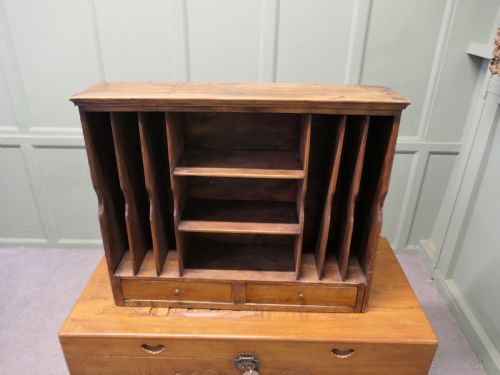


Vintage Letter Sorter
These vintage letter sorter pieces bring order to a desk, shaped by decades of correspondence through Victorian and Edwardian offices.
Vintage Letter Sorter
A vintage letter sorter organises correspondence upon a desk, appearing across periods from the Georgian era through to the 1930s. The listings show forms ranging from stationery cabinets and pigeon holes to simpler racks.
Buyers meet variations such as Edwardian oak letter boxes and Victorian desk tidies intended for office or country house use. Novelty pieces like cricket bat racks also appear amongst these desk accessories.
Origin and period define these items, spanning the 19th century, Edwardian years, and George V era. French country post office filing shelves sit alongside English office letter organisers on this page.
How They Were Made
Timbers dominate the construction of these items, with mahogany, oak, and pine providing the structural rigidity required for daily desktop use. Craftsmen shaped these woods into cabinets, shelves, and pigeon holes.
Metal and glass elements complement the wooden bodies, seen in brass fittings and sterling silver with pink guilloche enamel. Paint and gilding occasionally finish the surface decoration.
Vintage Letter Sorter Retail Price Guide 2026
Typical asking prices for vintage letter sorter among the pieces listed under this phrase on Sellingantiques today, from the lower quarter to the upper quarter. They describe what is for sale here now, not the wider market.
Correspondence finds an unexpected home inside a wooden cricket bat, ball, and wicket novelty rack.
What Varies in Quality
The choice of material and decorative ambition set standard utilitarian office pieces apart from finer domestic examples. Sterling silver and enamel elevate an ordinary desk accessory into a substantial decorative object.
Complexity of form distinguishes simple wooden racks from elaborate stationery cabinets or multi-tier pigeon holes. The integration of specialty materials like brass hardware marks the division between basic utility and refined craftsmanship.
The Vintage Letter Sorter Glossary
- Pigeon holes
- Compartments arranged in rows for sorting incoming and outgoing post. They form the internal structure of many desktop storage pieces.
- Stationery cabinet
- A closed wooden box with fitted interior slots designed to hold writing paper and envelopes securely. These protect contents from dust and light.
- Toast rack
- A metal frame with vertical dividers originally used for serving toast at table. Similar forms occasionally double as light letter racks.
- Guilloche enamel
- Decorative metalwork covered in translucent enamel over an engine-turned pattern. It provides a colourful finish on silver desk accessories.
Vintage Letter Sorter: Frequently Asked Questions
What is a vintage letter sorter used for?
These pieces organise incoming post, envelopes, and writing paper on a desk or tabletop surface.
They keep correspondence separated and upright for easy daily access in a study or office.
How do I date a wooden letter rack?
Dating relies upon observing the timber, construction style, and period characteristics present in the piece. Oak and mahogany appear across different eras from the Georgian period through to the 1930s.
Cabinetry details and stylistic markers like Arts and Crafts or Art Deco provide further chronological context.
Are these sorters suitable for modern desks?
Their compact tabletop footprints fit contemporary workspace layouts while accommodating letters, notes, and bills.
They bring traditional wood and metal finishes into a modern room as functional storage.
What materials were used to make them?
Woods such as mahogany, oak, and pine form the primary structure for the majority of these desk accessories.
Brass, glass, silver, and enamel appear on specific items to add decorative detail or hardware functionality.