


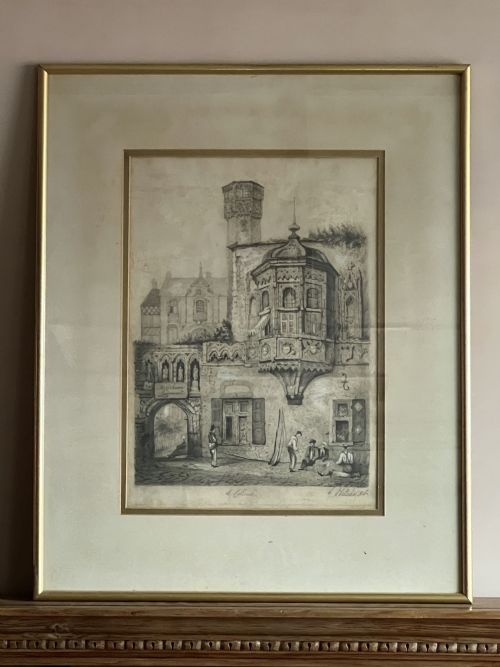


Vintage Ink Landscape Drawing
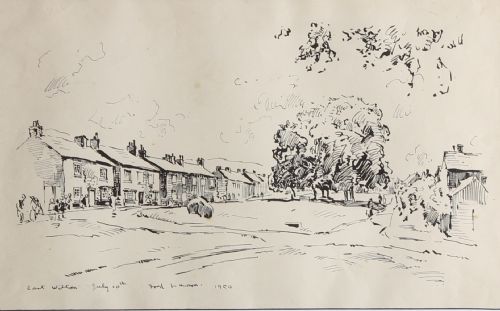
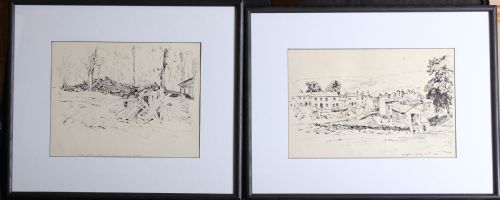
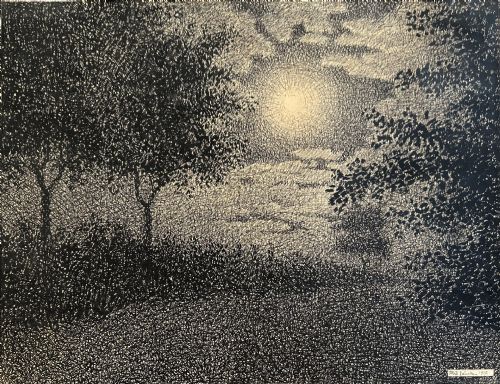
A vintage ink landscape drawing captures the quiet structure of field and architecture through the direct touch of pen and wash on paper.
Vintage Ink Landscape Drawing
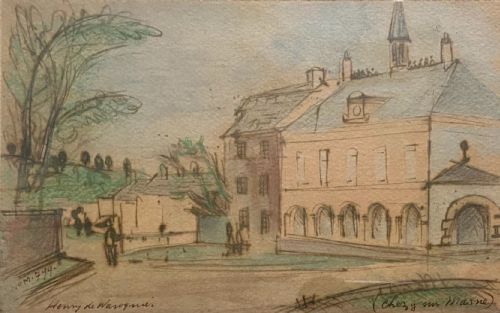
A vintage ink landscape drawing brings together precise line work and atmospheric shading to record countryside views, village streets and architectural studies. When you search for this phrase, you encounter works on paper spanning from the late eighteenth century through to the mid-twentieth century.
The selections on this page centre heavily on British traditions, including regional views by named artists such as Fred Lawson alongside anonymous school pieces. Landscapes range from quiet northern dales and ruined castles down to coastal scenes and European travels.
Most examples appear framed behind glass in wood mouldings, preserving fragile paper supports. They function as intimate wall art that records both topographical detail and the personal hand of the draughtsman.
Materials and methods
Draftsmen relied primarily on iron gall or carbon inks applied with nib and reed pens to establish the primary contours of a scene. This linear skeleton was frequently augmented with watercolour, sepia wash, pencil or crayon to build up tonal depth across the paper.
Supports consist entirely of various grades of paper, sometimes reinforced with board or mounted within period frames. The combination of ink line and transparent wash allowed artists to capture shifting light and weather quickly, whether working in the field or studio.
Several drawings document Yorkshire castles and northern dales through the prolific output of Fred Lawson.
Judging quality and execution
Quality rests upon the confidence of the ink line and the purposeful distribution of wash or colour. A superior drawing displays economy of stroke where every pen mark defines form, whereas weaker examples rely on heavy, uncertain outlines that flatten the composition.
Condition and preservation heavily influence standing, particularly the stability of the paper support against foxing and fading from light exposure. Original framing and clear provenance or attribution to known hands elevate specific sheets above anonymous sketches.
Fred Lawson·Henry de Waroquier·Edward Dayes·John Thurtle·Thomas Monro·Thomas Lound
The Vintage Ink Landscape Drawing Glossary
- Wash
- A translucent layer of diluted ink, sepia or watercolour applied with a brush to create shadow and depth behind pen lines.
- Foxing
- Small brownish spots caused by chemical reactions in ageing paper, frequently found on nineteenth-century sheets.
- Work on paper
- A broad category encompassing drawings, watercolours, sketches and prints executed on paper supports rather than canvas.
- Pencil and wash
- A preparatory or finished technique combining graphite underdrawing with applied liquid colour or tone.
- Attributed to
- A term used when a work shows the style of a specific artist but lacks definitive signature or documentation.
Vintage Ink Landscape Drawing: Frequently Asked Questions
How should I frame an old ink drawing?
Protect the paper by using acid-free mount board and framing it behind UV-filtering glass to prevent fading from light exposure.
Keep the drawing away from direct sunlight and damp environments to ensure the ink and paper survive intact for decades.
Are these drawings original works?
The pieces listed here are original hand-drawn works on paper rather than mechanical reproductions or printed book plates.
Each sheet records the direct application of pen, ink and wash by an artist working in the field or studio.
What is the difference between a sketch and a finished drawing?
A sketch is generally a quick preparatory study captured on location to record composition, whereas a finished drawing is fully resolved for display.
Many pieces bridge this divide, offering detailed linework combined with washes that stand alone as complete works of art.
How do I identify the date of a drawing?
Dating relies on inscribed dates, artist biography, stylistic markers of the period and the physical characteristics of the paper and framing.
Eighteenth and nineteenth-century sheets often feature laid paper watermarks and sepia tones, while twentieth-century examples display modern framing and bolder ink techniques.