



Vintage Highland Scene Art
Vintage highland scene art captures sweeping Scottish landscapes and sporting subjects that bring moody atmospheric depth to a room.
Vintage Highland Scene Art
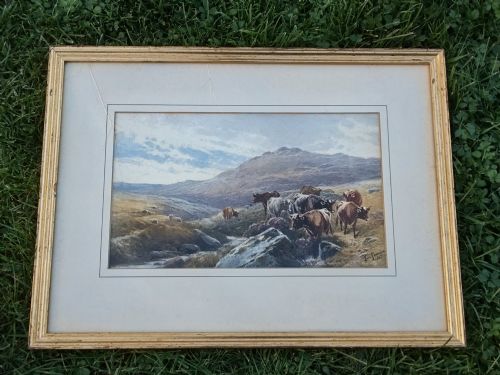
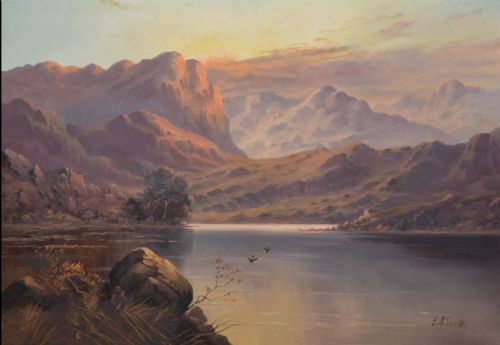
Vintage highland scene art comprises framed paintings and watercolours depicting Scottish mountains, moorlands, crofts and sporting subjects. These works capture the dramatic terrain and atmospheric light of the northern landscape through traditional artistic interpretations.
Most examples encountered here originate from the nineteenth century, the Victorian era, and the early decades of the twentieth century. Common formats include oil on canvas and gouache or watercolour on paper, often housed within gilded wooden frames.
How these pieces were made
Artists typically applied oil paint onto stretched canvas or worked with watercolours and gouache on paper to build up rich textures and tonal depth. These mediums allowed painters to capture shifting cloud formations, rugged terrain and atmospheric Scottish mist with precision.
Finished works were mounted within wooden frames, frequently featuring gilded ornamentation that complemented the traditional subject matter. The combination of durable canvas supports and protective glazing for works on paper ensured these landscapes survived across generations.
Vintage Highland Scene Art Retail Price Guide 2026
Typical asking prices for vintage highland scene art among the pieces listed under this phrase on Sellingantiques today, from the lower quarter to the upper quarter. They describe what is for sale here now, not the wider market.
Several Victorian hounds and stags stare steadfastly from these canvases, having clearly outlived their original hunting days.
What varies in quality
Quality rests upon the artist's ability to handle light, atmosphere and scale within the composition, distinguishing masterly brushwork from routine topographical recording. Stronger examples demonstrate confident handling of paint and a compelling sense of place rather than mere technical accuracy.
The physical condition of the canvas, pigment stability and the integrity of the original frame contribute significantly to the overall standing of a piece. Works retaining their untouched surface and period framing carry greater authenticity.
Archibald Kay·William Grant Murray·Harry Davis·John Charles Tunnard·Sir David Murray·AJ Thornton·Alfred de Breanski Sr·Milton Drinkwater·E M Seaton·William Crampton
The Vintage Highland Scene Art Glossary
- Oil on canvas
- Pigments bound in a drying oil applied to a woven fabric support stretched across a wooden frame. This medium allowed artists to build rich impasto and deep tonal variations.
- Gouache
- An opaque water-based paint that dries to a matte finish, often combined with transparent watercolour on paper. It provides solid blocks of colour and fine linear detail.
- Gilded wood
- Timber frames finished with a thin layer of gold leaf or metallic powder applied over a prepared base. This traditional framing technique enhances the visual weight of landscape paintings.
- Sporting art
- Depictions of countryside pursuits, game animals, working dogs and hunting scenes integrated into the landscape. This genre formed a significant part of nineteenth and early twentieth century British painting.
Vintage Highland Scene Art: Frequently Asked Questions
What periods do these paintings come from?
The available selection spans the nineteenth century, the Victorian era, and the early twentieth century up to the 1920s. These periods encompass distinct movements including Scottish Impressionism and 19th Century British Landscape.
Artisans and painters of these eras focused heavily on naturalistic depictions of terrain, wildlife, and rural architecture. Each era brings subtle shifts in palette and handling to the highland genre.
How do I care for an oil painting on canvas?
Keep the artwork away from direct sunlight and fluctuating humidity to protect both the canvas and the underlying wooden stretcher. Gentle dusting with a soft, dry brush is generally sufficient for maintenance.
Avoid using water or liquid cleaners on the painted surface or the gilded frame. Professional conservation should be sought if the canvas requires cleaning or structural repair.
How are watercolours protected?
Works on paper such as gouache and watercolour require glass glazing to shield them from airborne moisture and atmospheric pollutants. Framing materials should be acid-free to prevent discolouration of the paper over time.
Placement should avoid direct sunlight to prevent fading of sensitive water-based pigments. Maintaining stable indoor conditions preserves the integrity of both the paper and the painted medium.
What subjects besides landscapes appear in these artworks?
Sporting subjects such as hunting dogs, stags, and moorland game frequently feature alongside traditional Scottish crofts and mountain vistas. These elements reflect the broader interest in Highland sporting art during the Victorian and Edwardian periods.
Figures and animals are often integrated to provide a sense of scale within the vast landscape. Such details ground the topographical views in the lived rural experiences of the era.