


Vintage Harvest Landscape
These vintage harvest landscape works capture agricultural scenes on canvas and paper through British Impressionism and Realism.
Vintage Harvest Landscape
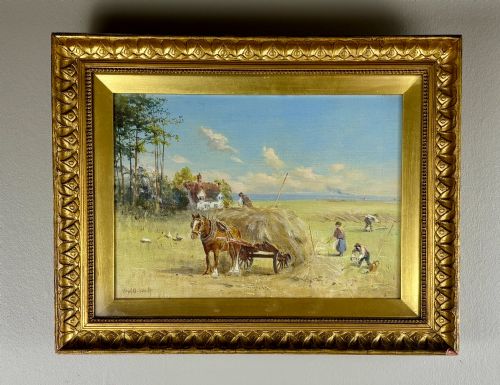
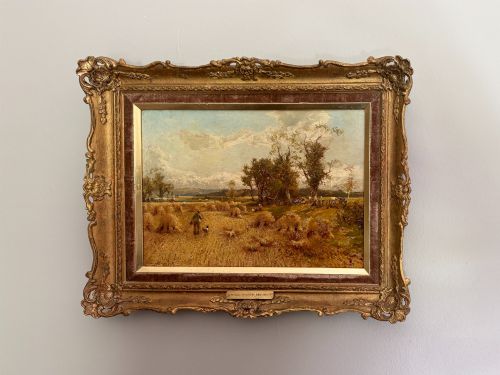
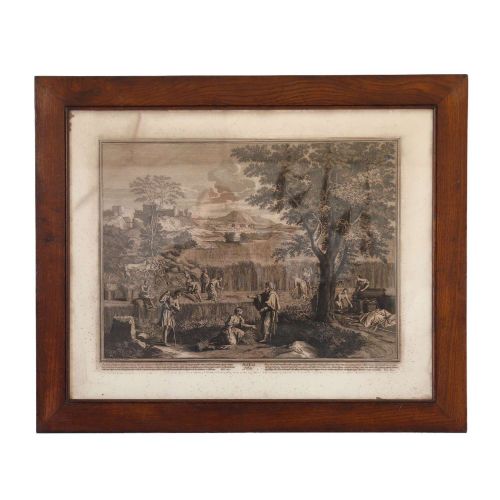
When you examine a vintage harvest landscape, you look at rural scenes depicting haymaking, farming, and agricultural labour across the nineteenth and twentieth centuries. The selection on this page centres on paintings, watercolours, and framed works created during periods from the eighteen-eighties to nineteen-fifties. You will frequently encounter works executed in oil paint and watercolour, capturing rural fields and farmers at work.
British Impressionism and realism dominate the styles seen in these countryside depictions. Artists document specific locations such as Wharfedale, the Grampians, and Hampshire, alongside general pastoral views. These pieces reflect a sustained artistic interest in agrarian life and seasonal farm work.
How they were made
Makers utilised oil paint on canvas and applied watercolour or gouache to paper to create these rural views. Canvases are stretched over wood supports and often housed in gilt or glazed frames, while paper works rely on the fluidity of water-based media. Pigments are brushed with varying degrees of impasto and detail to record light across harvest fields.
The physical construction typically combines traditional artist materials with protective framing in wood and glass. Painters balanced detailed brushwork with broader atmospheric effects, capturing sunset light or stormy skies above the hay cart.
Periods represented range from the nineteenth century through the nineteen-fifties.
What varies in quality
Quality rests in the sureness of the handling and the artist's command of light, atmosphere, and composition. A stronger painting conveys the heat of the day or the heavy stillness of an approaching storm through confident brushwork, whereas weaker examples rely on formulaic repetition without observation. The integration of figures such as loaders, carters, and harvesters into the wider landscape terrain reveals the painter's skill.
Materials also indicate the level of execution, from finely prepared canvases with rich oil paint layers to more modest watercolours on paper. The preservation of the paint surface and the quality of the original wood framing contribute to the standing of an individual piece.
James William Booth·Henry John Boddington·JOHN ATKINSON·William Grant Murray·Helmut Reuter·Walter Williams·Herbert Royle·Rowland Henry Hill·FREDERICK J.KNOWLES·Joseph Paulman·Frederick William Jackson·WALTER DUNCAN·GEORGE HAMILTON CONSTANTINE·William Greaves·David Heward·William Kay Blacklock·George Graham·Reginald Mills·ROBERT THORNE WAITE·JE Hood·Claude Muncaster
The Vintage Harvest Landscape Glossary
- Gouache
- An opaque water-based paint that dries to a matte finish. It allows artists to build solid passages of colour and highlight details on paper.
- Impasto
- Paint applied thickly to a canvas, leaving visible brush or palette knife marks. This technique adds tactile dimension and catches light across the harvest field.
- Watercolour
- Pigments suspended in a water-soluble vehicle, applied to paper to achieve translucent washes. It demands precise control from the painter.
- Gilt
- A thin layer of gold leaf or gold-coloured pigment applied to wood frames. It enhances the visual boundary of the framed artwork.
Vintage Harvest Landscape: Frequently Asked Questions
What subjects appear in these scenes?
These works depict agricultural life, focusing on hay carts, wheat harvesting, farm workers, and rural valleys. Artists recorded the seasonal rhythm of rural labour across British and European countryside locations.
Common motifs include loaded horse-drawn carts, meadows at sunset, and storms gathering over farmland.
How do I date a harvest painting?
Dating relies on artist signatures, period styles like British Impressionism, and accompanying documentation on the frame or backing. Twentieth-century works often show looser brushwork compared to nineteenth-century pieces.
Examining the canvas preparation and framing materials also provides clues to the era of creation.
Where should I hang these artworks?
These pastoral landscapes suit dining rooms, studies, and hallways where natural light complements oil and watercolour media. They pair well with traditional interiors and wooden furnishings.
Keep them away from direct sunlight and damp walls to protect the canvas and paper.
What is the difference between oil and watercolour here?
Oil paintings feature heavier pigment layers on canvas, offering rich texture and depth. Watercolours on paper provide a lighter, more translucent quality under glass.
Both media capture harvest light, but through distinct chemical and physical processes.