


Vintage Globe on Stand
A vintage globe on stand brings the printed geography of past centuries directly into a room, offering both decorative presence and historical cartography.
Vintage Globe on Stand
When searching for a vintage globe on stand, buyers encounter terrestrial and celestial spheres produced across multiple eras, ranging from compact desk versions to large floor-standing examples. The pieces recorded here span centuries of cartographic output, encompassing Victorian table globes, Edwardian schoolroom editions, and interwar geographical models.
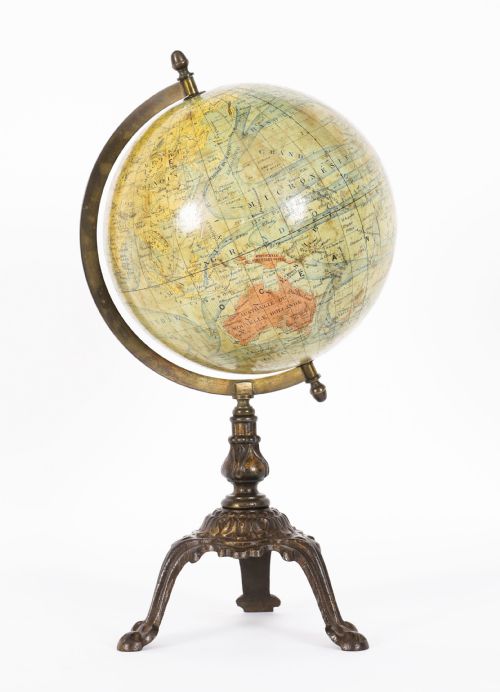
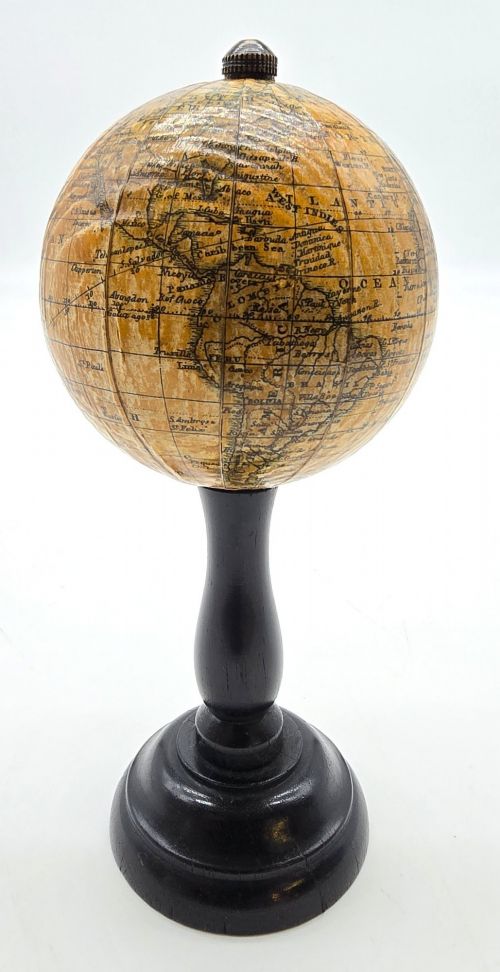
The format typically pairs a paper-mache or glass ball with a dedicated support structure, which can take the form of a heavy brass mount, an ebonised wood pedestal, or a tall floor-standing frame. Among these, table globes and desk globes appear frequently, often resting upon turned wooden stands or metal bases designed to permit smooth rotation.
Geographical origins vary widely across the selection, featuring English makers alongside French terrestrial globes by houses such as Lebegue and J. Forest, as well as German examples. Buyers are most likely to meet mid-sized paper-mache spheres mounted on timber or brass supports dating from the late nineteenth century and the 1930s.
Materials and construction methods
The construction of these globes typically relies on a core of paper-mache or glass, which provides a lightweight yet durable spherical base for the cartography. Printed gores - curved paper strips bearing the map details - are applied by hand to the surface, aligning the meridians and parallels across the sphere.
Support structures combine turned wood, such as mahogany and ebonised wood, with metal components including brass and cast iron for the meridian rings and desk bases. Heavier floor-standing models utilise substantial timber frames or adjustable brass stands to anchor the weight of the globe and allow smooth tilting motions.
The listings span multiple centuries of production, incorporating materials such as brass, cast iron, glass, and mahogany alongside traditional paper-mache spheres.
Distinctions in craftsmanship and condition
Quality in these pieces is dictated by the precision of the cartographic printing, the clarity of the geographical details, and the survival of the original paper gores without significant loss or discolouration. Finer examples exhibit crisp hand-colouring on the map surface and retain their original varnish layers, which protect the paper over decades of use.
The integrity of the stand also dictates the overall standard of the piece, with top-tier specimens featuring substantial turned timber or heavy brass mountings that operate smoothly without structural wobble. Makers who integrated detailed brass half-meridians and precise graduated horizon rings achieved a level of mechanical execution that elevates the object beyond a mere decorative accessory.
Thomas Malby·Lebegue and Cie·J Forest·Geographia·Phillips
The Vintage Globe on Stand Glossary
- Terrestrial globe
- A spherical map representing the earth, showing continents, oceans, and political boundaries. These objects served as both practical reference tools and decorative study furnishings.
- Celestial globe
- A spherical map of the night sky, depicting constellations and stars relative to the earth. They are often found paired with terrestrial globes in floor-standing formats.
- Gores
- The curved, petal-shaped paper strips printed with map details that are pasted onto the globe sphere. Their precise alignment is a key indicator of manufacturing skill.
- Meridian ring
- The metal or wooden ring that encircles the globe, allowing it to tilt on an axis. It is frequently graduated with degrees of latitude.
- Paper-mache
- A composite material made from paper pulp or layers of paper bound with glue, used to form lightweight and durable globe balls. It provides a stable surface for the application of printed gores.
Vintage Globe on Stand: Frequently Asked Questions
How do I read date clues on a globe?
Makers often printed revision years or specific publication dates near the cartouche or legend on the map surface. Changes in national borders and colonial territories also provide clues to the exact manufacturing decade.
Comparing the depicted geopolitical boundaries against historical records helps narrow down the production window when a printed date is absent.
Where should I place a floor globe?
Floor-standing globes require a stable position away from direct sunlight and strong heat sources, which can dry out the paper gores and crack the protective varnish. A study, library, or drawing room provides a suitable environment where the piece can be viewed from all angles.
Ensure the room maintains moderate humidity levels to prevent the wooden stands and paper spheres from warping over time.
How do I care for a paper globe?
Dusting the sphere requires only a soft, dry cloth used very gently across the surface. Avoid using water, chemical cleaners, or abrasive cloths, as these will dissolve the old varnish and ruin the paper gores.
Keep the piece out of direct sunlight to prevent the printed colours from fading.
What is the difference between desk and table globes?
Desk globes are typically smaller models designed to sit comfortably on working surfaces alongside books and writing instruments. Table globes often occupy a slightly larger footprint and feature more substantial wooden or brass bases intended for display on side tables or pedestals.
Both forms serve the same geographical function but vary in scale and the complexity of their mounting stands.