
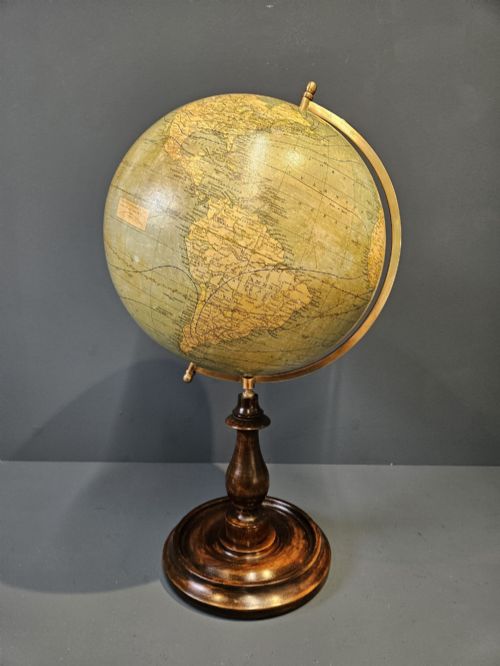


Vintage Terrestrial Sphere
A vintage terrestrial sphere brings the geography of earlier centuries into a room, offering both a decorative anchor and a study of the world as it was understood then.
Vintage Terrestrial Sphere
A vintage terrestrial sphere is an object designed to map the earth, appearing on this page in forms ranging from small desk globes to large floor standing models. These pieces span periods from the Victorian era and Edwardian years through the interwar decades and mid-century.
The version most commonly met here is the desktop globe, often spanning ten to twelve inches in diameter and mounted on stands of wood or metal. Makers such as Bacon and Geographia produced many of these educational and decorative instruments during the early twentieth century.
Floor standing examples also appear, offering a more commanding presence for a library or study. Alongside these sit smaller desk globes and French pieces like the petit globe terrestre, each reflecting the cartography of its specific decade.
Materials and construction
Construction relies on traditional methods, using plaster cores covered with printed paper gores that show the cartography of the world. These spheres are then mounted within brass, metal, or cast iron meridians.
The supporting bases utilise timbers such as mahogany and walnut, providing a stable footing for the desk or floor standing globes. Materials like paper mache also appear in the formation of the lightweight inner spheres.
Listings feature pieces spanning from the nineteenth century through the Edwardian era to the 1960s, constructed in wood, brass, paper, and iron.
Distinctions in quality
Quality rests upon the clarity and detail of the cartographic printing on the paper gores, alongside the precision of the gores' alignment. Finer examples maintain crisp political boundaries and legible place names across the sphere.
The substance of the base and the meridian adds to the character of the piece, with solid mahogany or walnut and heavy brass outlasting lighter metal and simpler woods. The integrity of the plaster sphere beneath the paper also determines the physical stability of the globe.
Bacon·Geographia·Carl Adami·Raths
The Vintage Terrestrial Sphere Glossary
- Gore
- Gore. The printed paper segments shaped like gores that are applied to the sphere to form the map of the earth.
- Meridian
- Meridian. The brass or metal ring that encircles the globe and holds it at the correct axial tilt.
- Plaster
- Plaster. The foundational material moulded into a sphere before the paper map is applied.
- Terrestrial
- Terrestrial. Pertaining to the planet Earth, distinguishing these world globes from celestial spheres that map the stars.
Vintage Terrestrial Sphere: Frequently Asked Questions
How do I date a globe?
Dating relies upon the political boundaries and country names printed on the paper gores, which reflect the geopolitical reality of the year of manufacture. Manufacturers also sometimes included publication dates directly within the cartouche on the sphere.
Additional clues come from the style of the wooden stand and the typeface used for the place names. Comparing the geographical borders to historical maps confirms the specific decade.
Where should I place a floor standing globe?
These larger pieces suit studies, libraries, or spacious hallways where they can stand away from walls as a focal point. They require a stable surface and protection from direct sunlight to prevent the paper gores from fading.
Allowing sufficient room to walk around the stand lets viewers inspect the details of the cartography from all angles. Their substantial presence works well alongside traditional wood-panelled or book-lined rooms.
What is the difference between desk and floor models?
Desk globes are scaled for placement on tables, bureaux, or desks, typically measuring between eight and thirteen inches in diameter. They offer a concentrated view of the world suitable for close study.
Floor standing models incorporate their own tall wooden or metal stands, designed to sit directly on the floor. These larger spheres provide a commanding decorative presence in a room.
How are these globes constructed?
The core is typically formed from moulded plaster or paper mache to create a lightweight yet solid sphere. Printed paper segments, known as gores, are then hand-applied to the surface to map the continents and oceans.
This sphere is mounted within a brass or metal meridian ring, which attaches to a turned wooden or cast iron base. The materials reflect the manufacturing standards of the Victorian, Edwardian, and mid-century periods.