


Vintage Glass Storage Chest
These vintage glass storage chest designs span practical apothecary travel cases and multi-drawer collectors' cabinets.
Vintage Glass Storage Chest
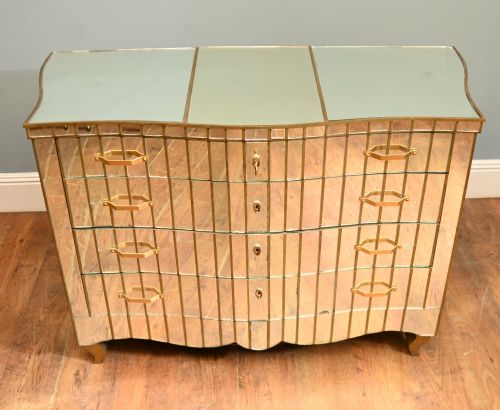
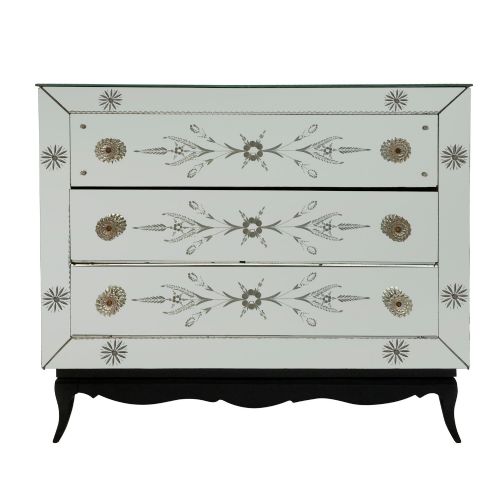
A vintage glass storage chest encompasses multi-drawer collectors' cabinets, apothecary travel cases, and mirrored commodes. Collectors will encounter various forms spanning the Victorian era through the Art Deco period, rendered in solid mahogany, burr elm, and painted pine. These pieces serve to organise small specimens, scientific slides, cigars, or personal items while displaying visible fronts.
The selection here leans heavily towards functional multi-drawer apothecary units and specimen storage, alongside French mirrored commodes. Pieces range from small apprentice chests on turned feet to large forty-drawer cabinets by established makers. Buyers frequently select these items for domestic display or specialised storage of small objects.
Materials and construction
Construction relies primarily on dense hardwoods such as mahogany and burr elm, often paired with brass handles, locks, and glazed or mirrored glass fronts. Cabinetmakers built these pieces to withstand frequent handling, utilising solid timber frames and multiple closely fitted drawers. Surviving examples incorporate specialist compartments, internal bottles, and brass hardware typical of maritime or medical utility.
Surface treatments vary from polished mahogany grains to sign-written painted pine and bevelled mirror plates. Joinery techniques reflect the period of origin, from nineteenth-century dovetailing to twentieth-century industrial framing.
The listings on this page span the Victorian era, 1900, 1910, 1920, 1930, and 1940 periods.
Judging quality in storage chests
Quality rests upon the structural integrity of the timber frame and the precision of the multi-drawer fit. Superior examples exhibit dense grain selection, such as burr elm, and retain original brass fittings, locks, and glass panels without replacement.
The scale and complexity of the piece dictate its standing, with high-drawer counts and signed maker attribution elevating the construction standard. Original internal fittings, such as apothecary bottles or microscope slide trays, separate utilitarian units from exceptional pieces.
Brady of Edmonton
The Vintage Glass Storage Chest Glossary
- Collectors Cabinet
- A multi-drawer piece specifically designed to house and display natural history specimens, geological samples, or microscope slides. These units often feature dozens of shallow drawers.
- Apprentice Chest
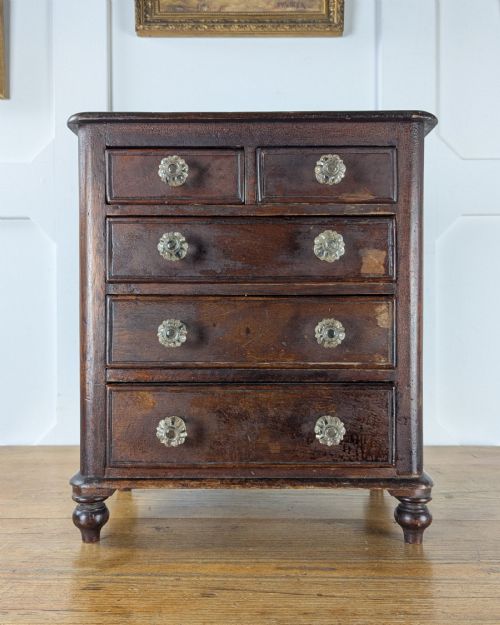
- A small-scale model of a full-size chest of drawers, traditionally made by a joiner to demonstrate proficiency. They replicate standard furniture joints and proportions in miniature.
- Humidor
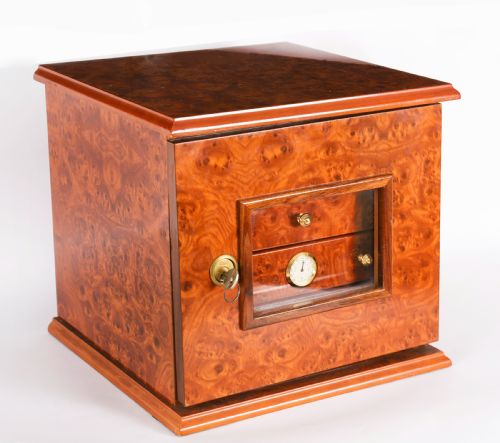
- A specialised storage box or cabinet designed to keep cigars at a constant humidity. Burr elm and mahogany are frequent choices for the exterior housing.
- Apothecary Case
- A portable or stationary chest fitted with internal compartments and glass bottles for storing medicines. These often include secure locks and brass carrying handles.
- Commode
- A low chest of drawers or cabinet, frequently mirrored in French Art Deco interpretations. The term denotes a decorative storage unit for domestic interiors.
Vintage Glass Storage Chest: Frequently Asked Questions
What were multi-drawer collectors cabinets used for?
These cabinets were built for scientists, naturalists, and collectors to organise delicate items like microscope slides, insects, or minerals. The numerous shallow drawers protected fragile specimens from light and dust.
Today, they are utilised in homes to store jewellery, art supplies, or small collections while keeping the contents visible or neatly catalogued.
How do I date a vintage glass storage chest?
Dating relies on examining the timber species, joinery methods, hardware, and overall style. Victorian and Edwardian pieces often feature hand-cut dovetails and solid mahogany, while Art Deco items introduce mirrored glass and stylised geometric forms.
Maker signatures or stamp marks on the timber framework also provide precise manufacturing decades.
Can I use an apothecary chest for modern storage?
These chests adapt readily to contemporary living as desktop organisers, jewellery holders, or bedside units. Their numerous small compartments suit the storage of modern trinkets and daily accessories.
Care should be taken to place them on stable surfaces away from excessive moisture or direct heat to protect the antique wood and glass.
What is the difference between an apprentice chest and a standard chest?
An apprentice chest is significantly smaller in scale, built as a detailed demonstration piece rather than for primary household storage. Despite their diminutive size, they utilise the same construction methods and wood types as full-sized furniture.
They sit easily on tables or desks, functioning purely as decorative display items.