


Vintage Glass Decanter Caddy
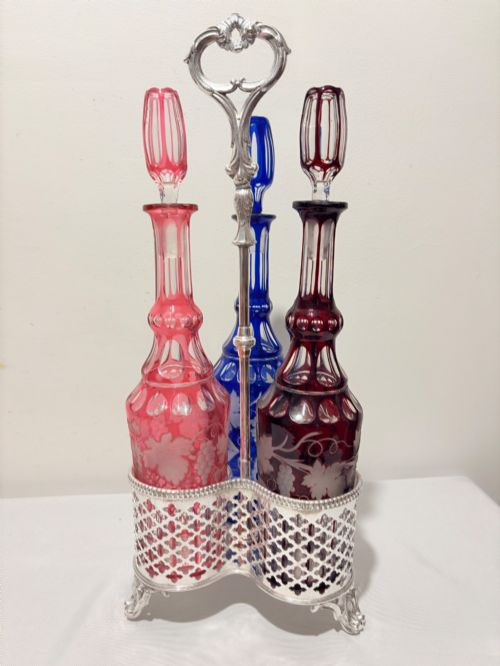
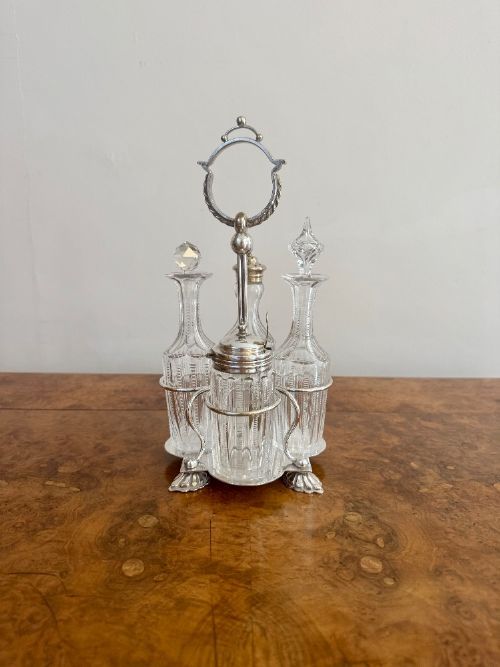
A vintage glass decanter caddy holds spirits securely on the sideboard, combining heavy cut crystal with plated metal frames.
Vintage Glass Decanter Caddy
When searching for a vintage glass decanter caddy, you encounter forms that span from eighteenth-century mahogany carriers to Edwardian oak tantaluses and Art Deco chrome frames. These serving pieces organise glassware and liquor bottles for the dining room or drawing room, frequently incorporating locking mechanisms in later Victorian and Edwardian examples to secure the contents.
The specimens on this page lean heavily towards silver plated and brass mounted oak frames alongside crystal decanters, cruet sets, and liquor caves. You will find pieces originating from nineteenth-century workshops as well as specific regional variants like Irish carriers and French Napoleon III cave à liqueur designs.
How they were made
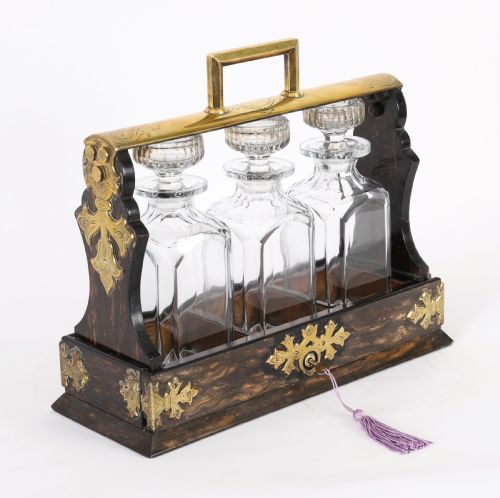
Makers constructed these frames using timber such as oak, mahogany, and coromandel, often mounting them with cast brass or heavy silver plate. Woodworkers joined the bases and carrying handles to withstand the considerable weight of filled glass vessels.
The bottles themselves rely on cut glass, frosted crystal, and coloured glass, shaped through blowing and wheel-cutting. Metal components like handles, lock plates, and bottle collars were cast, chased, and plated to provide durability and a polished finish.
Listings feature periods spanning from the 18th Century through to Art Deco pieces from the 1930s.
What varies in quality
Quality rests primarily in the substance of the metal plating and the density of the timber framing. Thicker silver plate and dense hardwoods like oak or mahogany indicate a higher standard of manufacture that survives decades of handling without structural wobble.
The glass vessels themselves set the upper tier apart through sharp, deep hand-cutting and precise matching between stoppers and bottles. Attributions to known designers or sophisticated locking mechanisms with original keys elevate certain pieces above standard production models.
Wade Wingfield Wilkins·Jacques Adnet
The Vintage Glass Decanter Caddy Glossary
- Tantalus
- A locking drink cabinet that holds decanters securely within a metal bar frame so they cannot be removed without a key. Named after the mythological figure who could not reach food or drink.
- Cruet Set
- A frame holding bottles and jars for condiments, oils, or vinegars, often sharing similar silver-plated and cut glass aesthetics with drink stands.
- Cave à Liqueur
- A French liquor chest, sometimes styled as a Napoleon III or Black Forest box, containing fitted glassware and decanters inside a polished wooden case.
- Silver Plate
- A thin layer of silver fused to a base metal like copper or nickel brass, widely utilised for nineteenth-century and Edwardian frames.
- Coromandel
- A dense, dark exotic timber with striking contrasting grain, utilised for high-end nineteenth-century decanter stands and boxes.
Vintage Glass Decanter Caddy: Frequently Asked Questions
What is a tantalus?
A tantalus is a locking decanter frame designed to keep guests or staff from helping themselves to the spirits inside. The wooden or metal bar locks over the stoppers until opened with a key.
They appeared frequently in late Victorian and Edwardian homes, sitting on sideboards in dining rooms and studies.
How do I date a decanter stand?
Dating relies on the materials, locking mechanisms, and cabinet styles present in the piece. Eighteenth-century versions use simple mahogany frames, while Victorian and Edwardian pieces frequently feature heavy silver plate and oak.
Art Deco examples introduce chrome and modernist lines that separate them clearly from earlier nineteenth-century designs.
Are the stoppers original?
Stoppers often get mixed up or replaced over decades of use and cleaning. You can check originality by looking at the cut patterns and the fit inside the bottle neck.
Matching glass tint and wear marks around the ground glass joint also help confirm if the stopper belongs to that specific decanter.
How do I clean silver plated frames?
Silver plate requires gentle cleaning with a soft cloth and a specialised polish formulated for plated items. Avoid harsh scrubbing that wears away the thin silver layer over the base metal.
Keep moisture away from wooden bases during cleaning to prevent water staining or warping the grain.