

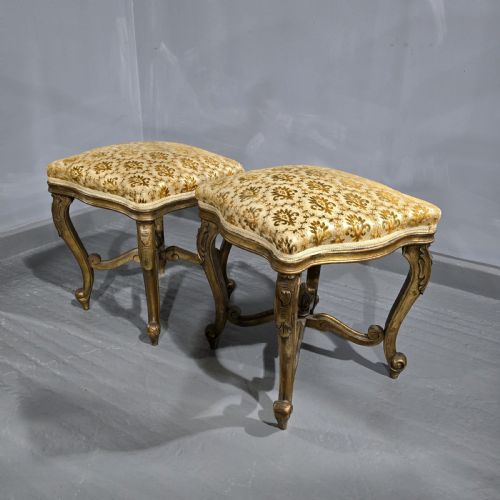


Vintage Giltwood Footstool
A vintage giltwood footstool offers gilded warmth and carved presence, bringing low seating with period character into a room.
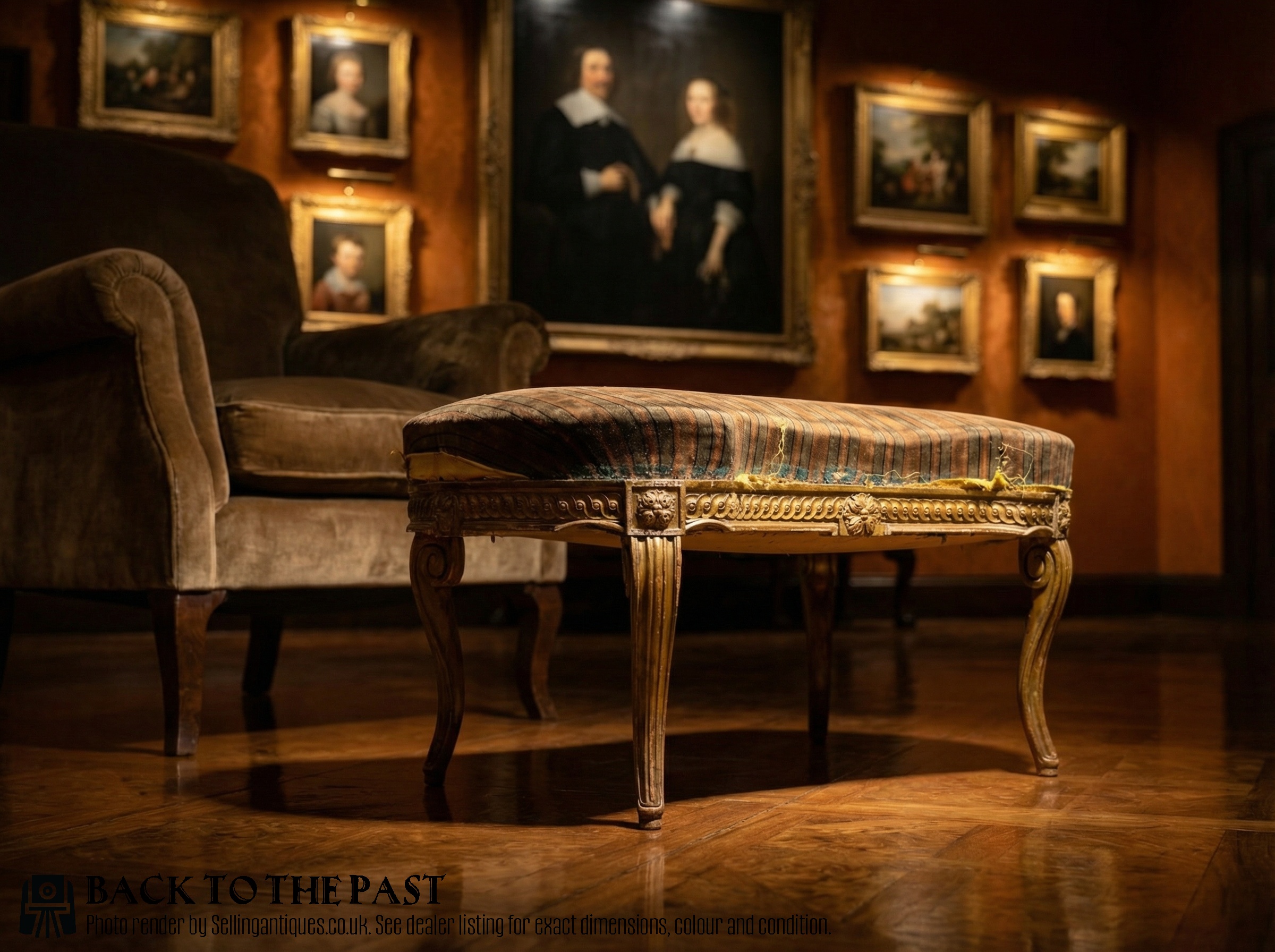
Vintage Giltwood Footstool
When you search for a vintage giltwood footstool, you encounter low seating designed for comfort and display. These pieces range across periods from the nineteenth century into the twentieth century, taking forms such as pairs of stools, curule frames, and low padded seats.
You are most likely to meet pieces finished in the French style or Victorian taste. The selection includes Louis XVI style examples, Louis XV designs, and Regency forms alongside Middle Eastern low stools.
Materials and construction
Construction relies on timber foundations prepared with gesso before application of the gilded surface. Artisans shaped these wooden frames through carving, producing classical details and curved outlines suited to formal interiors.
Upholstery completes the pieces, utilising textiles such as silk, velvet, and traditional fabrics. Deep buttoning and textile covers provide the soft upper surface supported by the gilded wooden base.
Vintage Giltwood Footstool Retail Price Guide 2026
Typical asking prices for vintage giltwood footstool among the pieces listed under this phrase on Sellingantiques today, from the lower quarter to the upper quarter. They describe what is for sale here now, not the wider market.
The listings show items spanning the Victorian era, the nineteenth century, and 1920, incorporating wood, giltwood, gesso, velvet, and silk.
Assessing quality and character
Quality rests in the crispness of the carved detail and the depth of the gilt surface. Hand-carved elements display sharper definition and greater nuance than simpler commercial production.
The integrity of the underlying timber frame and the appropriateness of the upholstery materials determine the lasting appeal of an example. Finer pieces maintain harmonious proportions between the gilded woodwork and the textile top.
Miles & Edwards
The Vintage Giltwood Footstool Glossary
- Giltwood
- Timber that has been gilded with gold leaf or metal leaf over a prepared gesso ground. This finish provides the characteristic metallic brilliance seen on period frames.
- Gesso
- A plaster-like mixture applied to wood to create a smooth surface for gilding and carving. It allows crisp decorative details to be moulded or carved before the gold leaf is laid.
- Curule
- An ancient X-shaped form of stool or chair derived from Roman magistrate seats. This structural design appears in nineteenth-century interpretations with crossed supports.
- Louis XVI style
- A neoclassical design vocabulary characterised by straight lines, symmetry, and classical motifs. Pieces in this manner often feature fluted legs and rectilinear frames.
Vintage Giltwood Footstool: Frequently Asked Questions
What periods do these footstools date from?
The pieces span the nineteenth century and the early twentieth century, including Victorian examples and items dated around 1800, 1870, 1880, 1890, 1900, and 1920.
Design influences range from Regency and Victorian Rococo Revival to French Neoclassical and Middle Eastern styles.
How were these stools used originally?
They served as low seats or footrests in formal reception rooms and parlours, complementing larger armchairs and seating arrangements.
Their decorative gilt surfaces and upholstered tops combined utility with visible display.
What materials make up the frames?
Frames are constructed from timber, often enhanced with gesso layers to prepare the surface for gilding. The resulting giltwood provides a metallic sheen.
Some variations involve painted wood rather than traditional gold leaf finishes.
What upholstery fabrics are found?
Upholstery includes silk, velvet, and various traditional textiles chosen for the upper cushion. Deep buttoning techniques are also present on selected nineteenth-century examples.
These soft coverings contrast with the hard, gilded wooden framework below.