


Vintage Gilt Commode
A vintage gilt commode brings ornamental French or Italian flourish to a room, offering both decorative presence and practical storage.
Vintage Gilt Commode
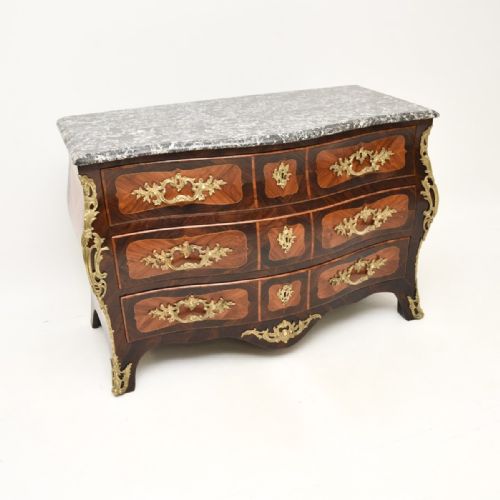
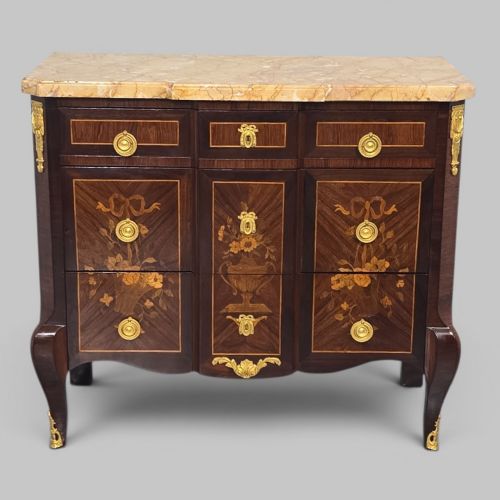
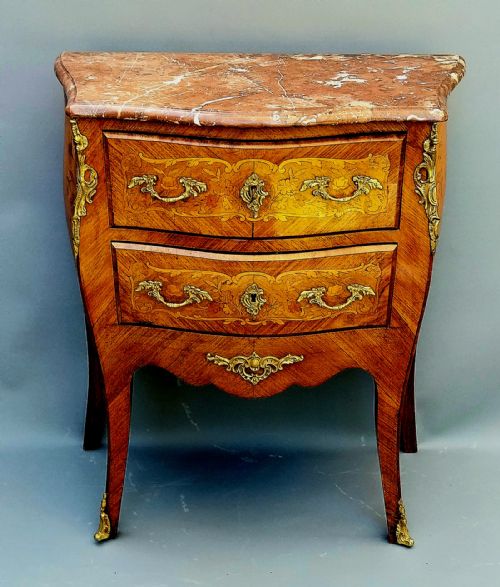
A vintage gilt commode is a low storage unit, typically formed as a chest of drawers, side cabinet, or bedside table with decorative gold leaf or ormolu mounts. When searching for a vintage gilt commode, buyers encounter pieces primarily originating from French and Italian workshops across the eighteenth, nineteenth, and early twentieth centuries.
The selections span distinct continental styles, including Louis XV, Louis XVI, Italian Rococo, and French Transitional designs. Common forms range from serpentine and bombe shapes to straight-fronted chests featuring marble tops and detailed marquetry inlay.
How they were made
Construction relies upon solid timber frames layered with decorative wood veneers such as kingwood, rosewood, walnut, satinwood, and burr walnut. Skilled cabinetmakers shaped these timbers into curved bombe profiles and fitted them with fitted marble slabs.
Surface ornamentation integrates hand-applied paint, intricate marquetry inlay, and cast brass or ormolu mounts. Gilding and giltwood carving provide the characteristic metallic sheen that defines the aesthetic of these decorative cabinets.
Some commodes hide secret locking drawers designed to keep love letters and family jewels safely away from curious guests.
What varies in quality
Quality rests upon the precision of the cabinetmaker's joinery, the depth of the wood veneers, and the crispness of the cast ormolu mounts. Finer examples display meticulous hand-cut marquetry and heavy, finely chased bronze or brass details rather than light pressings.
The choice of top material also signals grade, with thick, heavily veined marble slabs elevating a piece above simpler painted timber surfaces. Structural integrity in the curved carcass and drawer sides separates standard production from superior craftsmanship.
Jacques Bircklé
The Vintage Gilt Commode Glossary
- Ormolu
- Cast bronze that has been mercury gilded to achieve a bright gold finish. It appears as decorative mounts and handles on fine continental furniture.
- Bombe
- A swelling, outward-curved furniture profile associated with rococo design. This curved contour requires advanced woodworking skill to execute properly.
- Marquetry
- The art of applying small pieces of veneer to a structure to form decorative patterns and pictorial scenes. Makers utilised contrasting timbers to achieve naturalistic shading.
- Serpentine
- A furniture front or top shaped with a central convex curve flanked by two concave curves. This undulating line creates movement across the face of a cabinet.
Vintage Gilt Commode: Frequently Asked Questions
How do I clean a marble top?
Wipe the marble surface regularly with a soft damp cloth using neutral soap. Avoid acidic cleaners or lemon juice which etch the stone.
Dry the surface completely after washing to maintain the polish and prevent water marks from setting into the porous stone.
Where should I place a commode?
These decorative cabinets work well in hallways, living rooms, or bedrooms as statement storage pieces. Position them away from direct sunlight and heat sources to protect the wood veneers and prevent timber cracking.
Ensure the room maintains stable humidity levels to preserve the integrity of the antique glue and gilt surfaces.
How do I identify a Louis XV style?
Look for asymmetrical ornamentation, cabriole legs, and sweeping serpentine curves. The style favours natural motifs such as acanthus leaves and floral scrollwork.
Structural lines remain soft and flowing, avoiding rigid geometric angles in favour of organic grace.
Are these pieces suitable for daily use?
Yes, drawers and cupboards function effectively for modern storage needs. Treat the antique surfaces with care by using coasters on marble tops and avoiding excessive weight in the drawers.
Gentle handling ensures the delicate veneers and gilt mounts remain intact for years to come.