
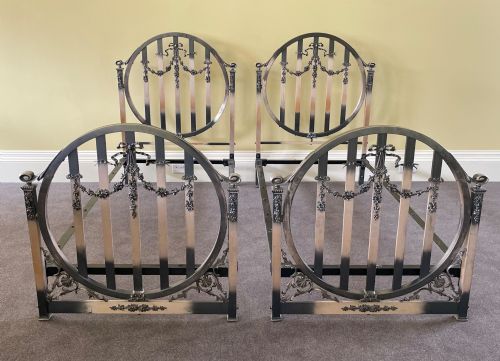


Vintage French Single Beds
Vintage french single beds bring continental charm to guest rooms, offering historic timber frames and ironwork suited to compact spaces.
Vintage French Single Beds
Vintage french single beds encompass single sleeping frames and bedsteads originating from continental Europe, spanning periods from the nineteenth century through the early decades of the twentieth century. These pieces emerge in styles such as Louis XVI, Empire, Rococo Revival, and Art Nouveau, reflecting distinct historical design movements.
Buyers frequently encounter pairs and individual examples fashioned from woods like walnut, fruitwood, and mahogany, alongside painted finishes and metal constructions like wrought iron and brass. Forms range from traditional no-end designs and corbeille shapes to platform beds and upholstered variants.
The selection includes continental and Portuguese pieces alongside French items, demonstrating regional stylistic variations in carving, upholstery, and metalwork while maintaining the scale appropriate for single sleepers.
Materials and Construction
Cabinetmakers utilised hardwoods such as walnut, mahogany, and fruitwood for carved wooden frames, applying parquetry and painted finishes to enrich the surfaces. Iron and brass provided robust structural alternatives, seen in cast and wrought iron frames as well as polished brass components.
Upholstery and textile panels formed integral elements of construction, featuring in padded headboards and leather inserts secured within timber frames. Metal plating, such as nickel, appeared on specific Edwardian and Art Nouveau examples to impart a durable metallic lustre.
Assessing Quality and Execution
The calibre of a bed rests upon the crispness of hand-carved wood ornamentation and the integrity of the underlying timber joinery. Superior examples display harmonious proportions across headboards and footboards, where decorative motifs align with historical style conventions rather than appearing generic.
Metalwork quality shows in the weight of cast iron, the solidity of brass assemblies, and the evenness of applied plating or paint finishes. Selection of fine timbers, such as figured walnut or detailed parquetry work, distinguishes higher-grade commissions from simpler utilitarian frames.
The Vintage French Single Beds Glossary
- Bedstead
- A framework of wood or metal that supports a mattress and forms the structure of a bed. It often incorporates decorative headboards and footboards.
- Corbeille
- A French bed style featuring curved, basket-like ends that wrap slightly around the mattress. This form is frequently associated with twentieth-century painted furniture.
- Louis XVI Style
- A neoclassical design aesthetic characterised by straight lines, symmetrical ornamentation, and classical motifs such as fluting and ribbons. It dates back to the eighteenth century but heavily influenced later nineteenth and twentieth-century revivals.
- Parquetry
- Geometric wood mosaic work used for decorative surface inlay on furniture panels. Craftsmen arrange small veneer pieces to form repeating patterns.
- No End
- A bed configuration possessing a headboard but lacking a high footboard, creating an open appearance suitable for restricted spaces.
Vintage French Single Beds: Frequently Asked Questions
How do I fit a modern mattress?
Many vintage french single beds accommodate standard single or continental single mattresses, though historical dimensions can vary slightly from contemporary standards. Checking internal frame measurements ensures proper placement before obtaining a mattress.
Custom mattress options or adjustments to modern bed bases allow older frames to function comfortably with contemporary bedding.
Are pairs common for these beds?
Listings frequently feature matching pairs of single beds, which originated for shared guest rooms or twin chambers in grand houses. These pairs share identical wood types, carved details, or painted finishes.
Securing matched pairs offers a uniform aesthetic for larger bedrooms, whereas individual pieces suit smaller or standalone spaces.
What maintenance do painted wooden frames need?
Painted wooden surfaces require gentle dusting with a soft cloth and protection from direct sunlight to prevent finish degradation. Avoiding harsh chemical cleaners preserves the integrity of antique paintwork and underlying gesso.
Periodic inspection of joints and fixings ensures the structural stability of timber frames during everyday use.
How do I identify the period?
Period attribution relies on stylistic indicators, such as the curved asymmetry of Rococo Revival or the linear geometry of Art Nouveau and Louis XVI revivals. Material choices and construction techniques also provide chronological clues, distinguishing nineteenth-century hand-carved walnut from later twentieth-century painted pieces.
Comparing decorative hardware and upholstery methods helps narrow down the exact decade of manufacture.