



Vintage French Office Table
A vintage french office table brings architectural form and practical workspace together, offering a distinct centrepiece for a study.
Vintage French Office Table
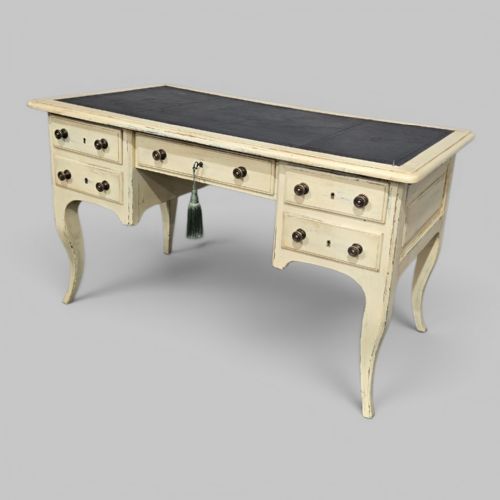
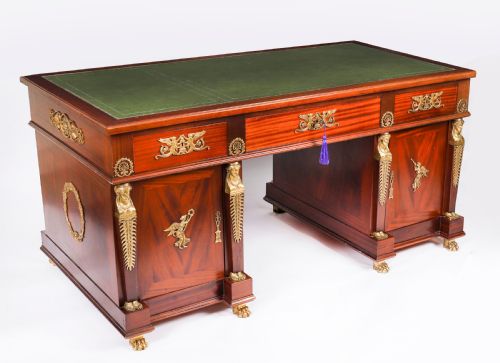
A vintage french office table encompasses writing tables, bureau plat desks, and kneehole desks originating from various periods including the nineteenth century and the nineteen-thirties. These pieces combine utility with decorative presence, often featuring finished backs that allow them to sit freely in the middle of a room.
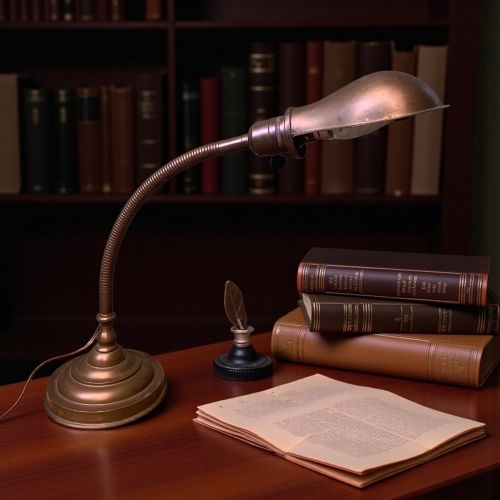
The selection here ranges from restrained nineteenth-century mahogany writing tables to nineteen-thirties Art Deco designs incorporating bakelite and chrome. Buyers will also encounter specialised lighting such as brass desk lamps and adjustable desk lights that complement these workspaces.
The aesthetic vocabulary spans French Empire, Louis XVI style, and French Provincial, alongside industrial interpretations. This variety ensures that a vintage french office table can anchor both formal period interiors and contemporary minimalist schemes.
What varies in quality
Quality rests in the harmony of proportion, the crispness of ormolu mounts, and the integrity of timber veneers such as burr walnut and faded mahogany. Finer examples display meticulous attention to secondary timbers and the precision of brass inlay work.
The degree of original preservation significantly influences the standing of a piece, especially regarding leather inserts and patinated metal surfaces. Desks retaining their original hardware and structural stability demonstrate superior workshop origins.
Materials span traditional hardwoods like kingwood and walnut alongside industrial chrome, bakelite, and brass.
Eileen Grey·Étienne Kohlmann·Pirouette·Jumo
The Vintage French Office Table Glossary
- Bureau plat
- A freestanding writing table, typically featuring drawers across the frieze and a leather-lined top, designed to be viewed from all sides. These tables became prominent during the seventeenth and eighteenth centuries in France.
- Ormolu
- Gilded bronze applied as decorative mounts on furniture and lighting fixtures. This technique enhances the visual richness of nineteenth-century pieces.
- Kneehole desk
- A desk featuring a central recess for the user's legs, flanked by pedestals of drawers. This form provides substantial storage capacity while maintaining a compact footprint.
- Kingwood
- A dense, richly figured timber native to Brazil, prized by cabinetmakers for decorative veneers. It often exhibits contrasting dark and golden brown tones.
Vintage French Office Table: Frequently Asked Questions
How do I choose the right size desk?
Consider the proportions of your room and whether the desk will sit against a wall or float in the centre of the space. Freestanding bureau plat models require clearance on all sides to appreciate their finished backs.
Measure your available floor area carefully, leaving adequate space for a chair to pull out comfortably. Compact writing tables suit smaller studies, while pedestal desks offer extensive surface area and storage.
Are these desks suitable for daily computer work?
Many vintage writing tables and pedestal desks provide ample surface depth and sturdy construction to accommodate modern desktop equipment or laptops. However, internal drawer dimensions in older pieces may require careful checking for keyboard storage.
Protecting the leather or wood writing surface with a blotter or desk pad helps preserve the original finish during everyday office use.
How do I identify a Louis XVI style desk?
Louis XVI style pieces typically exhibit neoclassical restraint, characterised by straight tapered legs, fluting, and symmetrical geometric mounts in ormolu. Unlike the curving lines of earlier Louis XV furniture, these desks emphasise architectural straight lines and classical proportions.
Look for rectangular top formats and restrained brass or bronze enrichment rather than elaborate scrolling ornamentation.
What maintenance do leather desk inserts need?
Leather writing surfaces benefit from occasional cleaning with a slightly damp cloth followed by a neutral leather cream to prevent drying and cracking. Avoid using harsh chemical cleaners or excessive water, which can stain the hide and damage the surrounding wood.
Keeping direct sunlight away from the desk prevents the leather colour from fading unevenly over time.