


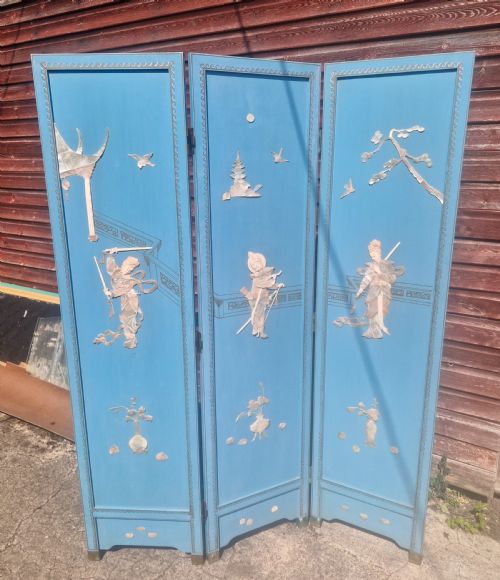


Vintage Folding Partition
A vintage folding partition divides a room or frames a corner with hinged panels spanning centuries of craft and global design.
Vintage Folding Partition
A vintage folding partition serves to divide a room, screen a dressing area, or anchor a corner, appearing in formats from three-fold frames to grand eight-leaf panels. When you search for a vintage folding partition, you encounter freestanding room dividers and privacy screens originating from diverse global traditions, spanning the nineteenth century through the early decades of the twentieth.
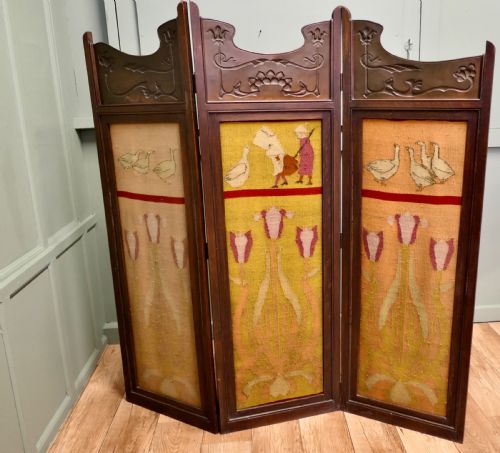
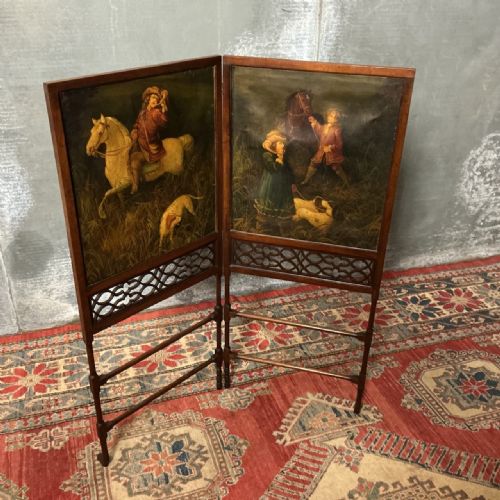
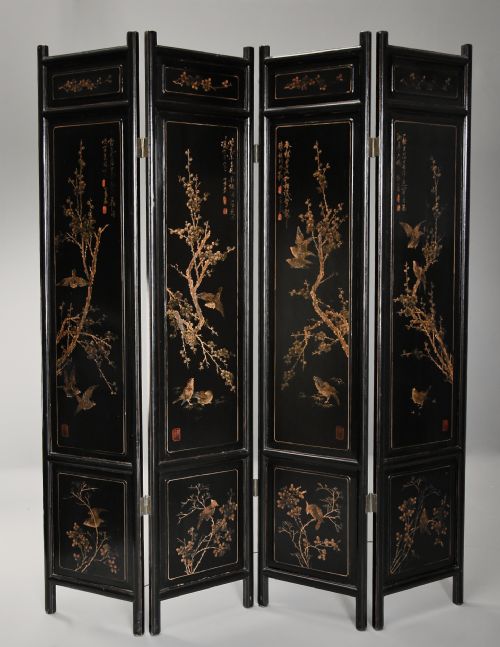
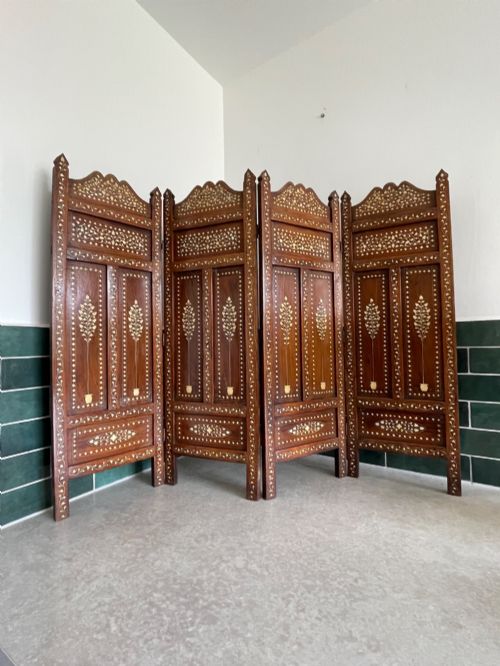
The selections here range from substantial Chinese lacquered screens and intricate Indian carved woodwork to British Arts and Crafts oak frames and Edwardian mahogany vanity dividers. Many pieces function as room dividers and folding screens, while others take the form of smaller table screens or fire screens.
Periods represented stretch from the Victorian and Edwardian eras back to the eighteenth century, incorporating Chinoiserie, Art Nouveau, and Persian styles. Each folding partition relies on hinged panels that allow the piece to angle across a floor or flatten against a wall.
Materials and technique
Construction relies heavily on timber frames built from mahogany, oak, walnut, padauk, and assorted hardwoods, joined by hinges to form multiple leaves. Woodwork often incorporates fretwork, carving, or inlay to articulate the structure of each panel.
Surface decoration defines many examples through black and coloured lacquer, gilding, hand-painted leather, oil paintings, and giltwood. Fabric elements appear in wool panels, needlepoint, silk, and William Morris velvet, alongside glazed glass panels and decorative copper.
One debating society utilised an oak-framed panel to partition discussions, proving that even arguments occasionally require proper boundaries.
Judging the work
Quality reveals itself in the depth of hand-carving, the crispness of fretwork, and the execution of painted or lacquered surfaces. Superior examples demonstrate accomplished artistry in oil paintings, needlepoint, or gilt leather rather than mechanical repetition.
The integrity of the frame construction and the smoothness of the folding mechanism separate standard pieces from exceptional ones. Heavier woods like padauk and mahogany provide robust structural support for large multi-fold panels.
The Vintage Folding Partition Glossary
- Folding partition
- A movable screen composed of multiple hinged panels used to divide spaces or provide privacy. These objects stand independently on floors or sit upon tables.
- Chinoiserie
- European interpretations of Chinese and East Asian artistic traditions, frequently expressed through lacquer and gilt decoration. This style appears prominently on eighteenth and nineteenth-century screens.
- Fretwork
- Ornamental perforated woodwork created by cutting patterns through a board. Indian and Victorian screens frequently employ this technique to lighten heavy panels.
- Lacquer
- A durable resin finish applied in multiple layers and polished to a smooth sheen. Chinese and Japanese panels use this technique to depict pictorial scenes.
- Padauk
- A dense tropical hardwood prized for its rich colour and durability. Makers utilised this timber for substantial carved screens.
Vintage Folding Partition: Frequently Asked Questions
How are folding partitions used in a modern interior?
These pieces function to zone open-plan spaces, create privacy in a bedroom, or conceal utilitarian areas. They stand independently and move easily to alter room layouts.
Their decorative panels also serve as visual art against a plain wall when folded flat.
What is the difference between a room divider and a table screen?
Room dividers are tall, freestanding structures designed to stand on the floor and partition human-scale spaces. Table screens are miniature versions meant to sit atop desks, tables, or sideboards.
Both types utilise hinged panels but serve entirely different spatial scales.
How do I identify an Edwardian screen?
Edwardian pieces often feature mahogany frames, sometimes incorporating inlaid stringing, oil paintings, or mirrored and glazed sections. They reflect the lighter furniture styles popular in the early twentieth century.
These screens frequently served as dressing room vanity dividers.
What materials are common in lacquer screens?
Lacquer screens typically employ a wooden core finished with multiple coats of resin, painted and gilded with pictorial scenes or floral motifs. Black and coloured grounds predominate in East Asian examples.
The technique yields a hard, lustrous surface that resists wear.