
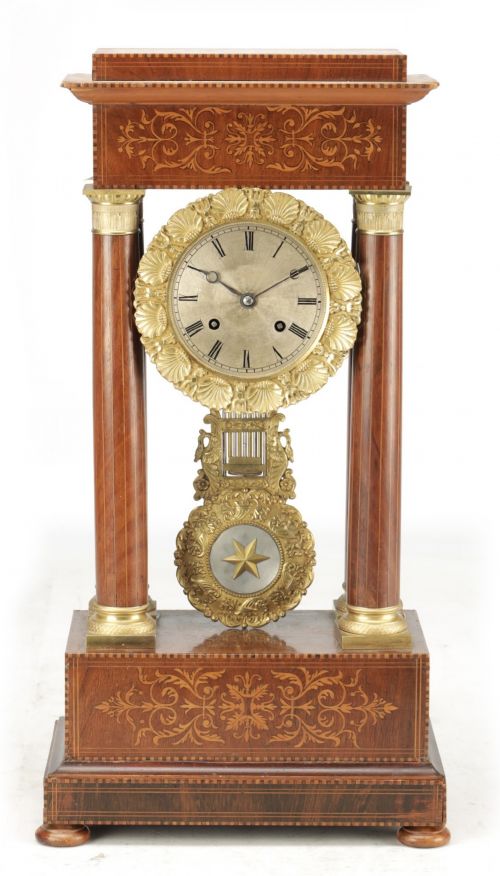


Vintage Floral Table Clock
These vintage floral table clock pieces bring together brass, enamel, and marquetry inlay across Victorian and Edwardian periods for practical timekeeping.

Vintage Floral Table Clock
A vintage floral table clock serves as both a practical timepiece and a decorative object for the home, typically designed to sit upon a mantelpiece, shelf, or table. When searching for a vintage floral table clock, buyers encounter various forms ranging from porcelain and portico designs to carriage clocks and bracket styles.
The pieces listed on this page span the Victorian and Edwardian eras, extending into the 1920s and 1930s. The most common manifestations include French mantel clocks and Edwardian inlaid wooden timepieces featuring botanical motifs or floral marquetry.
Makers such as Henry Marc, Savory & Fils A Paris, Marti, and Malecot appear within the evidence, alongside French and English workshops. These makers produced works reflecting stylistic movements from Rococo Revival and Art Nouveau to Art Deco.
Materials and construction methods
Makers utilised a variety of woods including rosewood, mahogany, satinwood, and oak as the foundational structures for wooden mantel clocks. Many of these timber cases feature intricate marquetry inlay, depicting floral subjects such as poppies alongside geometric patterns.
Metalwork played a central role, with brass, gilt bronze, ormolu, and silver utilised for bezels, cases, and decorative mounts. Enamel and porcelain dials or panels added coloured surface detail, frequently ornamented with painted floral designs.
Glass protected the delicate dials of carriage clocks and portico clocks, while specialised movements drove the timekeeping mechanics within each housing.
Materials across these listings include rosewood, mahogany, brass, enamel, porcelain, and gilt bronze.
Distinctions in quality and execution
The standard of a vintage floral table clock depends heavily upon the precision of the cabinetwork and the execution of any floral marquetry inlay. Finely cut veneers and tightly fitted wooden joints separate superior examples from standard production pieces.
The refinement of the metal casting and the clarity of enamel or painted porcelain dials also dictate value. Pieces featuring signed movements by established makers like Henry Marc or Malecot demonstrate a higher degree of horological and decorative ambition.
Henry Marc·Savory & Fils A Paris·Marti·Malecot of Paris
The Vintage Floral Table Clock Glossary
- Mantel clock
- A clock designed to sit on the mantelpiece above a fireplace. These timepieces are typically portable and housed in decorative wooden, metal, or ceramic cases.
- Marquetry inlay
- Decorative woodwork where small pieces of veneered wood are fitted together to form patterns or pictures. On these clocks, marquetry frequently depicts floral subjects.
- Ormolu
- Gilt bronze produced by applying a finely ground high-carat gold-mercury amalgam to a bronze object. The technique creates a rich golden finish common on French decorative clocks.
- Portico clock
- A clock featuring a architectural case supported by columns, resembling a miniature temple portico. These examples often utilise polished wood and gilt metal mounts.
- Carriage clock
- A small, portable spring-driven clock developed for travelling officers. They usually feature glass panels allowing the movement to be observed.
Vintage Floral Table Clock: Frequently Asked Questions
Where should I place a mantel clock?
Mantel clocks are traditionally placed on a fireplace mantel, though they sit equally well on sideboards, bookshelves, or dedicated tables in a room.
Ensure the surface is stable and level to keep the internal pendulum or movement operating accurately.
How do I wind a mechanical clock?
Mechanical clocks use a key inserted into winding arbors on the dial face to tension the internal springs or weights.
Turn the key gently until you feel resistance, taking care not to overwind the mechanism.
How do I identify an Edwardian clock?
Edwardian clocks date from the early twentieth century and frequently combine mahogany or satinwood cases with subtle inlay work.
Many incorporate design elements from the Art Nouveau movement alongside traditional proportions.