
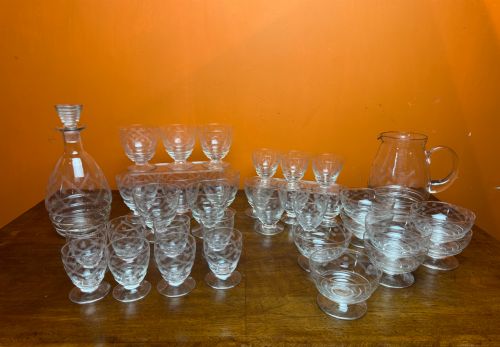


Vintage Etched Glass Stemware
Vintage etched glass stemware brings crisp pattern and period weight to the table, spanning Victorian goblets and French Art Deco suites.
Vintage Etched Glass Stemware
When you search for vintage etched glass stemware, you encounter drinking glasses, wine glasses, and champagne coupes shaped across the Victorian, Georgian, and Art Deco eras. These pieces range from solitary 18th-century gin glasses to large suites numbering dozens of drinking vessels.
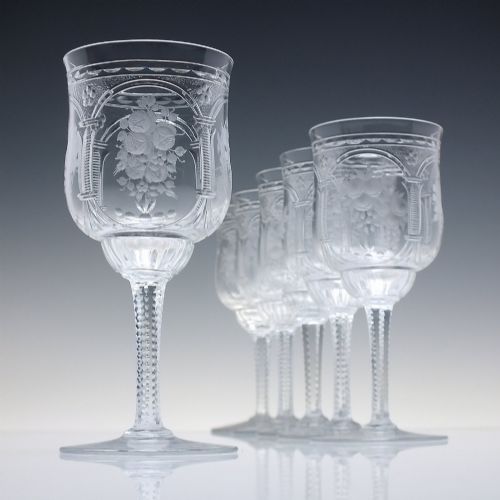
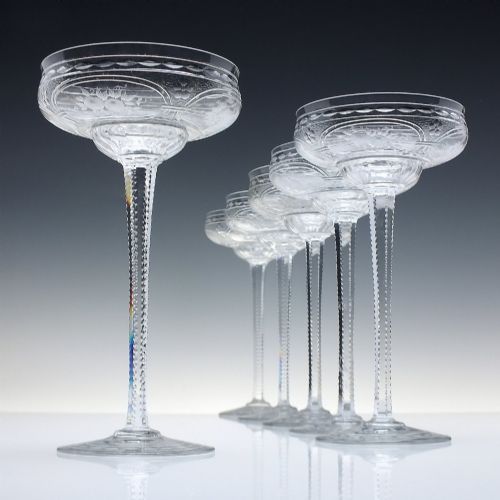
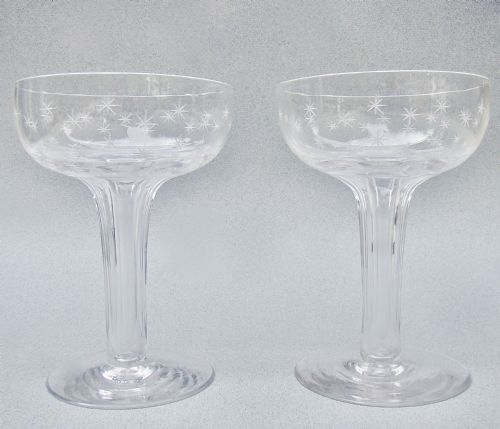
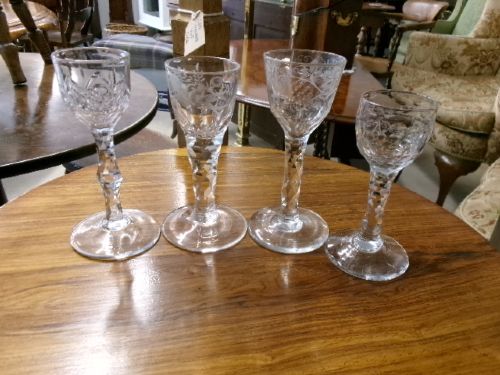
The versions you meet most often on this page are Victorian wine glasses and larger sets of champagne coupes, alongside 1930s continental drinking glasses. Forms vary from hollow stem champagne glasses and dessert wine glasses to tall chalices and faceted stemmed drinking glasses.
Origins stretch from English workshops to French suites and Scandinavian designs, crossing styles such as Victorian, Georgian, Edwardian, Jugendstil, and Art Deco. Each period brings distinct proportions and decorative motifs to the table, from fruiting vines to geometric cuts.
Materials and methods
The primary material across these listings is glass, encompassing lead glass, lead crystal, crystal, and clear glass alongside coloured variants like ruby glass and amber glass. Hand-blown glass forms the foundation of many pieces, providing the organic weight expected of older tablewares.
Decoration is achieved through engraving, etching, and acid cutting to bite patterns permanently into the bowl, stem, or foot. Makers apply these techniques to create floral motifs, star patterns, and fruiting vines that catch the light across the surface.
A solitary 18th-century gin glass sits comfortably alongside large suites of thirty-four French drinking glasses.
Distinctions in quality
Quality rests on the clarity of the material, whether clear glass, lead crystal, or layered red over crystal. Heavier lead content and hand-blown execution separate substantial table pieces from simpler production.
The crispness and depth of the engraving or acid cutting dictate visual merit, as does the uniformity across a matched suite of drinking glasses or champagne coupes. Intricate execution on bowls and foot bases distinguishes finer examples.
Stevens & Williams·Riihimaki·Adelbert Niemeyer
The Vintage Etched Glass Stemware Glossary
- Stemware
- Drinking vessels raised upon a stem and foot base. This category includes wine glasses, champagne coupes, and goblets.
- Champagne Coupe
- A shallow, broad-bowled glass traditionally utilised for champagne and dessert wines. Many vintage examples feature engraved bowls and foot rims.
- Lead Crystal
- Glass containing metallic oxide to increase weight, refractive brilliance, and sonority. It forms the body of many finer vintage drinking glasses.
- Acid Cutting
- A decorative technique applying acid to eat away exposed areas of the glass surface. This method produces crisp, detailed patterns such as cameos and foliage.
- Harlequin Set
- A collection of drinking vessels that match in form or period while varying in colour or minor decorative detail. They offer a mixed display for the dining table.
Vintage Etched Glass Stemware: Frequently Asked Questions
How do I clean vintage etched glass?
Wash by hand in warm water using mild soap, avoiding sudden temperature changes to protect the material.
Dry immediately with a lint-free cloth to maintain the clarity of the clear glass, lead crystal, or ruby glass.
Can I use these glasses daily?
Many vintage drinking glasses and wine glasses remain robust enough for regular dining use when handled with proper care.
Hand-blown glass and delicate crystal benefit from mindful placement and storage away from crowded cupboards.
How do I date an etched glass?
Examine the weight, material composition, and silhouette alongside the style of the engraving, whether Victorian, Georgian, or Art Deco.
Hand-blown characteristics and pontil marks on older pieces often point towards 18th-century or 19th-century origins.
What is the difference between etched and cut glass?
Etching and acid cutting create shallow surface patterns through chemical application or light scratching.
Cutting uses wheels to grind deeper facets into the glass body, producing distinct geometric planes.