

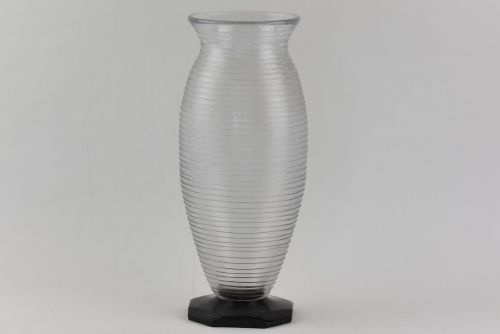


Decorative Etched Glassware
Decorative etched glassware brings texture and light into a room, offering tactile frosted surfaces and crisp engraved motifs that collectors prize.
Decorative Etched Glassware
When you search for decorative etched glassware, you encounter sculptural vessels, delicate chalices, and functional tableware produced across several decades. The selection centres on distinctive twentieth-century movements, showcasing pieces designed for display.
You are most likely to meet striking Art Deco vessels alongside sinuous Art Nouveau examples featuring naturalistic plant motifs. Forms range from heavy moulded candlesticks to slender vases and decorative bowls.
Origins span British and continental European workshops, reflecting varied aesthetic traditions from Victorian classicism to mid-century modern minimalism. These items function primarily as decorative centrepieces rather than everyday utilities.
Materials and production methods
Makers utilised techniques such as acid-etching and cameo layering to build depth and contrast across the glass surface. Acid-cut carving removed outer layers of coloured glass to reveal contrasting backgrounds beneath.
Clear, frosted, and blown glass served as foundational canvases for intricate surface decoration. Molten material was shaped through moulding or free-blowing before undergoing chemical or mechanical engraving processes.
Current listings span periods from 1890 to 1930, featuring cameo glass, acid-etched glass, and blown glass forms.
Assessing craftsmanship and quality
The distinction between standard production and exceptional work rests on the precision of the engraved detail and the depth of the cameo layers. Superior examples display crisp, controlled lines where chemical or physical cutting achieves precise tonal gradations.
Weight and balance also indicate quality, as finer vessels maintain uniform wall thickness despite complex surface carving. The clarity of the base material and the harmony between form and decorative motif determine overall desirability.
Venini·Rene Lalique·Daum·Karl Palda·Galle·Stevens and Williams·Paul Nicholas·Adelbert Niemeyer
The Decorative Etched Glassware Glossary
- Cameo Glass
- Glass formed with multiple layers of different colours fused together, then carved or acid-etched to create a raised design. This technique requires immense skill to avoid breaching the inner layer.
- Acid-Etched Glass
- Glass treated with hydrofluoric acid to eat away exposed surfaces, producing a frosted finish or recessed pattern. It allows for intricate, repeatable designs without manual engraving.
- Frosted Glass
- Glass with a translucent, matte surface created by acid-treatment or sandblasting. It diffuses light gently and softens the overall appearance of the vessel.
- Jugendstil
- The German and Central European variant of Art Nouveau, emphasising linear grace and stylised natural forms. Objects in this style often feature organic curves and botanical motifs.
Decorative Etched Glassware: Frequently Asked Questions
How do I distinguish Art Nouveau from Art Deco pieces?
Art Nouveau pieces feature fluid, asymmetrical lines inspired by natural forms such as flowers, vines, and landscapes. The colour palette often relies on earthy tones, orange, and delicate shading.
Art Deco design favours geometric precision, symmetry, and stylised motifs with sharp angles and clean contours. Vessels from this later period frequently showcase bold contrasts and streamlined silhouettes.
Where should I display these glass items?
Position your glassware on sturdy surfaces near natural light sources to accentuate the carved details and frosted textures. Glass shelves within illuminated cabinets offer stability while allowing light to pass through the vessel from behind.
Keep pieces away from direct, intense sunlight for prolonged periods to protect coloured glass from fading. Ensure they sit safely out of the path of household traffic to prevent accidental knocks.
What does cameo glass mean?
Cameo glass refers to vessels made with two or more distinct layers of coloured glass fused together during blowing. The outer layer is partially carved away, leaving a raised design that stands out against the contrasting background colour.
This method draws inspiration from ancient carved gemstone cameos. Achieving a successful piece demands precise control over the depth of the acid or cutting tools.