


Vintage Enamel Cuff Links
These vintage enamel cuff links bring sharp geometric colour and enduring metalwork straight from the wristwear of the twentieth century.
Vintage Enamel Cuff Links
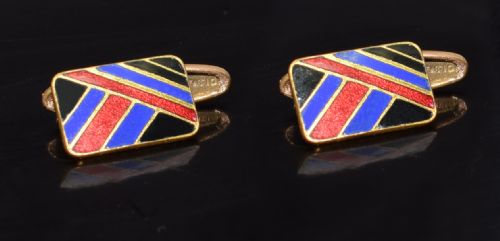
Vintage enamel cuff links span decades of gentleman's and lady's attire, appearing most frequently as matching pairs from the Art Deco period. You will encounter them set with bold green and black enamel work, alongside modernist designs shaped in England and beyond.
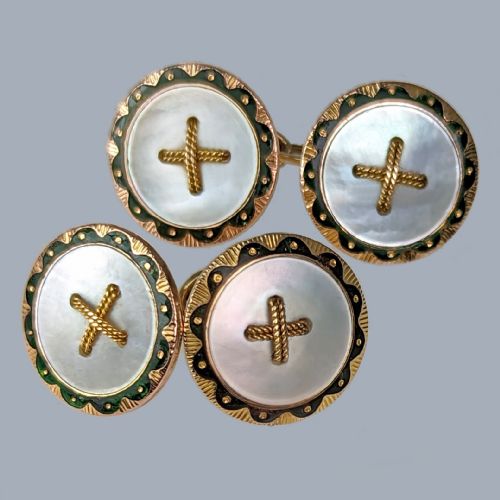
Earlier examples stretch back to the Edwardian and Belle Epoque eras, often combining mother of pearl with delicate yellow gold. Mid-century and Scandinavian modern pieces also emerge, sitting alongside occasional novelty shapes from the later archives.
How they were made
The makers combined vitreous enamel and standard enamel with precious metals including silver, silver plate, 9ct gold, and 18ct yellow gold. Chrome and brass also provide the structural foundation for industrial modernist styles.
Techniques relied on fusing coloured glass powders onto metal bases under high heat, securing smooth surfaces that held vibrant tones for generations. Artisans mounted these decorated faces onto secure toggle and rigid bar fittings.
The archive holds a diminutive Austin Mini, proving that someone once decided their cuffs needed a tiny British motor car.
What varies in quality
Quality rests upon the crispness of the geometric lines and the depth of the vitreous enamel surface. Stronger examples display tight colour saturation without heavy surface pitting or dulling.
The choice of base metal distinguishes standard production from high-end jewellers, moving from chrome and brass up to hallmarked gold and silver frames.
Solomon Blanckensee Son·Jakob Bengel·Taye Kenning Spencer Ltd·Cartier
The Vintage Enamel Cuff Links Glossary
- Vitreous Enamel
- Glass fused to metal through high-temperature firing. This technique creates a hard, glossy coloured surface that resists fading.
- Art Deco
- A design style from the nineteen-thirties favouring geometric shapes, symmetry, and modernist lines. It dominates the cuff link selections here.
- Hallmark
- An official stamp struck into precious metals indicating purity and origin. Birmingham examples demonstrate this verified standard.
- Mother of Pearl
- The iridescent internal layer of mollusc shell. It forms a shimmering backing beneath translucent enamel layers.
Vintage Enamel Cuff Links: Frequently Asked Questions
How do I date these cuff links?
Dating relies on stylistic markers such as Art Deco geometric forms or Edwardian motifs, alongside any metal hallmarks stamped on the fittings. These indicators help place pieces precisely across the 1910 to 1960 window.
Material choices also guide the timeline, as chrome and specific modernist enamel treatments point firmly towards the 1930s while earlier Edwardian pieces lean on gold and pearl.
Are these suitable for daily wear?
Most pairs are robust enough for regular use provided they are fastened with care. Solid gold and heavy silver frames handle routine cuff friction reliably.
Enamel surfaces benefit from gentle treatment to avoid sharp impacts against hard desks or masonry. Storing them in dedicated boxes preserves the glass finish.
What is the difference between enamel and vitreous enamel?
Vitreous enamel is true glass melted onto metal at high temperatures, creating a durable and lustrous finish. Standard enamel can sometimes refer to painted or synthetic resin coatings.
True vitreous work retains its colour intensity over decades without yellowing or softening under heat.
How do I match them with formal shirts?
Choose cuff links that complement your metal accessories, such as a gold watch or silver tie slide. Art Deco green and black designs add a sharp contrast to plain white cuffs.
Subtle mother of pearl styles work well for traditional evening wear and formal gatherings where restraint is key.