


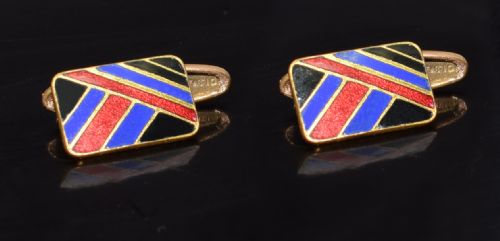


1930s Enamel Cuff Links
These 1930s enamel cuff links bring sharp geometric colour and modernist flair to a cuff.
1930s Enamel Cuff Links
When you search for 1930s enamel cuff links, you encounter striking accessories defined by the clean lines of the Art Deco period. The pieces appearing here comprise matching pairs for gentlemen alongside occasional related forms such as ladies bracelets.
Most examples originate from the 1930 era, showcasing modernist geometric motifs and skyscraper designs in green, red, and black enamel. These ornaments represent a distinct shift toward industrial styling in gentlemen's dress accessories.
How they were made
Maker workshops fused coloured glass enamel onto metallic bases, employing techniques suited to mass production and hand finishing alike. Common structural metals span chrome, silver plate, brass, and standard metal alongside finer precious metals.
Makers occasionally utilised solid 18ct yellow gold for high-end commissions, pairing the precious metal with durable vitreous or applied enamel surfaces. The resulting construction balances structural rigidity with vibrant, contrasting colour planes.
Skyscraper motifs let gentlemen wear a tiny piece of New York architecture on their cuffs.
What varies in quality
Quality separates through the precision of the geometric enamel work and the durability of the underlying metal chassis. Chrome and standard metal alloys display industrial utilitarian fabrication, whereas gold and silver pieces reflect finer traditional jewellery standards.
The crispness of the modernist lines and the integrity of the fitted mechanisms dictate the distinction between everyday workshop output and superior production.
Jakob Bengel
The 1930s Enamel Cuff Links Glossary
- Enamel
- A glassy substance fused to metal through high-temperature firing to provide durable colour. This technique creates the smooth, glossy surface characteristic of modernist accessories.
- Art Deco
- A prominent design style of the 1920s and 1930s emphasising geometric shapes and streamlined forms. This aesthetic heavily influences the symmetry and patterning of these pieces.
- Modernist
- An artistic movement favouring minimalist, functional design over historic ornament. In these accessories, it translates to stark lines and industrial motifs.
- Chrome
- A hard, corrosion-resistant metallic plating applied to base metals for a bright finish. It offered makers a durable and shiny surface popular in the period.
1930s Enamel Cuff Links: Frequently Asked Questions
Are these cuff links suitable for daily wear?
These pieces were built for regular gentleman's attire using durable metals like chrome and brass. Modern handling requires simple care to protect the coloured enamel surfaces from harsh impacts.
Most pairs feature sturdy mechanical fittings designed for secure fastening through shirt cuffs. Storing them in a lined box prevents unnecessary friction against other items.
How do I identify Art Deco style?
Art Deco design relies on strict symmetry, bold geometric patterns, and industrial motifs. Skyscraper steps and sharp angles appear frequently across the enamel decoration.
This aesthetic departs entirely from organic floral patterns of earlier decades. The focus rests on clean lines and high-contrast colour combinations like green and black.
What metals were used?
Makers utilised a broad spectrum of metallic foundations depending on the intended market. Everyday pairs typically feature chrome, brass, silver-tone metal, or silver plate.
Finer examples incorporate solid 18ct yellow gold or silver. Each metal choice alters the overall weight and visual tone of the piece.
Do matching pairs always survive together?
Many surviving sets remain as complete matching pairs intended for double-cuff shirts. Finding them intact reflects careful preservation by original owners.
Some designs incorporate specific geometric layouts that rely on the symmetry of both halves. Keeping the pair together maintains the intended visual balance of the modernist design.