

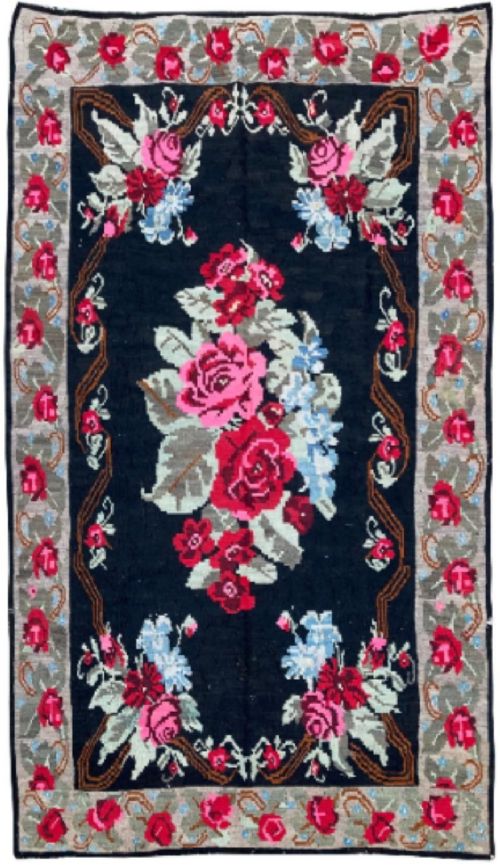
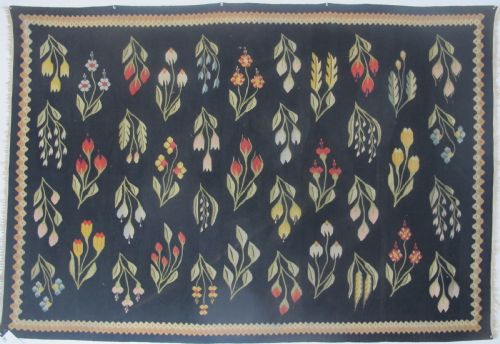


Vintage Eastern European Rug
A vintage eastern european rug brings heavy wool texture and flat-woven folk motifs directly to the floor.
Vintage Eastern European Rug
When you search for a vintage eastern european rug, you encounter flat-woven kilims and floral tapestries spanning the late nineteenth century through the interwar years. These textiles originate primarily from regions associated with Bessarabia, Ukraine, Romania, the Caucasus, and the Balkans. The selection here is dominated by Bessarabian kilims alongside Caucasian and Ukrainian examples.
Makers produced these floor coverings and wall hangings in traditional styles encompassing eastern european folk art, Moldavian traditional designs, and Thracian work. Formats range from large room-sized carpets down to paired smaller kilims and specific area rugs. Each piece reflects the vernacular textile traditions of its specific geographic origin.
Dating across the available items concentrates heavily around 1880, 1890, 1900, 1910, 1920, and 1930. The typical construction utilises traditional flat-weaving techniques rather than deep pile knots. These textiles serve both functional floor use and decorative tapestry display.
How they were made
Weavers constructed these rugs predominantly using natural wool for the primary textile body, paired with cotton foundations or structural elements where appropriate. The selection relies entirely on wool and cotton as the recorded material basis. This combination provided the necessary durability for floor placement alongside suppleness for hanging.
The technique relies on flat-weaving traditions without a raised pile, characteristic of kilim construction and traditional tapestry work. Artisans built up dense geometric and floral compositions through meticulous thread manipulation. This method yielded strong, reversible flat textiles capable of enduring decades of domestic use.
Vintage Eastern European Rug Retail Price Guide 2026
Typical asking prices for vintage eastern european rug among the pieces listed under this phrase on Sellingantiques today, from the lower quarter to the upper quarter. They describe what is for sale here now, not the wider market.
Several textiles arrive with minor historical mends, proving they spent a century being loved on farmhouse floors rather than locked away.
What varies in quality
Quality in a vintage eastern european rug is primarily determined by the crispness of the folk art design and the density of the wool weave. Superior examples display confident, highly detailed floral or geometric patterns executed with tight tension. Weaker instances show looser execution and less refined colour transitions across the field.
The preservation of the original wool and cotton fibres also dictates the standing of a textile. Pieces retaining strong structural integrity in the flat-weave foundation represent the upper tier of the selection. Handling by skilled historical weavers ensures the longevity of the individual regional styles.
The Vintage Eastern European Rug Glossary
- Kilim
- A flat-woven carpet or rug produced without a pile, common throughout Eastern Europe and the Caucasus. This technique creates a lightweight, reversible textile suitable for floors or walls.
- Bessarabian
- Pertaining to the historical region situated between the Prut and Dniester rivers, noted for distinctive dark-ground floral tapestries and kilims. These pieces form the core of eastern European flat-weave production.
- Caucasian
- Originating from the Caucasus mountain region between the Black Sea and the Caspian Sea. Rugs from this area typically feature pronounced geometric tribal motifs.
- Tapestry
- A form of textile art traditionally woven on a vertical loom, utilised here for both wall display and floor placement. The technique permits intricate pictorial and floral storytelling.
- Folk Art
- Artistic work produced from an indigenous cultural tradition or community craft standard. Eastern European examples rely on passed-down regional motifs rather than academic fine art instruction.
Vintage Eastern European Rug: Frequently Asked Questions
What is a kilim rug?
A kilim rug is a flat-woven textile produced without the knotted pile found in traditional carpets. Artisans interweave warp and weft threads to create geometric or floral patterns.
These textiles function effectively as durable floor coverings or decorative wall hangings. Their lightweight structure makes them versatile for various interior spaces.
How do I care for wool rugs?
Care for wool rugs involves regular gentle vacuuming without a rotating brush roll to protect the flat-weave structure. Professional cleaning tailored for antique textiles preserves the natural fibres.
Avoid excessive moisture and direct prolonged sunlight to maintain the integrity of the historical wool and cotton materials. Proper placement out of heavy moisture areas ensures longevity.
Where did Bessarabian rugs originate?
Bessarabian rugs originated in the historical region situated between the Black Sea and the Carpathian mountains. Local weavers developed distinct floral and botanical compositions on dark wool grounds.
These regional textiles reflect a blend of Ottoman, local folk, and European neoclassical design influences. They remain among the most sought-after flat-weaves from Eastern Europe.
How old are these vintage rugs?
The available rugs and kilims span from the late nineteenth century through the early twentieth century. Recorded production dates concentrate around the 1880s, 1890s, 1900s, 1910s, 1920s, and 1930s.
Each period piece carries the specific aesthetic traits and weaving techniques of its decade of origin. The dates reflect traditional hand-weaving traditions before industrial standardisation.