

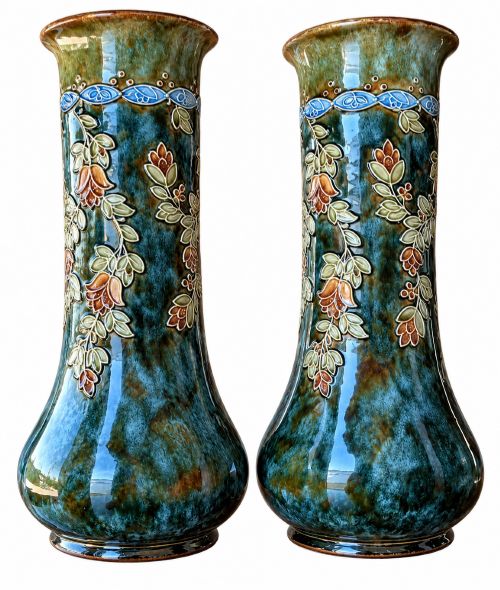
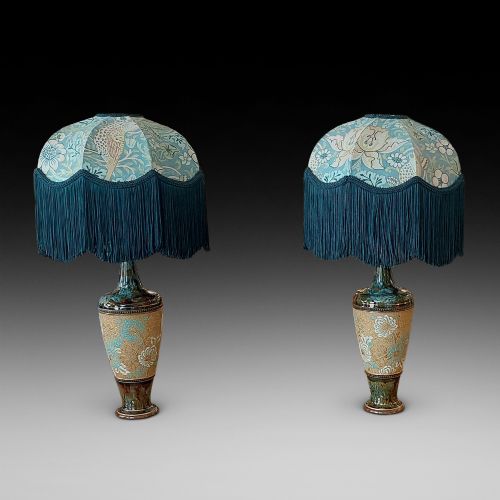
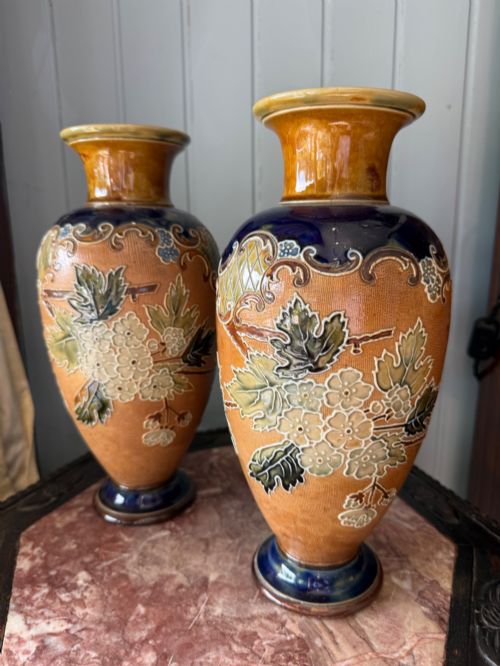


Vintage Doulton Stoneware Pair
These vintage doulton stoneware pair selections offer dual vessels shaped by late Victorian and early twentieth-century hands, built to anchor a mantelpiece or sideboard.
Vintage Doulton Stoneware Pair
When you search for a vintage doulton stoneware pair, you encounter twin vessels created by the prominent English potteries, spanning the Victorian era through the mid twentieth century. These matching sets include decorated vases, loving cups, planters, candlesticks, storage jars, and table lamps converted from tobacco jars.
The objects frequently reflect the design philosophies of the Arts and Crafts movement, the Aesthetic movement, and Art Nouveau. Pairs often display coordinated floral decoration, Slater's patent texturing, or rich enamel highlights over dense salt-glazed bodies.
Most examples originate from the Doulton Lambeth factory or general Royal Doulton workshops operating between eighteen eighty and nineteen forty. Buyers typically find symmetrical baluster vases or matching utilitarian containers adapted for domestic display.
What varies in quality
The distinction between standard production items and superior examples lies in the complexity of the hand-chiselled decoration and the crispness of the incised ornament. Pieces bearing specific artist signatures display superior artistic control over anonymous factory output.
Symmetry and proportion within the pair dictate visual success, as matching vessels must demonstrate identical profile shrinkage during high-temperature firing. Intact enamel highlights and pristine salt-glaze surfaces without hairline cracks command greater admiration among collectors.
Vintage Doulton Stoneware Pair Retail Price Guide 2026
Typical asking prices for vintage doulton stoneware pair among the pieces listed under this phrase on Sellingantiques today, from the lower quarter to the upper quarter. They describe what is for sale here now, not the wider market.
Several large shipping alcohol jars from London docks survived decades of maritime transit to end up displayed as heavy decorative stoneware.
Royal Doulton·Doulton Lambeth·Ethel Beard·Doulton of London
The Vintage Doulton Stoneware Pair Glossary
- Stoneware
- A robust, vitrified ceramic pottery fired at high temperatures until impervious to liquid. It provides a heavy, durable body suitable for detailed incised decoration.
- Slater's Patent
- A Doulton technique pressing coarse lace or fabric into damp clay to create a textured textile pattern across the surface. This textured ground was often highlighted with enamel and gold.
- Salt Glaze
- A glossy, slightly pitted texture resembling orange peel achieved by throwing common salt into the kiln during high-temperature firing. The sodium reacts with the silica in the clay body.
- Loving Cup
- A large two-handled drinking vessel traditionally passed among guests at celebrations. In this selection, they serve purely decorative or display functions as matching pairs.
- Art Nouveau
- A decorative style popular from the late nineteenth century characterised by flowing, organic lines and floral motifs. Doulton artisans applied these sinuous designs extensively to vase profiles.
Vintage Doulton Stoneware Pair: Frequently Asked Questions
How do I date a vintage Doulton pair?
Examine the impressed factory stamps on the base, which evolved from simple Doulton Lambeth marks to the crowned Royal Doulton lion and circle motif introduced around nineteen hundred. Stylistic cues such as Art Nouveau sinuous lines or Victorian aesthetic panels further narrow the production decade.
Matching pairs usually share identical factory ciphers and assistant monograms scratched into the clay beneath. Comparing these alphanumeric stamps against standard pottery registers confirms the exact manufacturing period.
Were these pairs originally made as lamps?
Most Doulton pairs started life as utilitarian vessels, tobacco jars, or display vases rather than electrical light fittings. Victorian and Edwardian owners frequently converted robust stoneware jars into table lamps by drilling the bases for wiring.
Conversions often preserve the original ceramic body while adding brass fittings to accommodate lamp shades. Collectors evaluate both the ceramic integrity and the quality of the subsequent conversion work.
How should I display stoneware pairs?
Position matching vessels symmetrically on heavy wooden sideboards, mantels, or dedicated console tables to balance their substantial weight and visual gravity. Keep them away from direct foot traffic where accidental knocks might chip the dense salt-glazed bodies.
Ensure adequate natural light reaches the shelves to highlight the subtle variations in cobalt glazes and hand-painted enamel decoration. Grouping them with complementary Arts and Crafts metalwork enhances their historical context.