
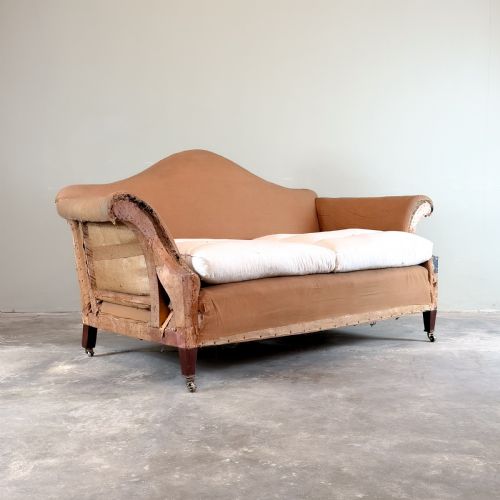
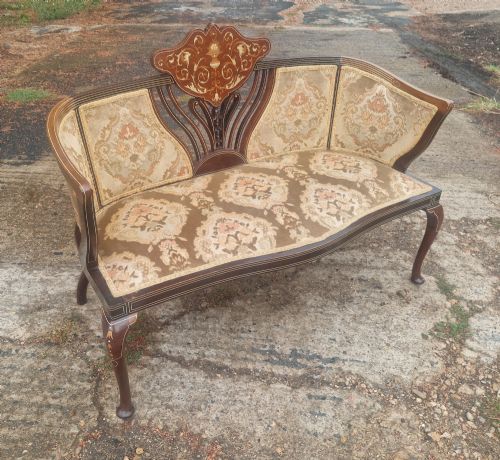
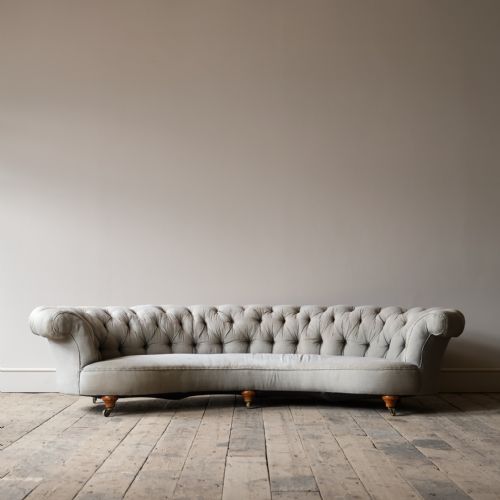
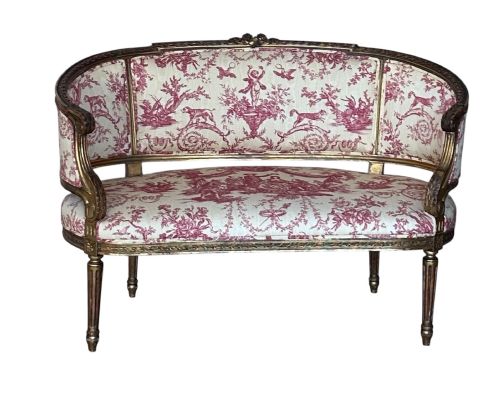


Vintage Curved Settee
A vintage curved settee brings an organic line to a room, offering seating shaped for conversation rather than the straight wall.
Vintage Curved Settee
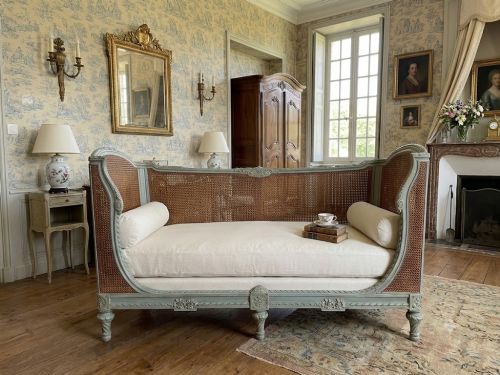
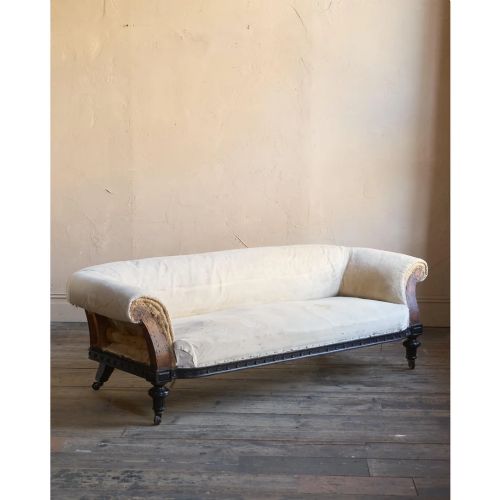
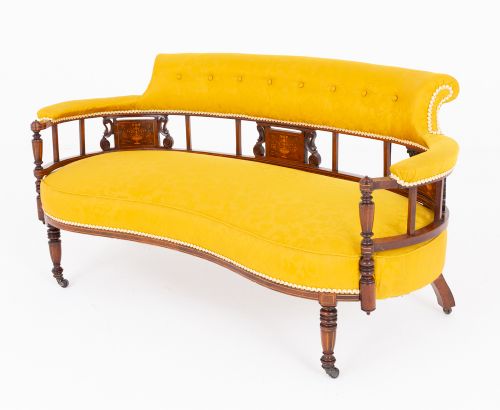
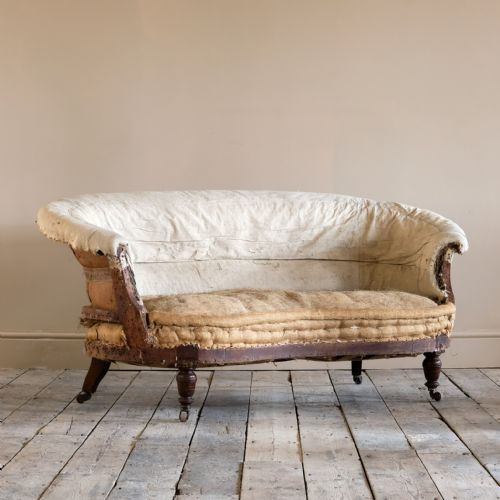
When you search for a vintage curved settee, you are looking at upholstered and wooden seating built in shapes that depart from the rigid rectangular sofa. The pieces here span from the nineteenth century through the Edwardian era and into the Art Deco period, taking forms such as the canapé, the crescent Chesterfield, and the rounded daybed. French Louis styles sit alongside English Victorian and Edwardian examples, offering swept frames and cabriole or fluted legs.
The version you are most likely to meet on this page is an Edwardian or nineteenth-century piece, often bearing French influence in its curved cane or painted framework. These range from substantial leather Chesterfields to lighter salon pieces in mahogany, walnut, or beech. Whether built for a bedroom, a boudoir, or a formal drawing room, each design uses the sweep of the timber or the roll of the upholstery to soften the geometry of the interior.
Materials and construction
Makers of these settees relied on solid timbers like mahogany, walnut, beech, rosewood, and palisander to shape the curved framework. Steam-bending techniques allowed workshops such as Thonet to form continuous wooden curves for bentwood settees and benches. In other pieces, joiners carved solid wood to create the flowing contours of Louis XV and XVI revival frames.
Upholstery and cane work complete the structure, utilising leather, cotton, and various fabric coverings over sprung or padded foundations. Caning appears threaded through wooden rails on light daybeds and salon pieces, while button-backed Chesterfields employ deep-buttoned leather or fabric over dense stuffing. Brass and wrought iron occasionally provide structural detailing or support on garden and interior benches.
One listed salon suite comes from Baumann, ready to host animated debates about the 1930s.
What separates the fine examples
The distinction between ordinary production and superior work lies in the integrity of the curved wooden frame and the precision of the joinery. A fine settee maintains structural rigidity despite the inherent stress placed on curved rails and bent timber. Carved ornament, where present, remains crisp and well-defined rather than soft or cast in inferior composition.
Upholstery quality shows in the handling of fabric or leather around complex radiuses, where neat pleating and even tension indicate skilled labour. Maker attribution also elevates certain pieces, as does the survival of original cane work and untouched surface finishes on woods like rosewood and walnut.
Howard And Sons·Thonet·Hampton And Sons·Baumann
The Vintage Curved Settee Glossary
- Canapé
- A traditional French term for a sofa or settee, usually featuring an exposed wooden frame and upholstered seat and back. These often reflect stylistic periods such as Louis XV or Louis XVI.
- Chesterfield
- A deep-buttoned upholstered sofa with arms and back of the same height. Nineteenth-century examples frequently employ leather and horsehair stuffing.
- Caning
- Woven rattan or cane panels fitted into the back or seat frame of a wooden settee. It provides a lightweight, decorative surface.
- Bentwood
- Wood softened by steam and bent into curved structural forms. This technique defines pieces produced by makers like Thonet and Baumann.
- Palisander
- A dense, heavily figured exotic timber belonging to the rosewood family. It was favoured by cabinet makers for high-end Art Deco furniture.
Vintage Curved Settee: Frequently Asked Questions
Where did people put curved settees?
These pieces were designed for drawing rooms, salons, and large bedrooms where seating arranged away from the walls was preferred. Their curved profiles allowed them to sit comfortably in bay windows or conversational groupings.
In modern interiors, they serve a similar purpose by breaking up the hard lines created by contemporary box furniture. They work well placed centrally in a room or angled in a corner.
How do I identify a French style settee?
French style settees typically display exposed wooden frames with carved floral motifs, scroll arms, and cabriole or fluted legs. Woods like walnut and beech are common, often painted or gilded.
They frequently carry designations like Louis XV or Louis XVI style, reflecting the curvilinear or neoclassical lines of those periods. Caned panels and shaped backs further distinguish them from English forms.
What is a bentwood settee?
A bentwood settee is constructed using solid rods of beech that have been steamed until pliable and then pressed into curved moulds. This process allowed makers to create strong, lightweight frames without traditional heavy joinery.
Associated primarily with late nineteenth and early twentieth-century manufacturers, these pieces feature characteristic continuous loops of wood.
Can I use a daybed as a settee?
Daybeds and canapés are built with one raised end or a partial back, functioning as dual-purpose furniture for reclining and sitting upright. Historically, they occupied boudoirs and dressing rooms for daytime resting.
They function adequately as settees in smaller spaces, provided scatter cushions are added to adjust the seating depth for upright posture.