


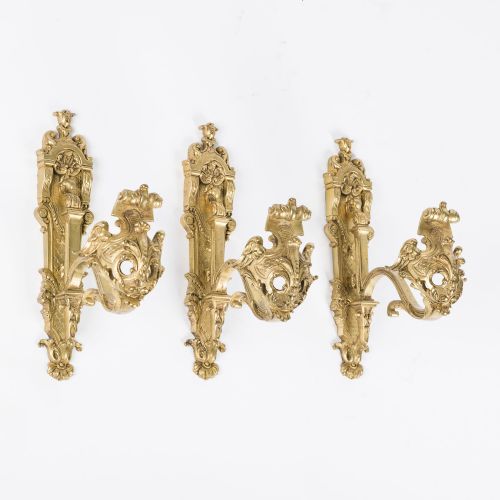


Vintage Curtain Hooks
These vintage curtain hooks and tie backs bring period weight and cast detail to a room, holding heavy drapes with proper historical form.
Vintage Curtain Hooks
When you search for vintage curtain hooks, you are looking at substantial hardware designed to secure heavy window drapes against a wall. The examples on this page span from the eighteenth century through the nineteenth century, including Georgian and Victorian periods.
You are most likely to meet French rococo revival and baroque pairs made from cast brass or ormolu. These take the form of decorative tie backs and wall hooks rather than simple functional fasteners.
The selection ranges from early Georgian brass lion designs to ornate late nineteenth century French ormolu pieces. Enamel decoration and gilded finishes also appear among these pairs and sets.
How they were made
Metalworking methods for these pieces rely on casting in brass, bronze, and gilt metal. Molten metal was poured into detailed moulds to create intricate scrollwork and figural motifs.
Surface finishing involved mercury gilding to produce ormolu, or applying layers of gold wash over brass. Enamel elements were fused to metal surfaces to add colour and contrast to the design.
Gilded lions occasionally guard your curtains.
What varies in quality
The depth and crispness of the cast relief define the upper tier of these pieces. Softer, worn contours indicate a secondary casting or excessive wear to the original mould.
Gilt surfaces show variation in longevity and richness depending on the original metal preparation. Heavier foundational brass and bronze weight generally distinguishes finer pairs from lighter commercial hardware.
The Vintage Curtain Hooks Glossary
- Ormolu
- Gilded bronze produced by applying a mercury and gold amalgam to a bronze base. This technique was widely used in French decorative hardware.
- Tie back
- A decorative fixture mounted beside a window to hold a curtain open. These items match the decorative style of the room's other metalwork.
- Rococo revival
- A nineteenth century design style copying the asymmetrical scrolls and natural motifs of the eighteenth century. It appears frequently on French curtain hardware.
- Gilt brass
- Brass that has received a thin coating of gold or gold coloured wash to imitate solid gold or ormolu. It offers a bright finish at a lower weight.
Vintage Curtain Hooks: Frequently Asked Questions
How were vintage curtain hooks used?
These hardware pieces were screwed directly into the window frame or wall flanking a window. Heavy drapery fabric was gathered behind the projecting arm to keep the window unblocked.
Pairs were mounted at matching heights to ensure the drapes draped symmetrically on either side of the glass.
Are these hooks sold individually?
The listings on this page consist primarily of matched pairs, though sets of three or four also appear. Buying them as sets ensures consistency in the metal finish and casting style across a room.
Single hooks are less common for this type of decorative hardware.
How do I identify French rococo style?
French rococo pieces feature asymmetric C-scrolls, acanthus leaves, and naturalistic shell motifs. The metalwork curves fluidly without rigid geometric symmetry.
This style appears frequently in nineteenth century reproductions of earlier eighteenth century designs.
What is the difference between ormolu and brass?
Ormolu specifically denotes gilded bronze, where gold is bonded to a bronze casting using mercury. Brass is a copper and zinc alloy that may be gilt or left as polished metal.
Ormolu generally displays a warmer, deeper golden tone compared to standard polished brass.