

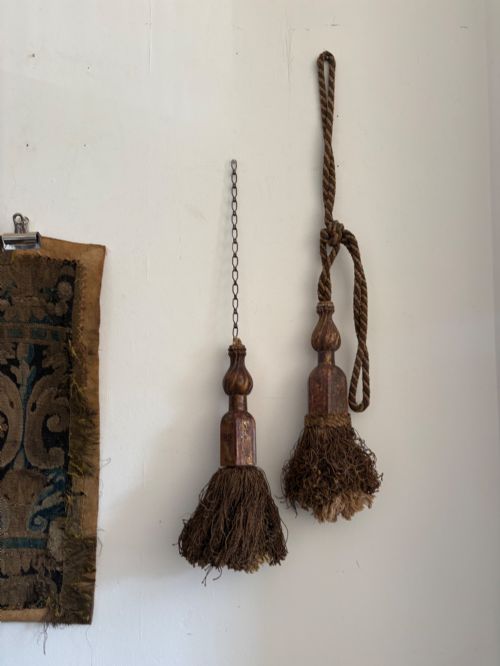


Gold Drapery Holdbacks
Gold drapery holdbacks secure heavy fabrics at the window while bringing rich metallic texture to period interiors.
Gold Drapery Holdbacks
Gold drapery holdbacks function as both hardware and ornament, designed to fasten and frame window hangings with distinct historical character. The selection spans robust Georgian forms alongside ornate French Rococo Revival and Baroque examples, showing how differently makers approached the window over two centuries.
Buyers will most frequently encounter pairs and sets fashioned in France and Venice during the nineteenth century, often cast in ormolu or gilded brass. These pieces range from mid-eighteenth-century enamelled designs to substantial Victorian giltwood pulls measuring significant lengths.
Each pair reflects the decorative priorities of its period, whether through the swirling asymmetry of Rococo styling or the disciplined geometry of Louis XVI influence. Selecting a set means considering both the weight of the fabric and the prevailing style of the room.
How they were made
The construction of these pieces relies on casting base metals like brass and copper before applying rich surface gilding such as ormolu. Ormolu mounts involve mercury gilding over bronze, creating a deep, luminous finish that endures across centuries.
Venetian makers occasionally carved wooden tiebacks to resemble giant knotted ribbons, tricking the eye with gilded textiles made of solid timber.
What varies in quality
Quality rests in the crispness of the casting and the depth of the surviving gilding across the metal surface. Finer examples display sharp relief work where every scroll and acanthus leaf remains distinct, while simpler pieces show softer contours from worn moulds.
The integrity of the construction, especially at the fixing points, distinguishes superior pairs from standard workshop production. Weight and substantial gauge metal indicate a higher grade of manufacture intended for grander domestic settings.
The Gold Drapery Holdbacks Glossary
- Ormolu
- Gilded bronze produced by applying a mercury and gold amalgam to a bronze object before heating. This technique creates a rich, durable golden surface characteristic of fine French decorative metalwork.
- Giltwood
- Timber carved and subsequently coated with a thin layer of gold leaf. This method was widely used in eighteenth and nineteenth-century interior ornament.
- Rococo Revival
- A nineteenth-century design style reviving the asymmetrical scrolls, shell motifs, and natural curves of the mid-eighteenth century. It dominates many continental drapery fittings.
- Curtain Tie Back
- A hardware fixture mounted to the wall beside a window to hold drapery panels open. They appear in pairs to frame the view symmetrically.
Gold Drapery Holdbacks: Frequently Asked Questions
How do I mount heavy holdbacks?
These pieces require secure anchoring into wall studs or proper masonry fixings to support the leverage exerted by thick drapery fabrics. Using appropriate screws matched to the original fixing holes preserves the structural integrity of the hardware.
Positioning height depends on the window proportions and the drape style, usually placed around one-third to halfway down the window frame for optimal fabric fall.
What periods do these pieces represent?
The available selection spans from the mid-eighteenth century through the Victorian era and the late nineteenth century. Earlier examples often incorporate enamel work or Georgian proportions, while later pieces frequently adopt French Baroque and Rococo Revival styling.
Stylistic cues such as symmetry, leaf motifs, and casting sharpness help distinguish between eighteenth-century craftsmanship and nineteenth-century revivals.
Are these items sold in pairs?
Many listings offer matching pairs designed for symmetrical window dressing, though sets of four also appear for larger rooms or multiple windows. Purchasing complete sets ensures uniform patination and matching decorative detail across the room.
Individual variations can occur in hand-finished pieces, making paired sets particularly desirable for balanced interior schemes.
How should I clean gilded metal?
Dusting gently with a soft, dry cloth is the safest method for maintaining ormolu and gilded brass surfaces. Avoid abrasive cleaners, commercial metal polishes, or harsh chemicals that can strip away the historic gold layer.
Preserving the existing surface patina maintains both the visual depth and the historical character of the metalwork.