




Vintage Cornish Wall Art
These vintage cornish wall art pieces capture the distinct light and maritime character of the region through oils and watercolours.
Vintage Cornish Wall Art
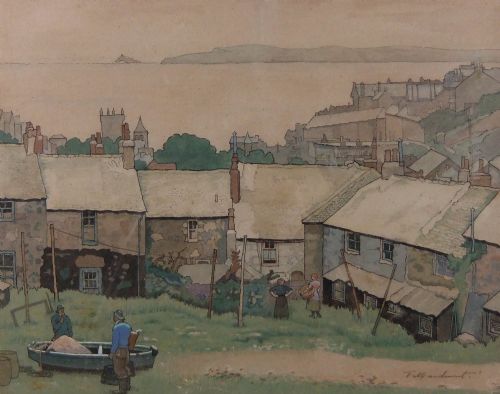
The physical forms include traditional oil paintings on canvas and board alongside delicate watercolour paintings on paper. These pieces range from intimate harbour views created en plein air to larger marine and landscape compositions produced by established regional artists.
Materials and construction
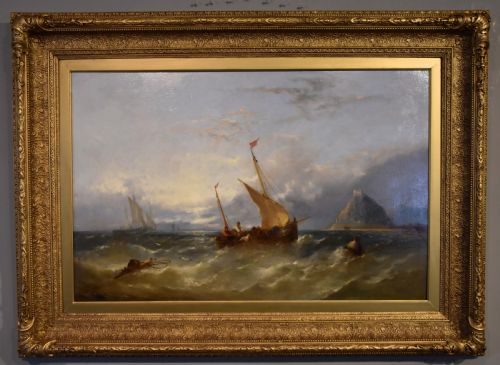
The works utilise traditional artist materials including oil paint, watercolour pigments, and pastel applied to canvas, paper, or prepared wood boards. Many of these paintings retain their period gilt wood frames which complement the maritime subjects.
Techniques range from detailed nineteenth century academic watercolours to looser, impressionistic brushwork associated with twentieth century coastal colonies. Artists frequently worked directly outdoors to capture transient atmospheric conditions along the shore.
The inventory records coastal subjects across Cornwall and Devon, executed on canvas, paper, wood, and panel.
Assessing quality and depth
Quality in these regional works rests upon the artist's ability to render the specific quality of coastal light and atmosphere rather than mere scale. Superior examples demonstrate confident brushwork and precise tonal balance, particularly in marine scenes where sea and sky meet.
The integrity of the surface condition and the originality of the mounting also contribute significantly to the standing of a piece. Works retaining documented attribution and period framing offer a more complete historical context.
Sidney A Court·William Banks Fortescue·Thomas Maidment·William Henry Williamson·George F Pennington·Joan Gillchrest·Tony Giles·Denis Mitchell·Edward Matthew Elliott·Charles Napier Hemy·Richard Harry Carter·Gyrth Russell·William Pitt·Ernest F Hill·Fred Yates·Jack R Mould·William Lee Hankey·Hendrik Yan Wolter·S J Lamorna Birch·Cuthbert Crossley·Herbert James·John Baragwanath King
The Vintage Cornish Wall Art Glossary
- En plein air
- Painting outdoors to capture direct observations of light and atmosphere. This approach defined much of the local topographical work.
- Newlyn School
- An artist colony established in the late nineteenth century focusing on realistic depictions of fisherfolk and coastal life. Members worked closely with local inhabitants.
- St Ives School
- A twentieth century grouping of artists associated with modernism and abstraction alongside traditional landscape painting. It centred on the Cornish fishing port.
- Lugger
- A traditional two masted fishing boat commonly seen in historical maritime scenes of the West Country. These vessels feature prominently in coastal compositions.
Vintage Cornish Wall Art: Frequently Asked Questions
What subjects appear most often?
Harbour scenes, fishing vessels, and coastal cliffs dominate the imagery across these works. Artists focused heavily on the daily routines of local fishermen and the changing tides.
Views of specific landmarks like St Michael's Mount and local villages also recur frequently throughout the selection.
How do I care for these watercolours?
Watercolour paintings require protection from direct sunlight to prevent fading of the delicate pigments. Maintaining stable indoor humidity prevents warping of the paper.
Displaying them away from moisture sources ensures the longevity of both the paper and the surrounding mount.
Are original frames important?
Period frames provide historical context and often complement the aesthetic of the artwork. Gilt wood mouldings from the nineteenth and early twentieth centuries require gentle dusting rather than liquid cleaners.
Preserving the original housing maintains the integrity of the piece as a complete historical object.
How do I distinguish nineteenth century styles?
Earlier Victorian pieces tend toward detailed academic realism and muted tonal palettes. They often emphasise narrative elements within maritime and rural subjects.
Later twentieth century works embrace looser brushwork and brighter palettes influenced by impressionism and modernism.