



Vintage Cattle Landscape Oil
These vintage cattle landscape oil paintings capture rural idylls, pastoral scenes, and prized livestock across changing British and European countryside settings.
Vintage Cattle Landscape Oil
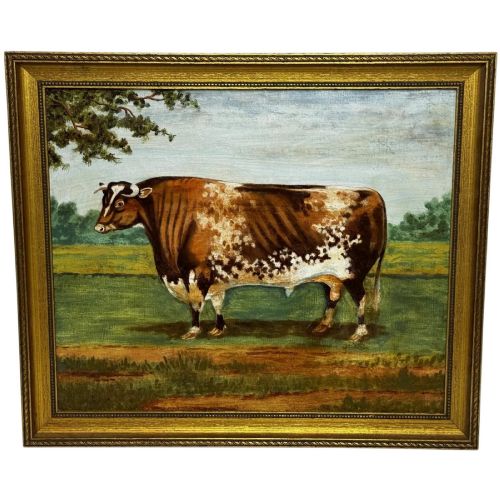
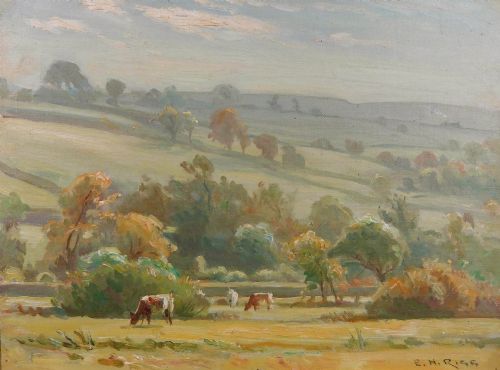
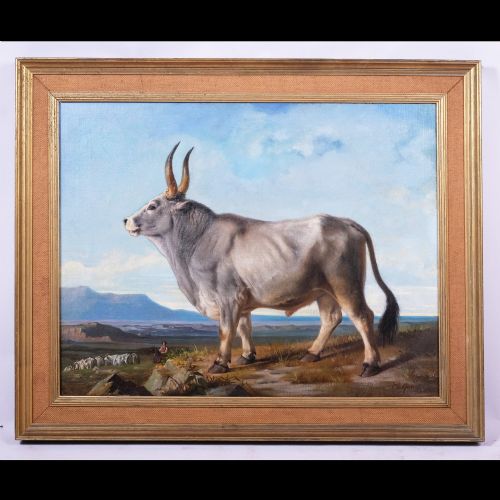
A vintage cattle landscape oil painting depicts rural scenes featuring herds, bulls, and calves grazing by riversides, in woodlands, or across mountainous Scottish loch settings. These works frequently record agricultural pride, rural labour, and regional topography through the artistic lens of pastoral realism and British Impressionism.
Buyers browsing this selection meet oil on canvas and oil on panel works spanning the Georgian, Victorian, Edwardian, and early twentieth-century periods. Common compositions range from solitary shorthorn portraiture to drovers navigating rivers and pastoral riverbanks framed in period wood and giltwood.
Materials and methods of the canvas
Artists painted these rural scenes using oil paint applied to stretched canvas or wooden panels, supported by timber stretchers and housed within decorative giltwood frames. The medium allowed painters to build rich textures across animal hides, water reflections, and shifting atmospheric skies.
Brushwork varies from the tight, precise realism of nineteenth-century animal portraiture to looser, impressionistic strokes captured by later landscape painters working outdoors or in regional studios.
Listings feature works executed on canvas and wood panel across Georgian, Victorian, and Edwardian periods.
Judging visual execution and condition
Quality rests upon the artist's ability to render the anatomical structure of livestock correctly while maintaining a balanced, atmospheric landscape composition. Finer examples display careful handling of light upon water and cattle hides rather than stiff, formulaic representations of rural animals.
Preservation of the original oil paint surface, minimal relining of the canvas, and the presence of period-appropriate gilt framing significantly influence the desirability of these pastoral works.
William H Myers·Ernest Higgins Rigg·A M Gauci·Henry Robinson Hall·Frederick James Knowles·Eugene Verboeckhoven·William Greaves·Claude Cardon·George Turner·William Traies·W A Clark·John Percy Cooke·Frederick William Jackson·William Sidney Cooper·Walter J Watson·Alfred de Breanski·Owen Bowen·George Smith·Thomas E Francis·E Van Drielst·Aelbert Cuyp
The Vintage Cattle Landscape Oil Glossary
- Oil on canvas
- A painting technique where pigmented oil paint is applied to a woven fabric support stretched across a wooden frame. This combination provides durability and allows for subtle blending of tones.
- Giltwood
- Timber carved and coated with gold leaf or a gold-coloured metallic finish to form decorative picture frames. It was widely utilised during the Victorian and Edwardian eras to complement pastoral canvases.
- Pastoral realism
- An artistic approach focusing on accurate depictions of rural life, farming landscapes, and farm animals without romanticised exaggeration. It dominated much of nineteenth-century agricultural painting.
- Stretcher
- The internal wooden framework that holds a canvas tight under tension. Inscribed notes and signatures are frequently found written directly onto these wooden bars by artists or dealers.
Vintage Cattle Landscape Oil: Frequently Asked Questions
What periods do these paintings date from?
The works span from the late Georgian and eighteenth century through the Victorian and Edwardian eras up to the early twentieth century. Painters of these periods documented changing rural industries and local countryside traditions.
Specific dates are often recorded through signatures, stretcher inscriptions, or stylistic markers typical of British and European landscape schools.
How were cattle depicted in Victorian art?
Cattle appeared both as individual prize-winning farm animals, such as shorthorn bulls, and as grazing herds integrated into wider river or mountain landscapes. Artists used them to symbolise agricultural prosperity and rural tranquility.
Different regional schools focused on distinct breeds, from Scottish Highland cattle near lochs to Friesian cows in pastoral pastures.
How should I frame and display an oil painting?
These paintings suit traditional spaces, often displayed within their original giltwood frames on neutral walls away from direct sunlight and moisture. Proper hanging preserves both the canvas and the delicate gold leaf on antique frames.
Ensuring stable room temperatures prevents the wooden stretcher and canvas from expanding or contracting excessively over time.
How do I distinguish regional British landscape styles?
Regional schools are identified through local topography, such as Welsh rivers, Yorkshire dales, Kentish marshes, or Scottish Highlands. Artists often inscribed specific locations onto the canvas reverse or stretcher bars.
Brushwork and palette choices also reflect the specific geographic preferences of regional painters working across England, Wales, and Scotland.