
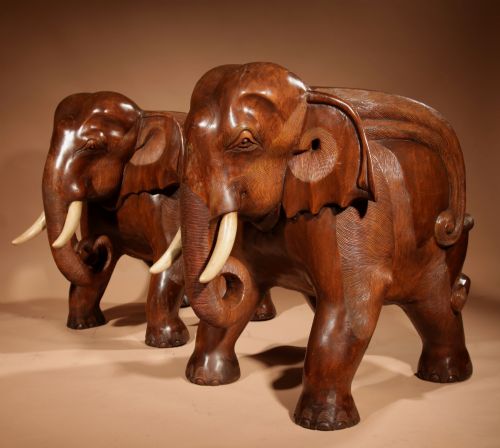
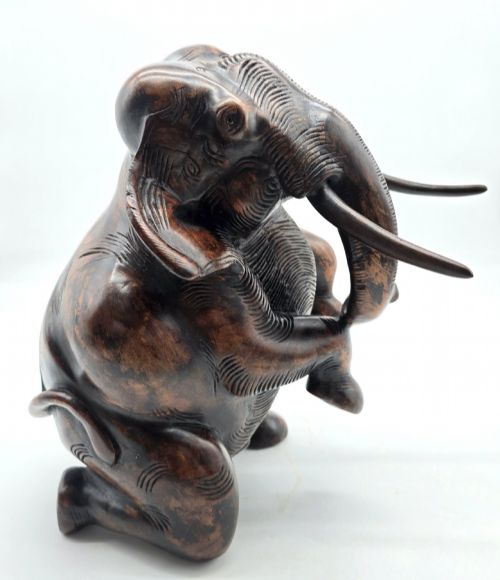


Vintage Carved Hardwood Elephant
A vintage carved hardwood elephant brings the rich weight of colonial craftsmanship directly into a room, offering both sculptural presence and functional design.
Vintage Carved Hardwood Elephant
A vintage carved hardwood elephant encompasses a striking variety of forms, from figural sculptures and bookends to occasional tables supported by carved legs. Buyers seeking these items encounter regional interpretations originating from Anglo-Indian, Anglo-Burmese, and Chinese traditions spanning the late nineteenth and early twentieth centuries.
The practical household items merge animal figures with furniture, utilising elephant heads and trunks as structural elements for small side tables and coffee tables. Purely decorative studies portray seated beasts, ceremonial processions with keepers, and pairs of statues designed for display on stands.
Dating ranges primarily across the nineteenth century, the Edwardian era, and the Art Deco period, capturing distinct colonial aesthetics. Tables and figures frequently showcase regional timber choices and decorative detailing that reflect the specific provenance of their maker.
Materials and construction methods
Selected examples incorporate contrasting inlay materials such as bone to accentuate decorative patterns on furniture tops and borders. Structural assembly relied on traditional joinery to secure table tops to figural elephant legs without modern mechanical fasteners.
Trunks turned upward on these carvings were traditionally believed by makers to shower good fortune upon the household.
What separates standard examples from the finest pieces
The depth and naturalism of the hand-carving define the tier of quality, distinguishing fluid anatomical rendering from stiff or formulaic execution. Finer sculptures capture muscular tension and realistic skin texture, whereas simpler work remains basic and blocky.
Material selection and decorative enrichment dictate overall desirability, with dense ebony or finely figured teak holding greater presence than generic stained timber. Integrated details such as bone inlay and complex ceremonial trappings elevate the artistic ambition of the piece.
Hunter and Palmer
The Vintage Carved Hardwood Elephant Glossary
- Anglo-Indian
- Pertaining to decorative arts produced in India during the British colonial period, often combining British furniture forms with local carving traditions. These pieces frequently utilise native hardwoods and feature dense floral or figural motifs.
- Ebonised
- Wood finished to resemble ebony through staining, painting, or chemical treatment. This technique creates a deep black, uniform surface common on nineteenth-century decorative items.
- Bone inlay
- Small pieces of animal bone fitted into recessed channels within a wooden surface to form decorative patterns. The creamy white material contrasts sharply against dark hardwoods.
- Occasional table
- A small, light table designed for flexible use in sitting rooms, frequently shaped with novelty supports like animal legs. They provide functional surface space while serving as decorative focal points.
- Raj period
- The era of British rule in the Indian subcontinent, lasting from eighteen fifty-eight to nineteen forty-seven. Furniture and carvings from this time often incorporate distinct colonial iconography and regional materials.
Vintage Carved Hardwood Elephant: Frequently Asked Questions
How do I date an elephant table?
Dating relies on examining the timber species, tool marks left by hand-carving, and stylistic markers consistent with nineteenth-century or Edwardian cabinetmaking.
Colonial pieces often display specific regional construction techniques that help narrow the production era alongside documented period styles.
Were these tables used daily?
Many smaller tables served as functional occasional furniture in British colonial homes for holding tea or books.
Heavily carved figural sculptures and ceremonial groups were primarily intended for decorative display rather than utility.
How should I clean dark hardwood?
Dust regularly with a soft, dry cloth to prevent particulate buildup within the deep recesses of the carving.
Aplying microcrystalline wax occasionally helps nourish the timber and maintain a soft sheen without building up heavy residues.
What is Anglo-Indian colonial furniture?
Anglo-Indian furniture represents a synthesis of European domestic forms adapted by local artisans using indigenous materials and carving techniques.
These objects reflect the cultural exchange and trade networks operating during the nineteenth-century colonial period.