



Vintage Carriage Sconces
These vintage carriage sconces bring original brass and iron transport lighting indoors as practical wall lights.

Vintage Carriage Sconces
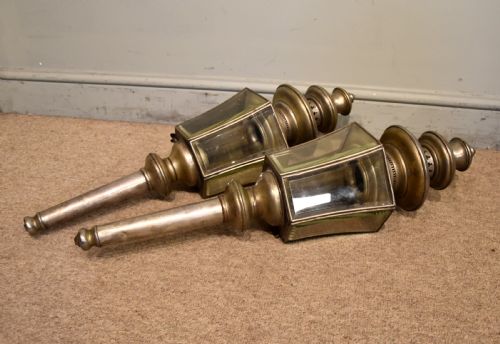
These vintage carriage sconces transform transport lighting into domestic wall fixtures using heavy metal frames and glass panels. Buyers meet examples originating from the Victorian and Edwardian eras through to the early decades of the twentieth century. The selection spans standard carriage lamps, coach-house wall lanterns, and Pullman table or wall combinations.
Forms range from compact Victorian brass designs to tall Arts and Crafts and French Empire style wall lights. Materials include brass, copper, cast iron, and nickel combined with bevelled glass panes. Pieces frequently appear in pairs, retaining the robust proportions required for exterior coach mounting.
Materials and construction
Makers utilised durable metals such as brass, cast iron, and copper to withstand exposure during travel. Verdigris patination occurs naturally on copper surfaces over decades, creating distinctive aged finishes on coach-house lanterns.
Glazing typically incorporates bevelled glass panels secured within metal framework to diffuse candle or oil light. Wrought iron elements provide structural support for heavy wall brackets and lantern bodies.
The listings here span the Victorian era, the Edwardian period, and the 1930s, using brass, copper, and cast iron.
Judging quality and character
Quality depends upon the integrity of the original metalwork and the presence of matching bevelled glass panels. Superior examples exhibit crisp casting details in styles ranging from Neo-Classical to Arts and Crafts.
The choice of material alters the character, with polished brass contrasting against verdigris patinated copper and heavy cast iron. Pairs demonstrate greater uniformity in metal finish and glass preservation than individual fixtures.
Daris
The Vintage Carriage Sconces Glossary
- Carriage Lamp
- A lighting fixture originally mounted to the exterior of a horse-drawn vehicle to illuminate the road. These objects now function as decorative wall lights.
- Bevelled Glass
- Glass panes featuring an angled edge cut around the perimeter, catching light and adding depth to the lantern housing.
- Verdigris
- A green patina formed naturally on copper and brass surfaces through atmospheric oxidation over long periods.
- Pullman
- A style associated with luxury railway carriage fittings, often incorporating versatile mounting options for tables or walls.
Vintage Carriage Sconces: Frequently Asked Questions
How do I mount carriage sconces?
These fixtures require secure attachment to wall studs or masonry due to the weight of the metal and glass construction. Professional installation ensures the electrical components integrate safely with domestic wiring.
Position the sconces at eye level in hallways, entrances, or reception rooms to showcase their original profiles.
Are these suitable for outdoor use?
While originally designed for exterior coach travel, surviving antique pieces often benefit from indoor placement to preserve delicate glass and patinated metal. Check individual wiring standards before exposing historic fixtures to weather.
Covered porches may accommodate certain robust iron and brass lantern types.
How do I date a carriage sconce?
Dating relies on identifying stylistic markers such as Victorian ornamentation, Edwardian proportions, or later Arts and Crafts simplicity. Materials like cast iron and copper alongside specific manufacturing techniques offer further chronological clues.
Comparing the construction of the frame against known period examples helps establish an approximate decade of origin.
Do they come in pairs?
Many listings feature matching pairs originally made to flank carriage doors or coach entrances. Single wall lights also appear, offering flexible placement options for smaller spaces.
Pairs provide symmetrical lighting arrangements for chimney breasts or narrow corridors.