



Vintage Brass Inlaid Slope
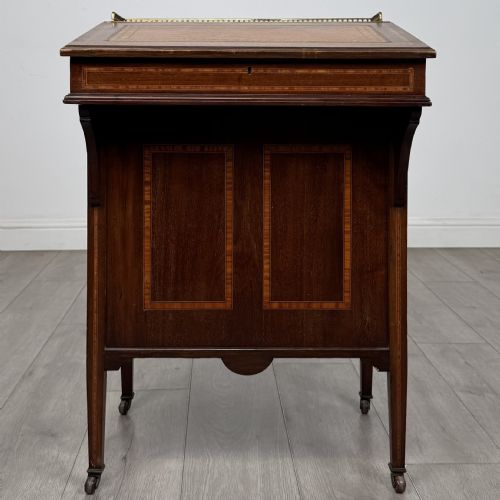
A vintage brass inlaid slope brings portable elegance to a desk, offering a sturdy timber housing fitted for correspondence and travel.
Vintage Brass Inlaid Slope
A vintage brass inlaid slope is a portable writing desk designed for correspondence and travel, folding open to reveal a sloping surface for paper. The examples found here span the Georgian and Victorian periods, alongside later nineteenth-century pieces.
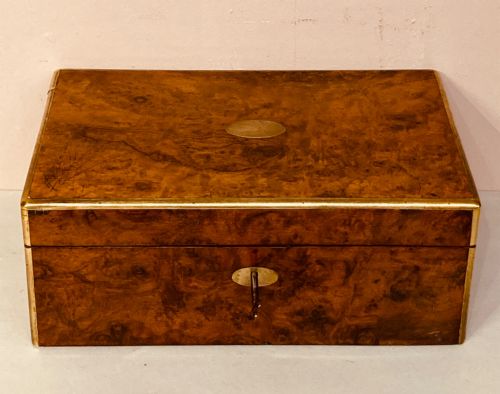
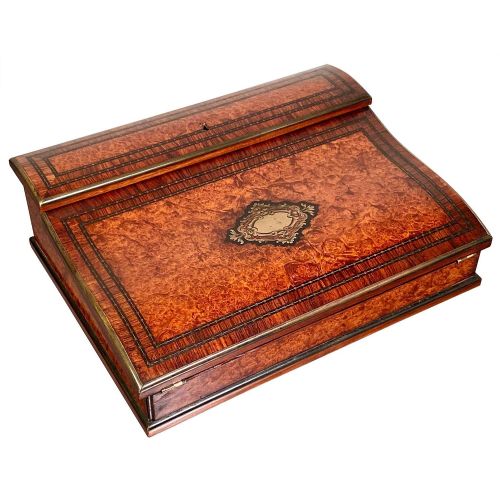
Buyers will encounter various forms on this page, including campaign writing boxes, stationery boxes, and bureau de dame styles. Mahogany, rosewood, and burr walnut dominate the selection, often accented with brass mounts or boxwood inlay.
Origins range across English workshops, French cabinets, and Chinese rosewood creations, reflecting the global reach of nineteenth-century desk furniture. Most pieces date from the eighteen-hundreds, utilising dense hardwoods to withstand constant movement.
How they were made
Cabinetmakers constructed these writing slopes from dense hardwoods such as mahogany, rosewood, burr walnut, and coromandel, providing a stable foundation for intricate decoration. Timber was carefully selected for grain pattern and cut to form the folding box structure.
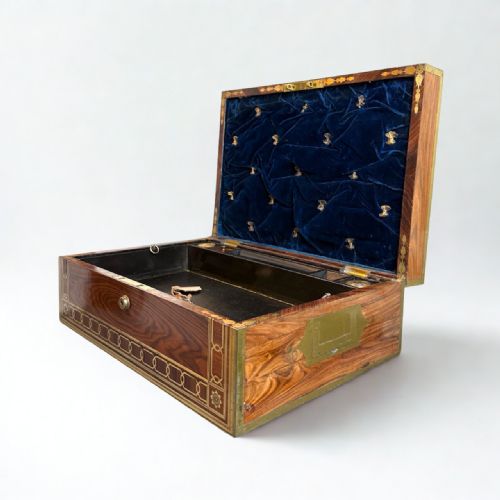
Brass inlay and bound mounts were meticulously sunk into the wood surfaces to protect the corners and edges during travel. Boxwood inlay and mother of pearl details frequently complement the metalwork, creating sharp contrasts against the dark timbers.
Vintage Brass Inlaid Slope Retail Price Guide 2026
Typical asking prices for vintage brass inlaid slope among the pieces listed under this phrase on Sellingantiques today, from the lower quarter to the upper quarter. They describe what is for sale here now, not the wider market.
Listings feature nineteenth-century forms in mahogany, rosewood, burr walnut, and coromandel, with brass inlay spanning Georgian and Victorian periods.
What varies in quality
Quality rests on the selection of timber and the precision of the brass inlay work set into the wood. Finer pieces display tightly fitted joints and sophisticated internal arrangements, including secret drawers and specialised stationery compartments.
The choice of exotic woods like coromandel or burr walnut elevates a piece above standard mahogany or plain walnut versions. Maker attribution, such as signed London works, further distinguishes superior examples from standard workshop production.
Lund of London
The Vintage Brass Inlaid Slope Glossary
- Writing slope
- A portable box with a slanted lid that folds open to create a writing surface. These objects house inkwells, pens, and paper inside.
- Campaign box
- A sturdy box or desk designed for military officers on the move, featuring reinforced brass corners and flush handles. These items were built to endure rough transport.
- Burr walnut
- Timber taken from the warted growths of walnut trees, displaying swirling grain patterns. Cabinetmakers prized this wood for decorative veneering.
- Coromandel
- A dense, heavily figured timber from South-East Asia, resembling calamander and used for luxury nineteenth-century boxes. This material brings deep brown and black striping to the surface.
- Secret drawer
- A concealed compartment hidden behind other drawers or panels within a writing box. These spaces protected sensitive letters and valuables.
Vintage Brass Inlaid Slope: Frequently Asked Questions
How do you use a writing slope?
The hinged box folds open toward the user to form an angled writing plane, traditionally lined with leather or velvet for writing comfort. Internal compartments secure inkwells, pens, and paper.
When closed, the box locks securely to keep correspondence and writing instruments safe during travel.
What is a campaign slope?
Campaign slopes are portable desks built for officers and travellers during the nineteenth century. They feature brass binding and flush handles to withstand rough journeys.
These utilitarian boxes prioritize durability while maintaining refined timber surfaces.
How do you date a writing slope?
Dating relies on timber choices, brass work styles, and internal construction methods. Georgian and Regency pieces often feature simpler mahogany or rosewood with modest brass stringing.
Victorian examples frequently introduce burr walnut, coromandel, and elaborate brass mounts or mother of pearl.
What are secret drawers?
Secret drawers are hidden compartments built behind visible stationery partitions or false panels. They require manipulating a spring or removing another small drawer to access.
Owners used these spaces to store confidential letters and valuables.