


Vintage Barometer Oak Case
These vintage barometer oak case pieces combine practical weather forecasting with traditional woodworking, offering an anchor for a traditional hallway or study.
Vintage Barometer Oak Case
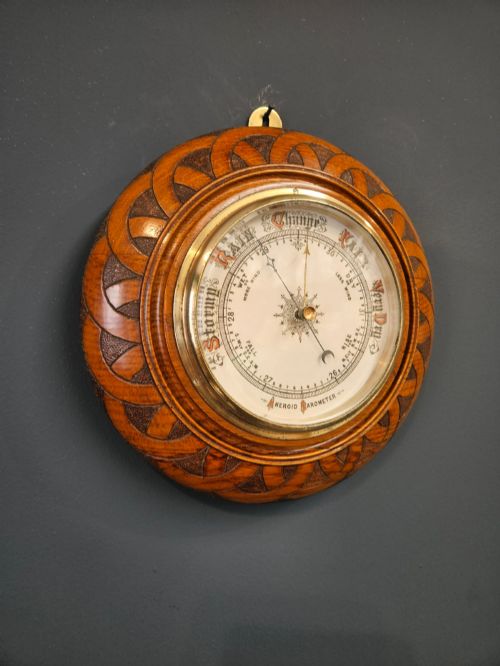
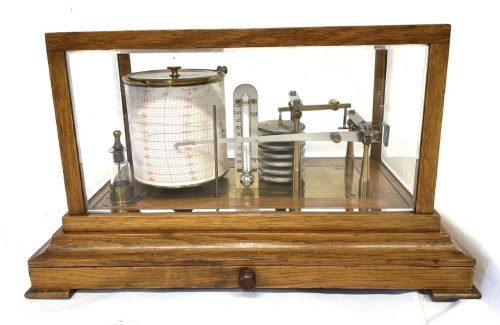
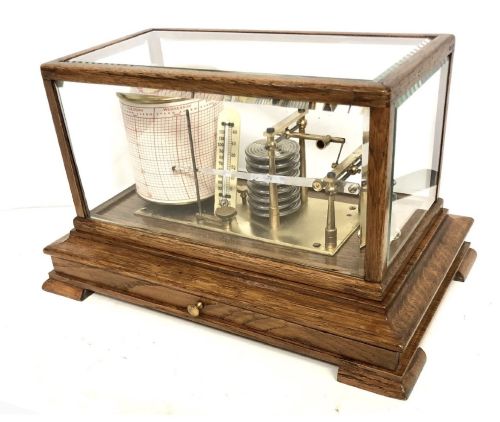
When you search for a vintage barometer oak case, you find weather instruments housed in timber frames dating from the Victorian period through to the 1940s. The selection ranges from wall-hanging banjo barometers to desk-standing barographs featuring brass fittings and paper charts.
You are most likely to meet pieces from the Victorian and Edwardian eras, alongside items from the 1910s, 1920s and 1930s. These examples span simple turned designs to elaborate carved cases and multi-glass recording instruments.
What varies in quality
Maker attribution also marks out the higher tier, with signed instruments from established scientific makers carrying distinct craftsmanship in both the instrument movement and the fitted timber case.
Admiral Fitzroy lent his name to nineteenth-century weather instruments designed to warn sailors of sudden gales before they reached the coast.
Short and Mason·Negretti and Zambra·Jules Richard·J Hughes London·Aitchison
The Vintage Barometer Oak Case Glossary
- Aneroid barometer
- An instrument measuring atmospheric pressure without liquid, using an expanding and contracting metal capsule linked to an indicator needle.
- Barograph
- A recording barometer that traces pressure changes over time onto a rotating paper chart using a pen arm.
- Bevelled glass
- Glass panes with angled, polished edges fitted into doors and viewing lids of instrument cases.
- Banjo barometer
- A wall-mounted weather instrument shaped broadly like a stringed banjo, typically featuring a thermometer above a large circular dial.
Vintage Barometer Oak Case: Frequently Asked Questions
How do I read a barograph?
A barograph records atmospheric pressure continuously onto a paper chart wrapped around a rotating drum. The pen rises and falls with weather changes, creating a permanent weekly line.
To read it, observe the slope and height of the ink trace. A rising line generally indicates improving weather, while a falling line signals approaching storms.
Where should I hang a wall barometer?
Hang your barometer on an internal wall away from direct sunlight, radiators and draughts. Rapid temperature fluctuations can interfere with the internal mechanical response.
A stable interior hallway or study provides the most reliable environment for maintaining the wooden case and the sensitive movement.
How do I date an oak barometer?
Dating relies on stylistic clues in the oak case, such as Victorian geometric carving, Edwardian proportions or 1930s light oak finishes. Maker signatures and patent dates inside the mechanism offer further chronological precision.
Compare the glass types, dial typography and secondary instruments like thermometers to narrow the decade of manufacture.
Do these barometers still work accurately?
Many vintage barometers retain their mechanical sensitivity and respond correctly to local air pressure changes. Some instruments may require professional calibration against a known standard.
Barographs require periodic replacement of ink and paper charts to function as recording devices, alongside careful handling of the clockwork drum.