
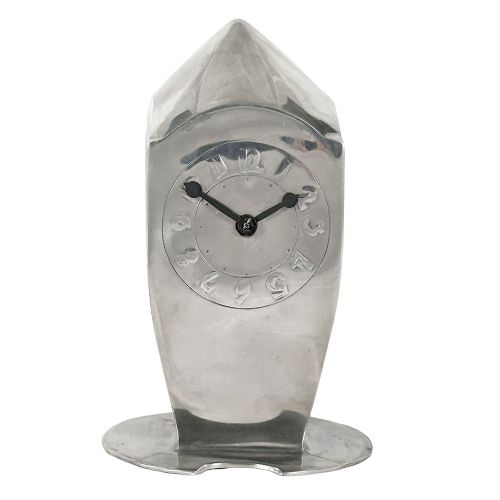
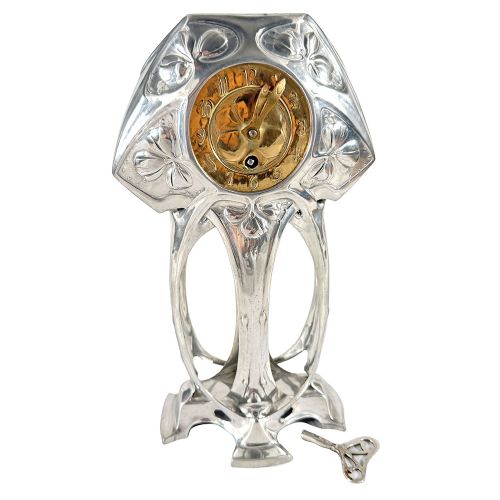


Vintage Art Nouveau Clock
A vintage art nouveau clock brings organic curves and floral motifs to a room, offering functional timekeeping wrapped in distinctive turn-of-the-century design.
Vintage Art Nouveau Clock
A vintage art nouveau clock encapsulates the fluid, plant-inspired lines and naturalistic motifs of the early twentieth century. When searching for a vintage art nouveau clock, buyers encounter varied forms ranging from compact desk timepieces to substantial mantel clocks and tall longcase models.
The pieces appearing here span the periods from nineteen hundred through the nineteen twenties, with Edwardian examples and transitional Dutch or German regional variants also represented. Domestic mantel clocks in oak, mahogany, and pewter dominate the selection, often accompanied by smaller boudoir or strut pieces.
Makers and designers working in England, Germany, France, and the Netherlands produced these objects using distinct regional vocabularies. English examples often showcase the hammered metalwork associated with the Arts and Crafts movement, while continental European pieces lean into sweeping Jugendstil and Amsterdam School geometries.
How they were made
Metals such as brass, pewter, and silver plate form the structural or decorative chassis of many pieces, frequently shaped via casting or hand-hammering. Pewter items often incorporate abalone shell or coloured enamel insets to create contrast against the dull grey metal.
Cabinetmakers utilised timber such as oak, mahogany, satinwood, and macassar ebony for wooden cases, sometimes adding marquetry inlays of floral motifs like poppies. Glass and champlevé enamel further embellish the dials and bezels of desk and strut models.
Periods represented span from nineteen hundred through the Edwardian era up to nineteen twenty-five.
What varies in quality
The distinction between standard production pieces and exceptional work rests on the integration of material and design by named artists or reputable firms. Pieces carrying documented designs by notable creators display superior proportion, relief depth, and finishing in the metalwork or woodwork.
The refinement of the dial and the execution of decorative inlays or enamel work dictate the tier of the piece. Superior examples maintain crisp casting details and cohesive stylistic alignment across the entire housing and dial face.
Archibald Knox·Liberty and Co·Friedrich Adler·Osiris·David Veasey·WMF
The Vintage Art Nouveau Clock Glossary
- Jugendstil
- The German counterpart to Art Nouveau, translating as youth style and drawing heavily on graphic, linear floral forms. It appears frequently on metalwork and clocks originating from central Europe.
- Tudric
- A brand name used by Liberty and Co for its range of pewterware, often associated with organic designs by Archibald Knox. The alloy typically contains a high proportion of tin with small amounts of silver and copper.
- Champlevé
- An enamelling technique where troughs or cells are hollowed out of a metal surface and filled with vitreous enamel powder before firing. This creates colourful decorative patterns flush with the surrounding metal.
- Strut clock
- A portable timepiece featuring a hinged prop or stand on the reverse to keep the dial upright on a desk or table. These often combine silver or gilt framing with enamel dials.
- Amsterdam School
- An architectural and design movement of the early twentieth century characterised by expressionist brickwork, rounded window forms, and richly textured timber craftsmanship. Its influence shows in several Dutch clock and barometer designs.
Vintage Art Nouveau Clock: Frequently Asked Questions
How do I identify a genuine period piece?
Examine the construction methods, materials, and backstamp markings to confirm early twentieth-century manufacture. Genuine examples display period-appropriate patination and traditional joinery rather than modern adhesives or synthetic finishes.
Look closely at the movement and dial construction for signs of age. Authentic pieces from this era utilise mechanical movements and traditional mounting techniques that distinguish them from later reproductions.
Where should I place a mantel clock?
Mantel clocks sit well upon fireplace mantels, wooden sideboards, or library shelves where their decorative cases remain visible. Keep them away from direct sunlight and damp environments to protect wooden veneers and delicate enamels.
Ensure the surface is stable and level to maintain accurate timekeeping for mechanical movements. Positioning the clock away from heavy foot traffic vibrations also helps preserve the longevity of the internal escapement.
How do I clean pewter clock cases?
Dust pewter gently with a soft, dry cloth to prevent the accumulation of grime in recessed crevices. Avoid harsh chemical polishes that can strip away the original surface patination.
If cleaning is necessary, use a mild soap solution and dry thoroughly immediately afterwards. Preserving the historical dull grey finish is preferable to achieving a bright, reflective shine.
What is the difference between Arts and Crafts and Art Nouveau clocks?
Arts and Crafts pieces emphasise visible handcraftsmanship, hammered metal textures, and simplified structural forms often linked to the British reform movement. Art Nouveau pieces focus more on fluid, asymmetrical lines and natural plant motifs.
Overlap occurs frequently, particularly in British metalwork where designers combined both philosophies. Examining the primary motifs helps clarify whether the piece leans toward linear botanical expression or honest structural craft.