


Vintage Architectural Watercolour Painting
A vintage architectural watercolour painting captures streets, monuments and country seats with the fluid immediacy of pigment on paper.
Vintage Architectural Watercolour Painting
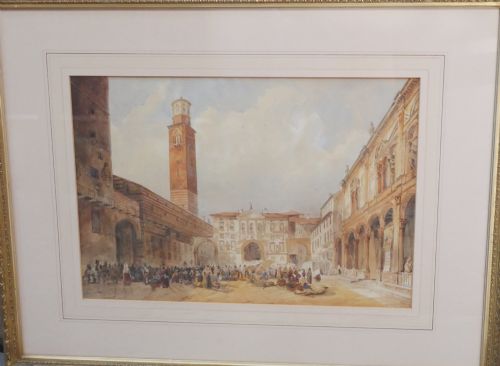
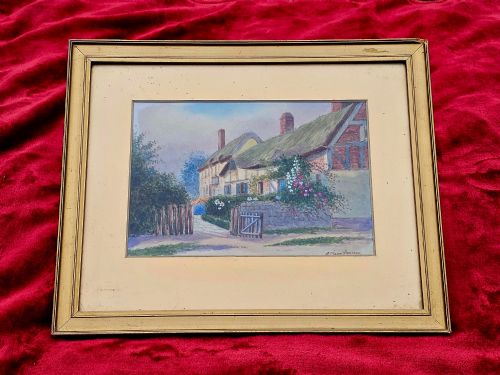
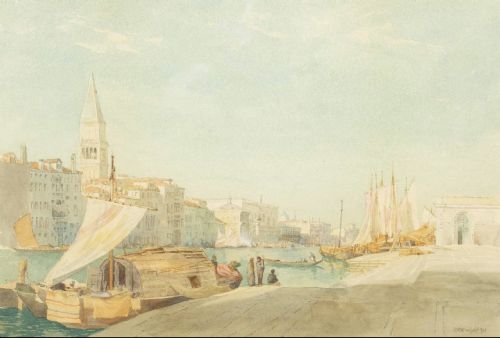
A vintage architectural watercolour painting brings together historical townscapes, grand ruins and domestic buildings rendered in wash and line. These works range from late Victorian depictions of Roman forums and Venetian canals to Edwardian London street scenes and mid-century British castle studies.
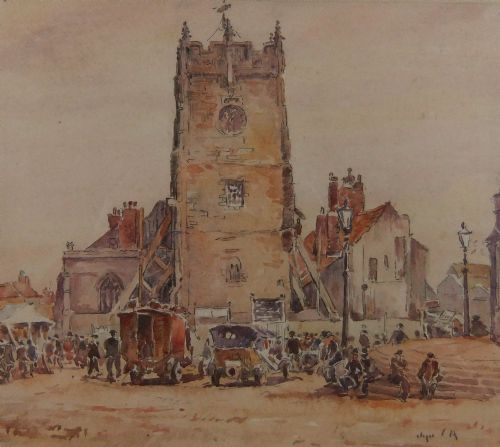
Buyers will find both intimate pencil and watercolour sketches of continental buildings and larger framed artworks detailing specific churches, market crosses and abbeys. The selection leans heavily towards early 20th century British and continental views produced across the decades from the nineteenth century into the mid-twentieth.
The subjects extend from local English scenes like Ludlow Castle and Kew Gardens to continental landmarks and Grand Tour destinations. Pieces appear both individually and in sets or pairs, framed under glass in wood or gilt wood surrounds.
Materials and technique
These works rely primarily on watercolour pigment and ink applied to paper supports. Artists built up their compositions using fluid washes alongside precise ink or pencil lines to define stonework, facades and perspective.
Many examples incorporate mixed media elements such as monochrome ink combined with watercolour paint. Framing typically involves glass protection set within wood frames, occasionally finished in gilt.
Techniques range from loose impressionistic washes capturing atmospheric light on water to highly detailed architectural and pen drawings recording intricate masonry and structural ornament.
Listings feature works spanning from the nineteenth century through to nineteen sixty, utilising paper, ink, watercolour pigment and gilt wood.
Factors of distinction
The strength of a vintage architectural watercolour painting rests on the confidence of the draughtsmanship and the clarity of the wash. Superior examples demonstrate a secure grasp of perspective and spatial depth, where ink lines and pigment work in harmony rather than competing for attention.
Signatures by documented artists, explicit topographical identification and detailed provenance elevate certain works above anonymous or generic studies. The handling of atmospheric light, particularly in complex townscapes and sunlit continental courtyards, marks out the more accomplished hand.
Richard Henry Wright·Alfred George Morgan·Charles James Lauder·Vittore Zanetti Zilla·Ettore Ascenzi
The Vintage Architectural Watercolour Painting Glossary
- Watercolour pigment
- Finely ground colour particles mixed with a water-soluble binder. This medium allows for transparent washes that preserve the reflective quality of the paper underneath.
- Grand Tour
- A traditional trip through Europe undertaken by upper-class Europeans in the eighteenth and nineteenth centuries. Paintings from this context typically record classical ruins, Italian monuments and continental street scenes.
- Wash
- A technique involving diluted watercolour pigment applied smoothly across paper to create broad areas of tone or colour. It forms the atmospheric backdrop for architectural details in these paintings.
- Diptych
- An artwork consisting of two painted panels or sheets presented together as a pair. This format often pairs related views of ecclesiastical or municipal buildings.
- Mixed media
- The combination of different artistic materials within a single work. In this context, it frequently describes pieces utilising both ink and watercolour paint on paper.
Vintage Architectural Watercolour Painting: Frequently Asked Questions
What periods do these waterpaintings cover?
The works span from the nineteenth century through the Edwardian era and into the mid-twentieth century. Many pieces date specifically from the decades between nineteen hundred and nineteen fifty.
Earlier nineteenth-century examples often reflect Grand Tour travel or formal topographical records, while later twentieth-century works lean towards British impressionism and regional townscapes.
How were these paintings traditionally framed?
Most pieces are preserved under glass within wood or gilt wood frames. This traditional framing protects the delicate paper supports and water-soluble pigments from environmental moisture and atmospheric dust.
Original frames frequently complement the era of the artwork, providing period context alongside the painted surface.
What subjects appear most frequently?
Common subjects include urban street scenes, cathedrals, castles, bridges and classical ruins. Artists frequently recorded notable town halls, abbeys and specific architectural landmarks across Britain and continental Europe.
Views of Venice, Rome and London recur alongside regional studies of English market towns and country houses.
How can I tell different eras apart?
Stylistic shifts and framing materials offer clues to a painting's age, moving from the tighter, more formal documentary style of nineteenth-century watercolours to the looser handling of early twentieth-century British impressionism. Subject matter and costume details within street scenes also help anchor pieces to specific decades.
Inscribed titles, artist signatures and dated mounts frequently confirm the exact period of execution.