

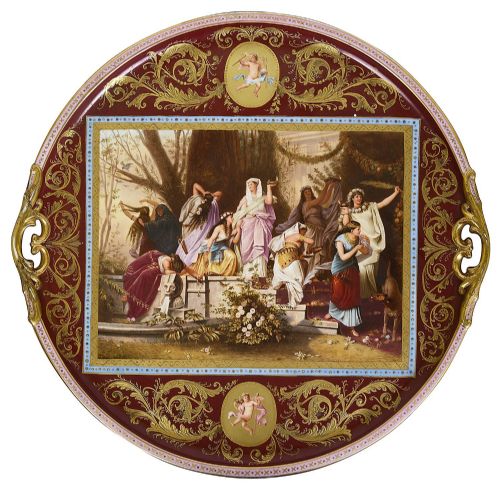


Vienna Cabinet Platter
These vienna cabinet platter examples bring nineteenth-century neoclassical revival artistry directly into your room through finely painted porcelain and rich gilding.
Vienna Cabinet Platter
When you search for vienna cabinet platter, you find large decorative porcelain chargers and trays designed for display rather than dining. These pieces emerge predominantly from the nineteenth century, capturing the detailed narrative painting typical of the period.
The objects take the form of substantial plates, chargers, and trays ranging up to fifty centimetres in diameter. Most examples present mythological or religious subjects executed in elaborate neoclassical revival and Vienna historicism styles.
You meet variations spanning classical figures, literary scenes like Othello, and classical narratives such as the birth of Adonis. Each piece functions primarily as a visual centrepiece intended for cabinet display or wall mounting.
Materials and construction methods
These items rely on hard-paste porcelain formed into generous circular chargers and trays. Artisans then applied detailed enamel painting to illustrate complex figural scenes across the broad central wells.
Makers finished the borders and rims with applied gold leaf and rich gilding to frame the painted narratives. Cobalt glaze frequently provides a deep, contrasting ground for the decorative gilt work and central artwork.
Vienna Cabinet Platter Retail Price Guide 2026
Typical asking prices for vienna cabinet platter among the pieces listed under this phrase on Sellingantiques today, from the lower quarter to the upper quarter. They describe what is for sale here now, not the wider market.
Assessing quality and execution
Quality rests in the precision and detail of the hand-painted enamel narrative at the centre of the porcelain surface. Finer examples display meticulous brushwork in facial expressions and drapery, whilst simpler pieces rely more heavily on standard transfer outlines or basic gilding.
The application of gold leaf and gilding varies noticeably between pieces, distinguishing standard decorative production from exceptional cabinet chargers. Heavier, more intricate tooling in the gilt borders separates the superior items from the more straightforward nineteenth-century outputs.
The Vienna Cabinet Platter Glossary
- Charger
- A large decorative plate or platter intended for display on a sideboard or wall rather than for serving food. These items measure significantly larger than standard tableware.
- Cabinet plate
- A fine porcelain piece created specifically for display inside a cabinet or cabinet-like setting. They showcase elaborate artistic painting rather than practical utility.
- Cobalt glaze
- A rich blue ceramic colouring applied beneath or over the glaze to create deep background tones. It frequently contrasts sharply with bright white porcelain and gold leaf.
- Neoclassical revival
- A nineteenth-century artistic movement drawing inspiration from classical Greek and Roman art. This style dictates the mythological themes and formal compositions found on these platters.
- Enamel
- Vitreous coloured paints fused to the porcelain surface through firing to create permanent pictorial scenes. It allows for the intricate polychrome details seen in these figural depictions.
Vienna Cabinet Platter: Frequently Asked Questions
How were these platters displayed?
Owners typically exhibited these large porcelain pieces inside glass-fronted cabinets, on sideboards, or mounted directly onto walls as prominent decorative art.
Their substantial diameters, often reaching forty to fifty centimetres, ensured the detailed mythological and historical scenes served as striking visual focal points in nineteenth-century interiors.
What themes appear on the painted scenes?
The central painted compositions draw heavily from classical mythology, history, and literature. Common subjects include mythological figures like Bacchus and Ariadne, classical narratives such as the birth of Adonis, and dramatic scenes from literary works.
These elaborate enamel illustrations reflect the nineteenth-century fascination with neoclassical revival aesthetics and historicism.
How do you identify nineteenth-century pieces?
Dating relies on the characteristic porcelain bodies, specific nineteenth-century historicism and neoclassical revival styles, and the application of enamel painting combined with heavy gilding. The visual language matches documented production patterns from that era.
Examining the depth of the cobalt glaze, the complexity of the gold leaf work, and the style of the figural painting helps confirm the nineteenth-century origins of each charger.