


Victorian Watercolour Street Scene
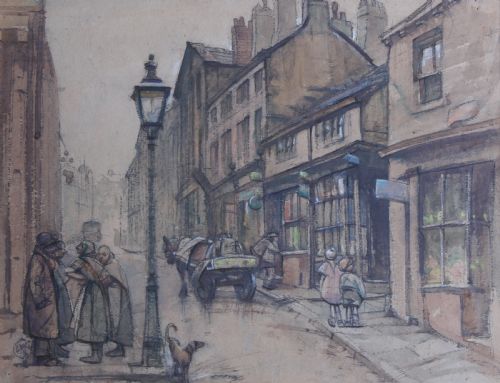
These Victorian watercolour street scene works capture bustling urban life and quiet provincial alleys with remarkable immediacy and delicate brushwork.
Victorian Watercolour Street Scene
A Victorian watercolour street scene depicts towns, cities, and local markets through transparent washes of pigment on paper. These paintings frequently document historic thoroughfares, European cityscapes, and everyday human activity during the nineteenth century.
The works appearing on this page span the nineteenth century, nineteen hundred, and nineteen ten, incorporating Victorian, Edwardian, and Belle Epoque aesthetic sensibilities. Collectors often encounter specific topographical views alongside romanticised genre realism and British impressionist approaches.
Common subjects range from bustling London markets and provincial Yorkshire streets to continental townscapes featuring French and Italian architecture. Each piece relies on the inherent immediacy of watercolour to record passing moments in urban history.
Materials and construction
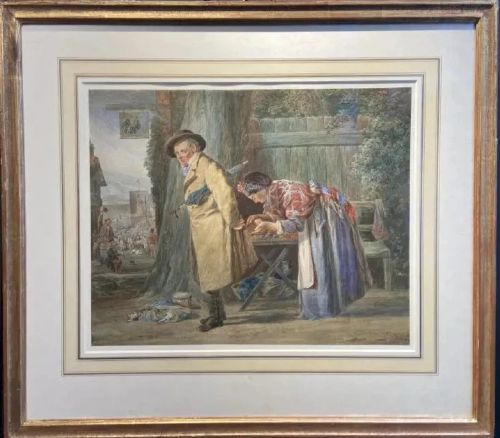
Artists executed these watercolours on paper supports, frequently applying bodycolour or ink to heighten architectural details and figures. The delicate pigments required protection behind glass within traditional wooden or gilt wood frames.
Makers utilised transparent watercolour washes to build luminosity, often working en plein air or translating field sketches into finished compositions in the studio. Gilt leaf occasionally embellished the framing to complement the warm tones within the painted scenes.
Listings feature works spanning the nineteenth century into the nineteen tens, utilising watercolour, ink, and paper housed in gilt wood frames.
Evaluating quality and execution
Superior works demonstrate a confident handling of perspective and atmospheric light, successfully capturing the bustle of a market day or the chill of a winter twilight. Lesser examples often rely on rigid draftsmanship and flat, uninspired washes that fail to convey depth.
The strength of a composition rests on the artist's ability to animate figures within an urban environment rather than treating architecture as a mere backdrop. Finer pieces reveal spirited brushwork and careful observation of local colour and human interaction.
Joseph H Barnes·Albert Ludovici Jnr·William Manners·Robert Hollands Walker·Joseph W Milliken·David Small·Charles H Poingdestre·Walter Emsley·Tom Dudley·Matthew Hale
The Victorian Watercolour Street Scene Glossary
- Watercolour
- A painting method in which the paints are made of pigments suspended in a water-based solution. The technique relies on the translucency of the paper to reflect light back through the washes.
- Gilt wood
- Wood that has been treated with a thin layer of gold leaf or metallic gilt paint. This framing material was standard for displaying finished watercolours.
- Genre realism
- An artistic style depicting subjects from everyday life, typically with an emphasis on realistic detail and narrative. In street scenes, this involves ordinary people going about their daily routines.
- Topographical
- Pertaining to the accurate representation of specific places and landscapes. Topographical watercolours serve as historical records of towns and streets as they appeared in the past.
- Belle Epoque
- A period of European history characterised by optimism and peace, lasting from the late nineteenth century until the First World War. Art from this era often reflects refined urban sophistication.
Victorian Watercolour Street Scene: Frequently Asked Questions
How do I care for a watercolour?
Keep watercolours away from direct sunlight to prevent the fugitive pigments from fading over time. Ensure they hang in rooms with stable humidity levels to protect the paper and framing.
Professional framing with acid-free mounts further safeguards the paper support from chemical degradation and foxing.
Were these painted outdoors?
Many artists created initial pencil or ink sketches on location in bustling city streets. They then completed the finished watercolour paintings back in the studio.
Some practitioners embraced direct observation outdoors, capturing transient effects of weather and light on the spot.
What defines Edwardian street scenes?
Edwardian watercolours date from the early twentieth century and often exhibit a lighter, brighter palette than their strict Victorian predecessors. They frequently record the transition of city transport and street life.
Stylistic influences from British Impressionism also emerge in these later urban depictions.
Why do some watercolours have ink?
Artists frequently utilised pen and ink work beneath or over their watercolours to define sharp architectural lines and intricate details. This mixed technique provided crispness to buildings and figures.
The ink layer ensured that structural elements remained prominent beneath translucent washes of pigment.